
LLM AI Tools
Discover 90+ AI tools tagged with LLM, explore comprehensive comparisons of tools based on use cases, features, and pricing plans.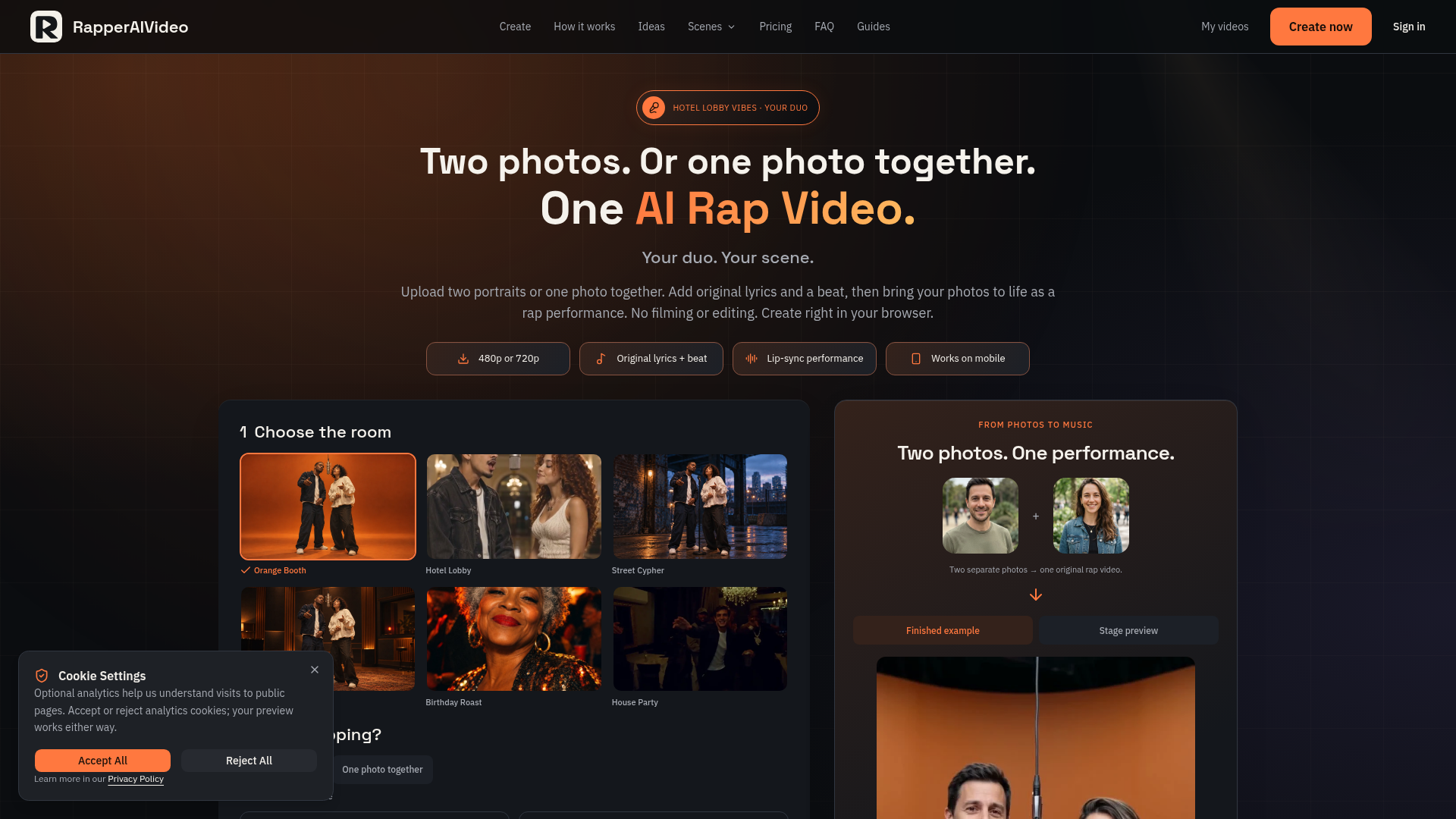
RapperAIVideo is a browser-based AI video studio that turns ordinary photos into short, original rap performances. Positioned as a consumer-friendly 'photo-to-rap-video' generator, it sits between novelty AI avatar apps and full music-video production tools: you upload one or two portraits, choose a themed rap scene, add lyrics or a beat, and receive a 5–15 second lip-synced performance without filming, casting, or editing. Its target audience is broad and social-first — friends, couples, families, teams, pet owners, and content creators who want a personalized video for a birthday, roast, anniversary, group-chat inside joke, or team win. Core features include six hand-built rap scenes (Orange Booth, Hotel Lobby, Street Cypher, Studio Booth, Birthday Roast, House Party), support for two separate selfies or one photo together, dedicated solo and pet performance modes, an original lyric-writing tool with occasion prompts (birthday shout-out, how we met, who cooks better, team win), original rap audio generation, optional user-supplied audio reference, and output in 480p or 720p at 5, 10, or 15 seconds in vertical (9:16) or landscape frames. Content features lean heavily on inspiration: an idea gallery with dozens of example performances, scene landing pages, a rap lyrics generator, a rapper name generator, blog guides, and a detailed FAQ. The user experience is a guided three-step flow — add your people, set the scene, drop your rap — with a free stage preview, a transparent credit quote before rendering, a saved draft, a My Videos library, and mobile-friendly downloading so clips can be posted directly to TikTok, Instagram Reels, YouTube Shorts, or a group chat. Technically, everything runs in the browser with no install, uses a credit-based render system with failed renders returning credits, and stores finished videos in an account library; current limits include 720p as the top resolution (1080p not yet on sale), 18+ photo subjects, and consent/permission confirmation at render time.
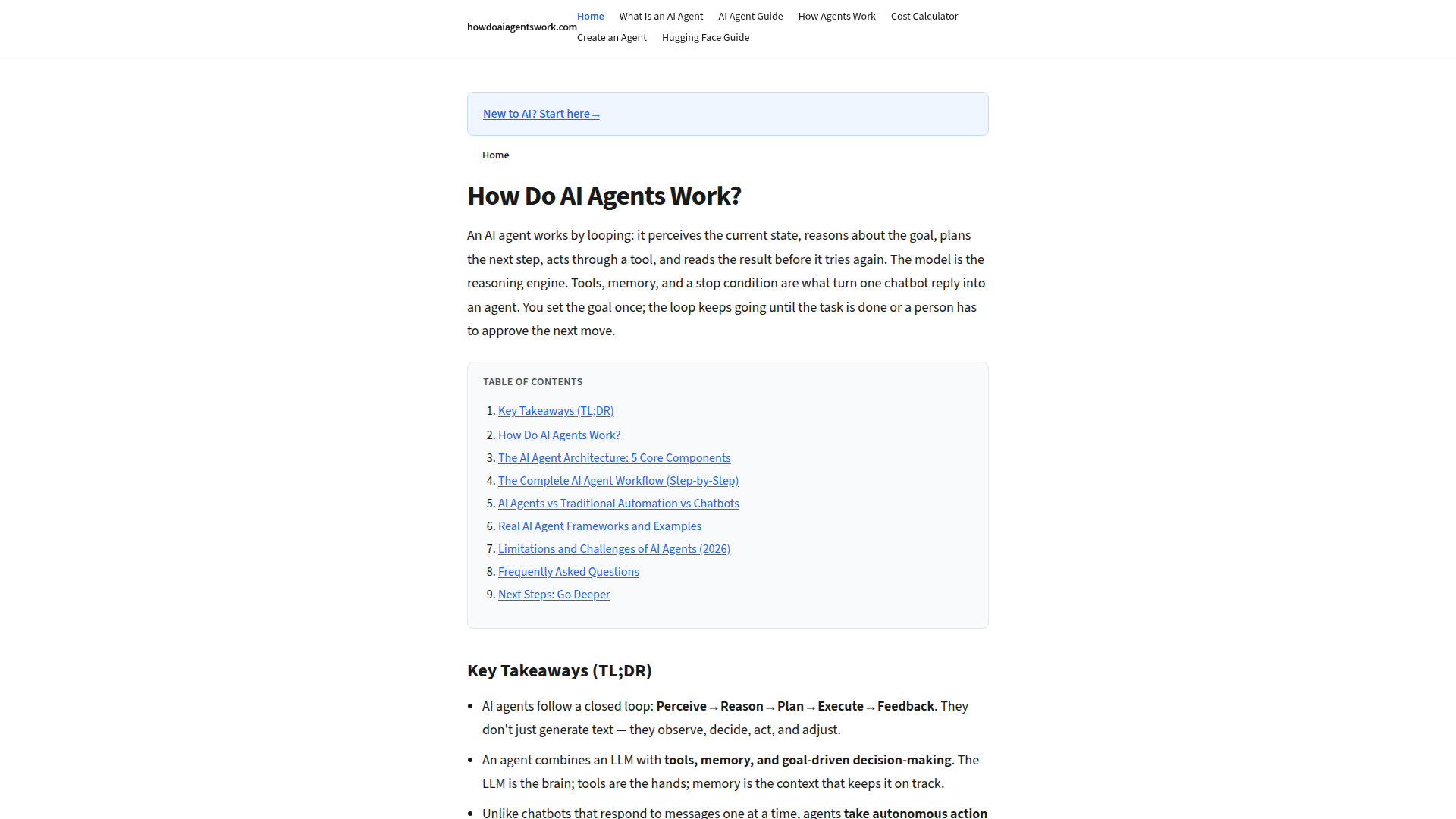
How Do AI Agents Work is a comprehensive educational resource dedicated to explaining the inner workings of AI agents in plain English. Positioned as a beginner-friendly guide, it targets developers, tech enthusiasts, and business leaders seeking to understand autonomous AI systems. The site breaks down complex topics like perception, reasoning, planning, tool use, and memory into digestible components. Core features include in-depth articles on AI agent architecture, step-by-step workflow explanations, comparisons with chatbots and RPA, and real-world examples like Devin and Claude Code. Content is structured with clear headings, tables, and a cost calculator tool. The user experience is clean and navigation-focused, with a simple layout that prioritizes readability. Technically, it's a static site built for speed and accessibility, with no login required. Updated regularly, it serves as a go-to reference for the evolving AI agent landscape in 2026.
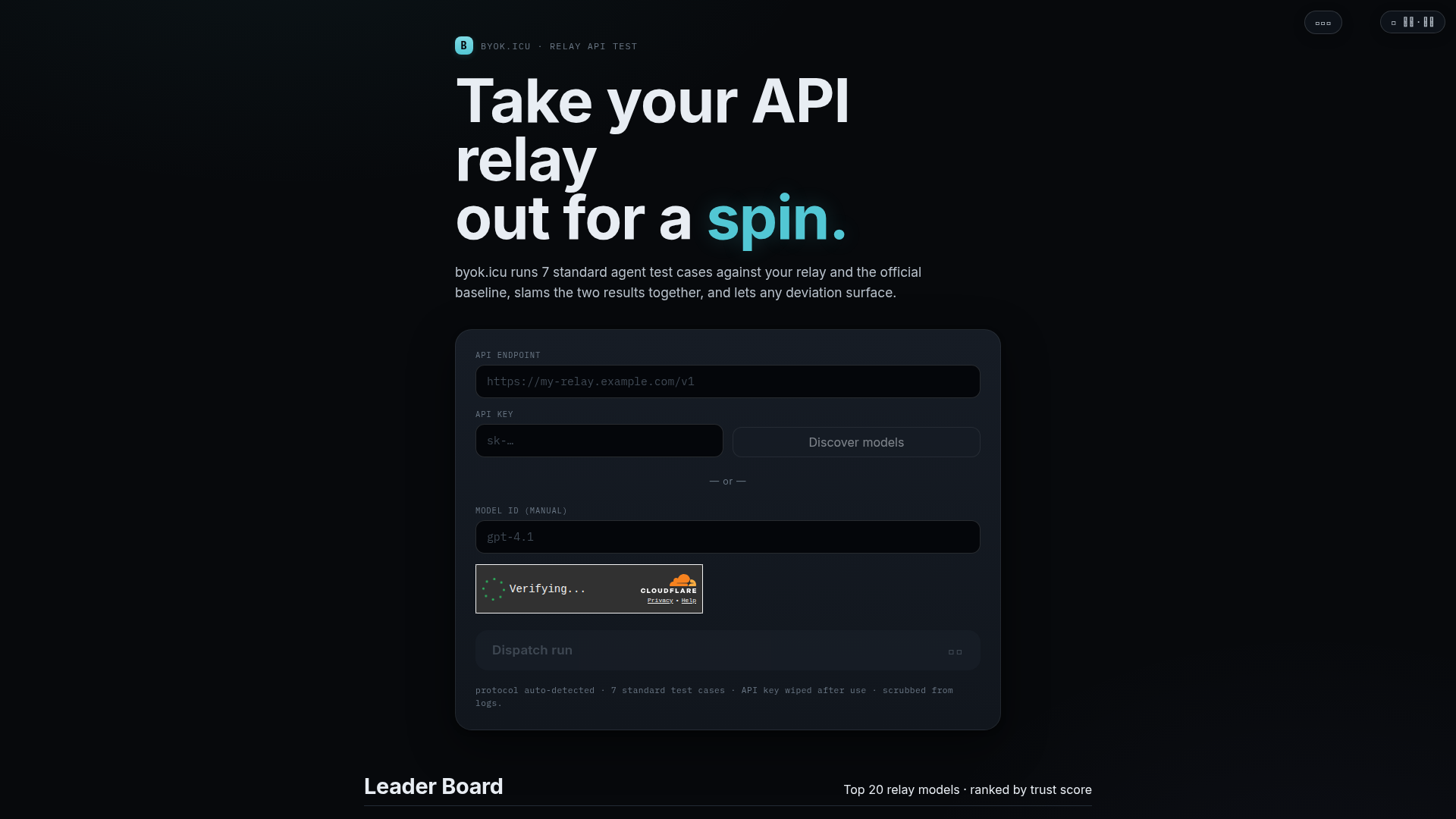
byok.icu is a free, browser-based testing and trust-scoring service for AI API relays — the third-party gateways that resell or forward access to models such as OpenAI's GPT and Anthropic's Claude. Its positioning is that of an independent verification layer for a market where users can see the price but not the behaviour: byok.icu runs 7 standardised agent test cases against a submitted relay and against the official upstream API, then compares the two result sets side by side so any deviation becomes visible. The target audience is developers, AI agent builders, indie hackers, startups and cost-conscious engineering teams who route real traffic through cheap relays and need evidence about protocol fidelity, latency and reliability before they commit. Core features include automatic protocol detection (OpenAI-compatible or Anthropic-compatible), model discovery or manual model-id entry, a live pass/fail view of each test case, a 0–100 trust score with verdict labels (trusted, solid, passable, weak), per-case latency and drift measurements, token-count and request-parameter verification, secret-pattern and prompt-injection flagging, and a public leader board ranking the top 20 relay models. The five evaluation dimensions are protocol compatibility, agent readiness, observability, performance and reference deviation, covering tool calls, chained calls, error recovery, multi-file synthesis, model-context synthesis and long-context recall. Content-wise the site leans on transparent, data-first presentation: comparison tables, explicit flags behind every score, and plain-language explanations of what each metric means. User experience is deliberately minimal — paste an endpoint and key, pass a quick human check, dispatch the run, then read a verdict table you can share or compare. Technically it is a lightweight web application that dispatches parallel test runs, auto-detects API dialects, discards submitted keys after dispatch and scrubs them from logs, and stores completed evaluations as public leader board entries. A Chinese-language version is available for the large Chinese-speaking relay-user community.
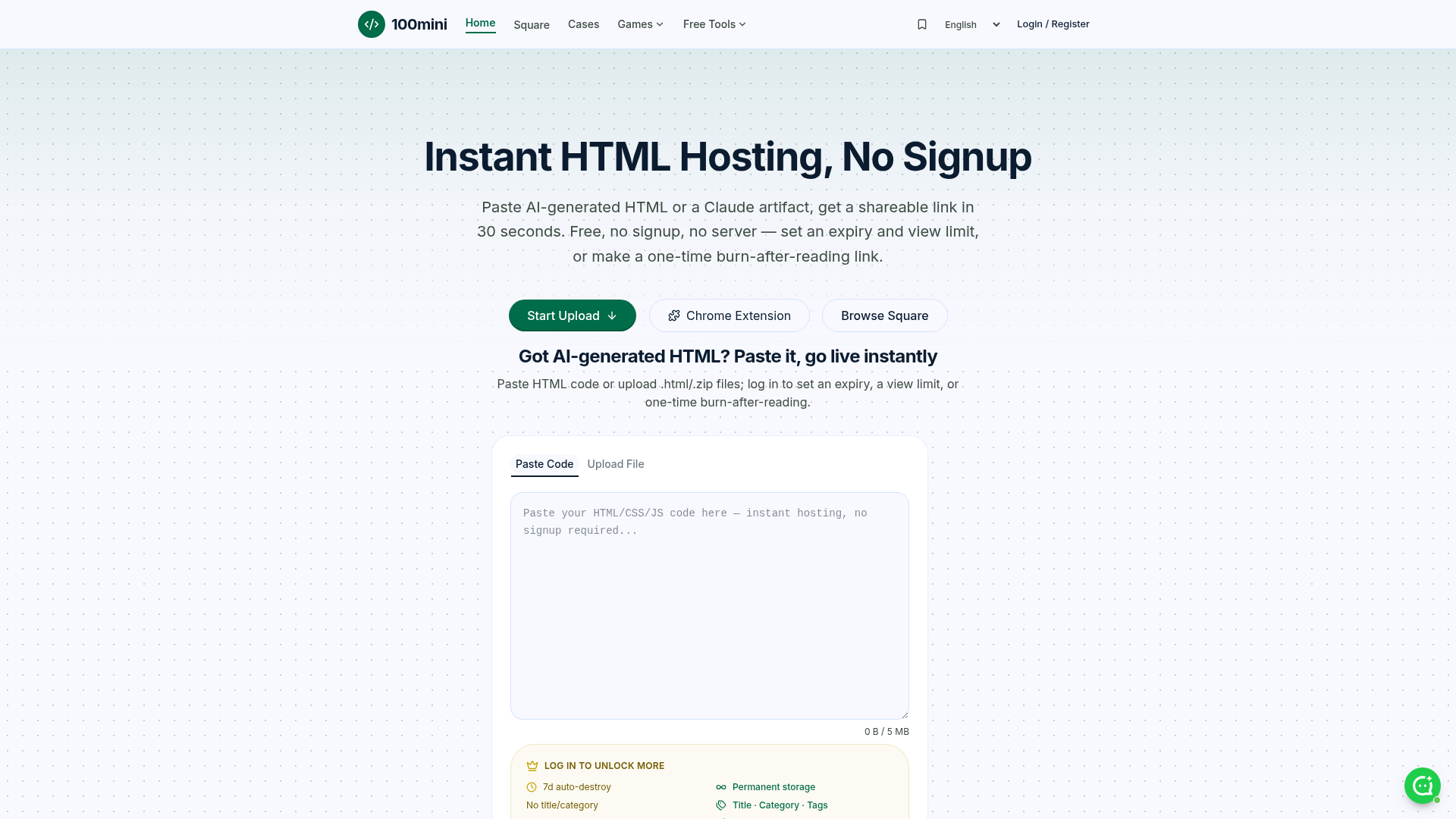
100mini is an instant HTML hosting and sharing platform positioned for AI-generated content, Claude artifacts, interactive prototypes, and single-file web pages. It lets anyone paste raw HTML/CSS/JS or upload .html/.htm/.zip files up to 5MB and publish a full-screen, shareable link in about 30 seconds—without signup, server, CLI, DNS, or deployment configuration. The target audience includes AI users, prompt engineers, educators, students, indie hackers, designers, and developers who need to turn LLM outputs into playable web URLs quickly. Core features include anonymous 7-day auto-destroy uploads, permanent slots for logged-in users, expiry settings from 1 hour to 30 days, view caps, one-time burn-after-reading links, link management, QR code sharing, a Chrome extension, and an agent skill for automated publishing. Content features include a Learning Square for categorized public pages, showcase/cases, free tools, games, and alternatives, making shared artifacts discoverable and reusable. User experience is extremely lightweight: paste code, upload a file, add optional title/category/tags, click Publish, and copy the link; mobile-friendly pages render directly in the browser. Technical features emphasize safety and simplicity: a CSP sandbox and safety banner help prevent phishing, uploaded code runs client-side only, nothing executes on 100mini servers, and anonymous uploads vanish without a trace. Overall, 100mini combines instant static hosting, temporary sharing, and AI-artifact publishing in a freemium package.
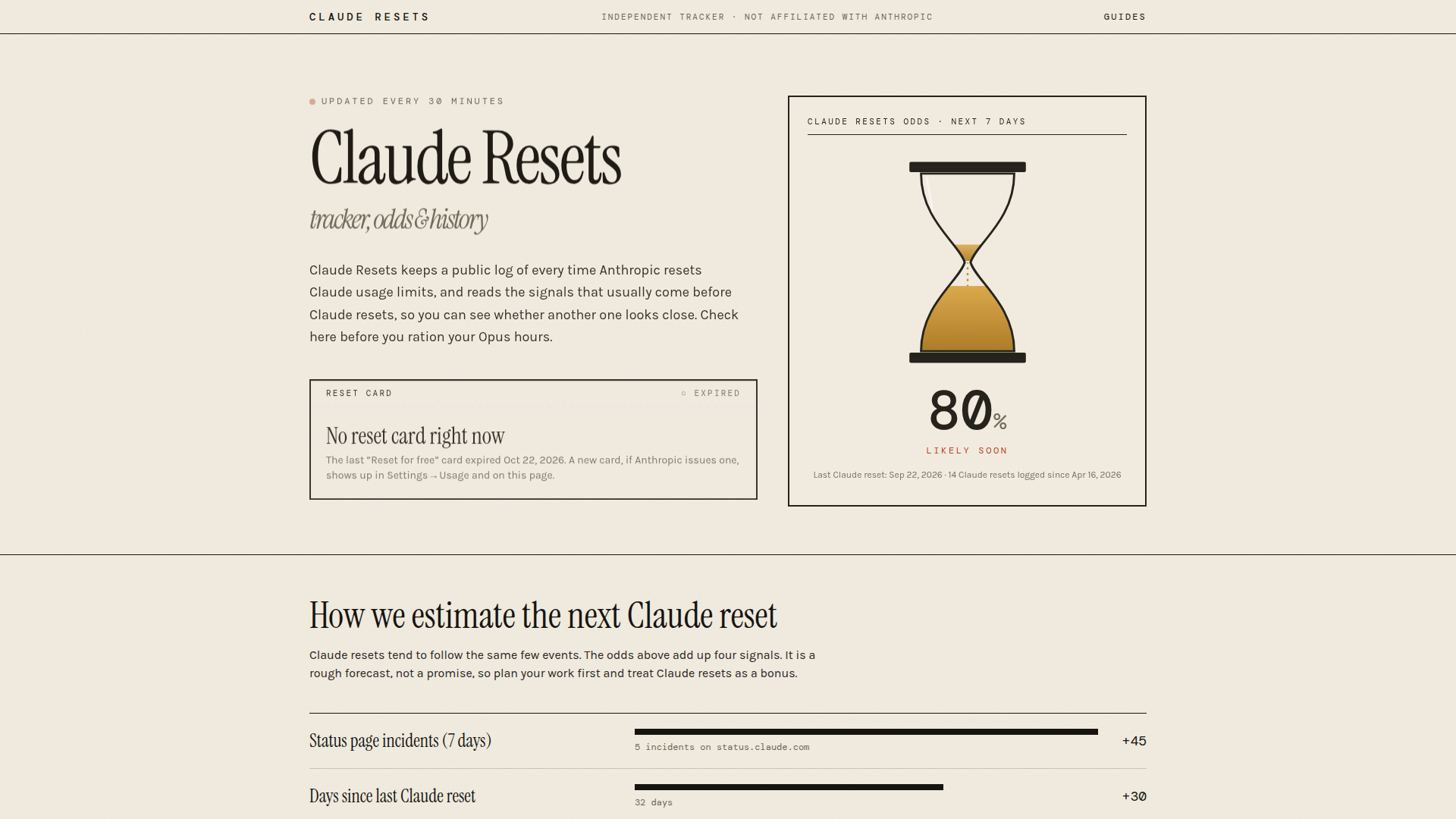
Claude Resets (claude-resets.net) is an independent, non-commercial tracking site that logs every occasion Anthropic resets Claude usage limits and estimates how likely the next reset is. Its positioning is that of a public, always-on observatory for Claude's 5-hour session windows, weekly caps and "Reset for free" cards — a page users check before rationing their Opus hours. The target audience is heavy Claude users: Pro, Max, Team and Enterprise subscribers, Claude Code developers, power users on the free tier, and anyone who has ever hit a "Claude usage limit reached" message mid-project. Core features include a live reset-card status widget, a 7-day reset-odds forecast that blends four weighted signals (status-page incidents, days since the last reset, model launch windows and staff hints on X), a dated reset history with 14 logged events since April 2026 plus outbound citations to X posts and news articles, and a growing library of guides covering the 5-hour limit, weekly caps, Opus limits, usage credits, reset-time calculation, Claude Code limits and Max vs Pro comparisons. Content is concise, data-driven and source-linked, refreshed roughly every 30 minutes, and localized into Chinese, Japanese and Korean. The user experience is deliberately minimal — no account, no login, no paywall — with a single-page dashboard layout, quick jump links into the guide library, and explicit disclaimers that the odds are a rough forecast rather than a promise. Technically the site is a lightweight, fast-loading web app that aggregates Anthropic's public status page and public social posts, timestamps every claim, and states clearly that it is not affiliated with, endorsed by or sponsored by Anthropic.

TwinSky is an AI-powered astrology platform that combines BaZi (Chinese Four Pillars) and Jyotish (Indian/Vedic astrology) into a single, complementary reading experience. Positioned as a dual-chart exploration tool rather than a simple horoscope generator, it lets users calculate both chart systems independently and compare them on one shared timeline. The target audience includes people interested in Chinese and Indian astrology, self-discovery, career timing, relationship compatibility, and life-stage planning, from beginners to experienced practitioners. Core features include free BaZi four pillars, Ten Gods, luck pillars, annual pillars, Jyotish birth chart and 19 divisional charts, daily outlook, monthly themes, day-picking calendar, birth profiles, and a conversational AI agent that answers questions about career, relationships, and timing. Users can choose BaZi only, Jyotish only, or both perspectives, and open linked chart references to see the evidence behind an answer. Content features include sample readings, beginner guides, transparent A/B test results, and explanations of how the two traditions differ. The user experience is free-first: charts and daily guidance are not paywalled; sign-up needs only email or Google; points are used only for AI questions, with 500 free points for new users and no auto-renewal. Technical features include a proprietary chart and rule engine that computes structured chart data, a traceable answer system, and Stripe payment handling. TwinSky aims to make complex astrology accessible, conversational, and evidence-aware.
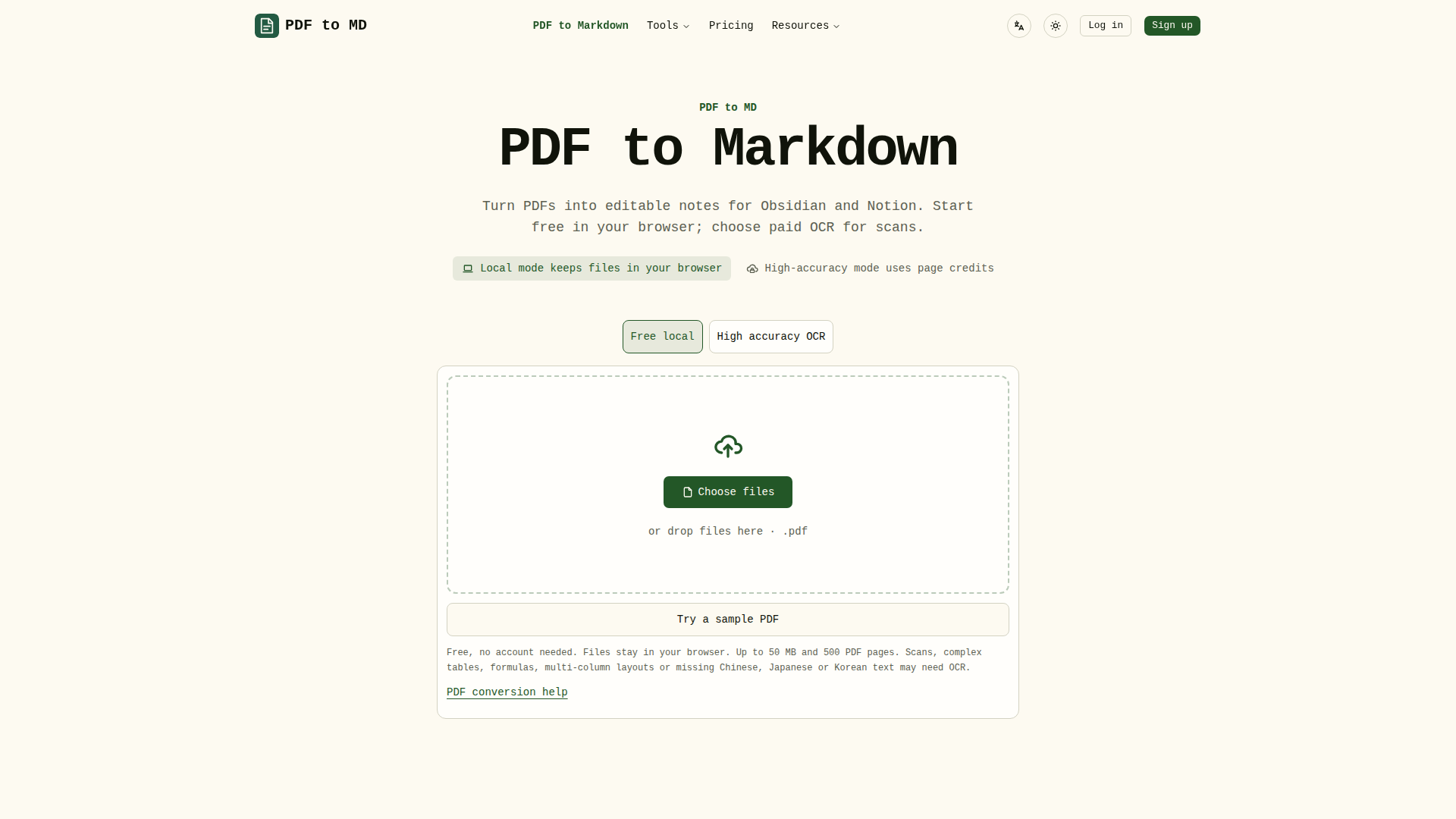
PDF to MD is a browser-based document conversion service that specializes in turning PDFs into editable Markdown for note-taking ecosystems like Obsidian and Notion. Its core positioning is privacy-first conversion: ordinary text-based PDFs, Word documents, and HTML files are processed locally in the browser, so file contents never leave the user's device. For scanned documents, complex tables, formulas, multi-column layouts, or missing CJK text, the platform offers an optional high-accuracy OCR mode that uses cloud processing and page credits. Target audiences include researchers, students, writers, developers, and knowledge workers who need clean Markdown notes from PDFs, reports, and web content. Core features include drag-and-drop conversion, batch processing, ZIP download, Obsidian and Notion guides, sample files, Word/Image/HTML to Markdown tools, Markdown to PDF, and API/MCP access for automation. The service uses a freemium model: free local conversion, a Pro subscription with monthly credits, and a one-time OCR pack. User experience is straightforward, with clear mode selection, file size limits, and privacy explanations. Technical features include local browser parsing, server-side OCR, cloud conversions, export limits, and isolated batch failures. Content resources include guides on troubleshooting, tables and formulas, Obsidian, Notion, and Python automation.
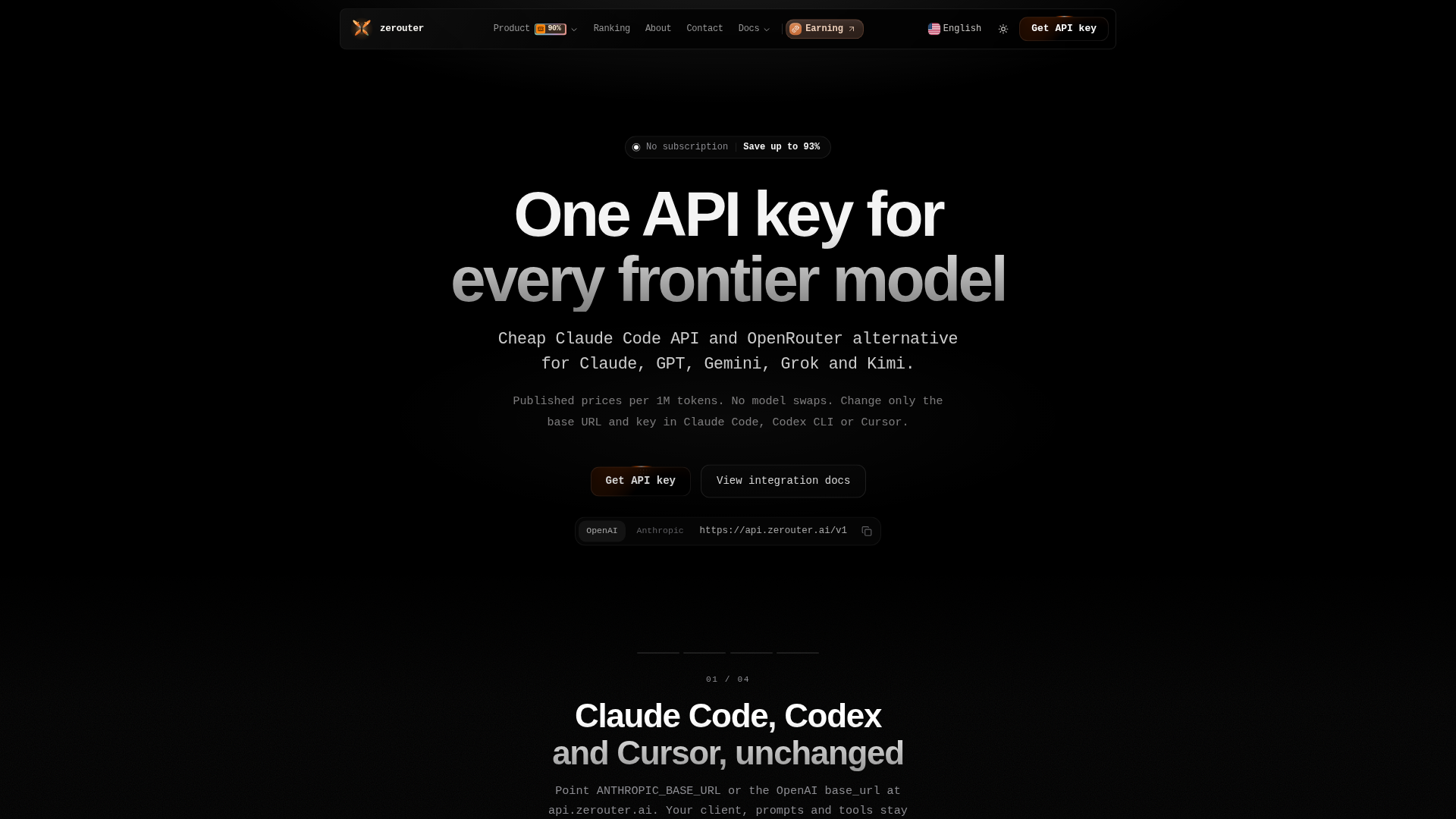
Zerouter is an AI API gateway and low-cost OpenRouter alternative positioned as a single access point for frontier models from Anthropic, OpenAI, Google, xAI and Moonshot. Developers use one Zerouter API key and one base URL to call Claude, GPT, Gemini, Grok and Kimi through OpenAI-compatible and Anthropic-compatible endpoints without changing their prompts, tools or coding clients. The service targets individual developers, AI coding-agent users, startups and cost-sensitive teams that rely on Claude Code, Codex CLI, Cursor or OpenAI SDKs and want predictable pay-per-use pricing. Core features include one-key access to multiple model families, published per-million-token rates, no model swaps or downgrades, request-level usage logs, key management, balance top-ups and a browser-based console. Content includes model catalogs with endpoint details, provider-specific pricing pages, integration guides, leaderboards, comparison pages and a token cost calculator. The experience emphasizes fast onboarding: users can inspect sample dashboards before signing in, copy the base URL, follow quickstarts and test requests from the browser. Technically, Zerouter routes calls to official model APIs through multiple providers, checks keys, balance and concurrency before routing, supports /v1/messages, /v1/responses and /v1/chat/completions, and encrypts login and payment. It offers no monthly subscription or minimum, with GitHub, X, Telegram, Discord and Medium community links.
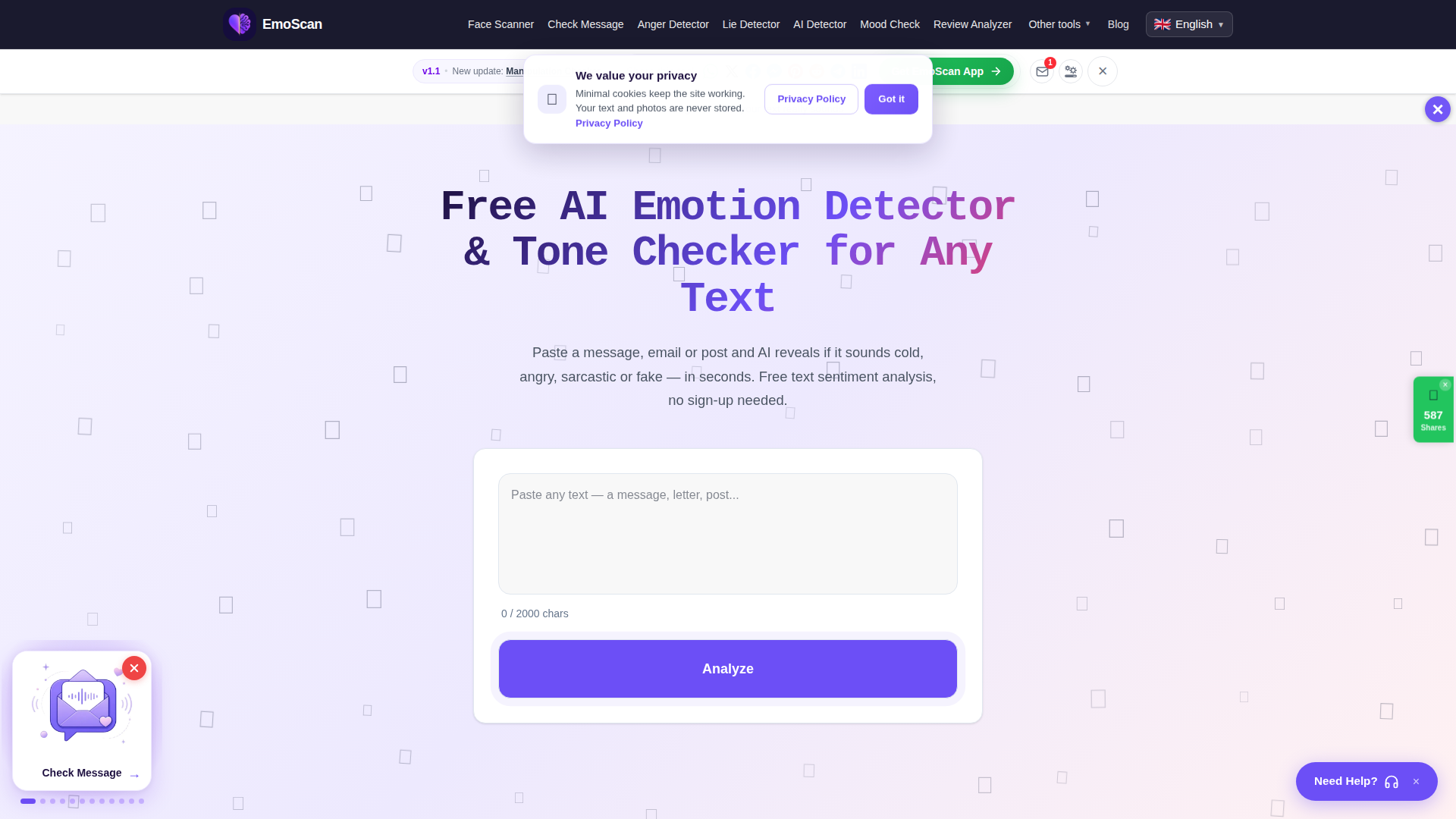
EmoScan is a free, ad-supported AI emotion and tone analysis platform positioned as a privacy-first communication assistant. It targets anyone who communicates in writing—friends, partners, job seekers, customer support teams, business owners, social media users, and professionals—who wants to understand how their words or photos may be perceived. Core features include a message tone checker, face emotion scanner, anger text detector, text lie detector, AI text detector, mood/depression self-check, review analyzer, manipulation checker, resume tone checker, dating profile analyzer, ragebait detector, and feed shield. Users paste up to 2,000 characters or upload a photo, and the AI returns an emotional breakdown with signals, often as a shareable emotion card. Content features include a blog, glossary, research, methodology, use cases, and FAQ. User experience is instant, anonymous, and requires no sign-up. Technically, it uses NLP and facial emotion/micro-expression recognition; text and images are processed in the moment and not stored. The service is free forever, with no premium tier, trial, or paywall, supported by unobtrusive ads.

Ptero is a free, open-source AI chat platform designed specifically for developers, offering a powerful and privacy-centric alternative to mainstream AI chatbots. Positioned as an always-free tool with no premium plans or paywalls, Ptero provides access to multiple cutting-edge AI models, allowing developers to experiment, code, and brainstorm without cost barriers. Its core audience includes software engineers, data scientists, and technical enthusiasts who value local-first data privacy and seamless integration into their workflows. Key features include a local-first privacy model where conversations are stored in the user's browser, not on servers, ensuring data sovereignty; Projects for organizing and syncing chats and files to the cloud for cross-device access; and a Developer API that enables programmatic use with personal API keys. GitHub integration allows users to sign in, star the repository to unlock additional models and earn higher hourly token quotas, and import public GitHub projects. The platform also offers token-based usage quotas (resetting hourly) with bonuses for invites and GitHub stars, export/import of chat backups, and multi-language support. User experience is streamlined: guests can start chatting instantly without registration, and the interface includes a guided tour, model selection, and news updates via Discord. Technically, Ptero is fully open source (hosted on GitHub), built on WordPress, and routes messages to third-party AI providers while maintaining minimal data collection. With its commitment to remaining free forever, Ptero is an attractive option for developers seeking a flexible, transparent, and cost-free AI chat solution.
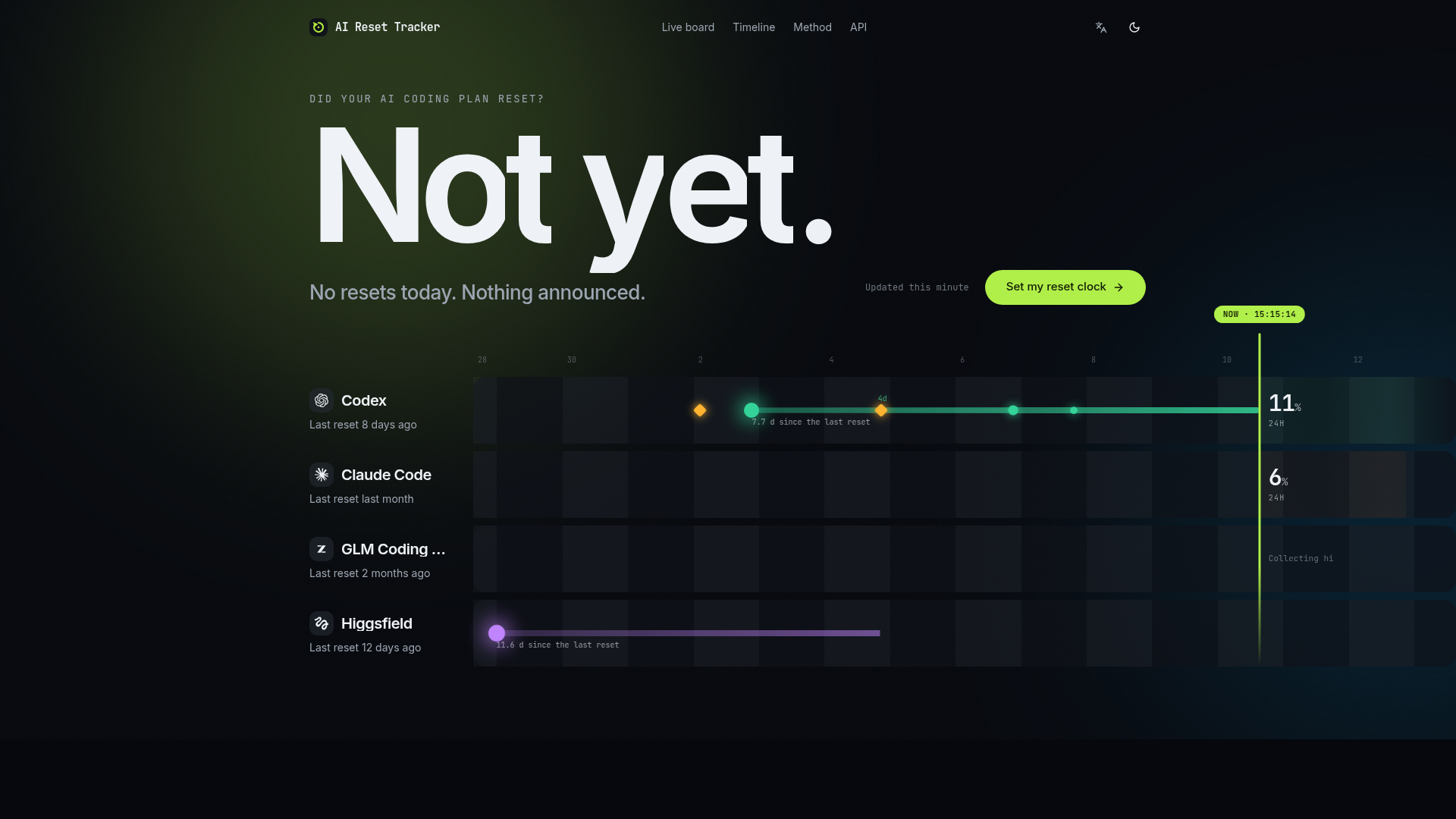
AI Reset Tracker is an independent community website that tracks, verifies, and forecasts reset events for popular AI coding plans including Codex, Claude Code, Zhipu GLM Coding Plan, and Higgsfield. Its positioning is a real-time intelligence board for developers and subscribers who depend on these plans and want to know when usage limits or credits may be restored. The target audience includes AI coding tool users, engineering teams, data analysts, and autonomous agents that need programmatic reset signals. Core features include a live board, provider-specific tracker pages, a source-linked timeline, verified signal classification, live 24-hour and 48-hour reset probability forecasts, personal browser-based reset clocks, and a free API with JSON, Atom, and MCP access. Content is built from official X accounts, status pages, release notes, docs, and community threads, with unconfirmed reports clearly labelled. User experience is minimal, fast, dark-mode friendly, and multilingual. Technically, it uses a memoryless cadence model, daily backtesting, confidence scoring, and browser local storage for private clocks. The site is free to use and not affiliated with the tracked providers.

FalcoScan is a comprehensive AI market intelligence platform that tracks over 7,000 AI products across 29 distinct markets, providing detailed rankings and scores for opportunity, saturation, and heat. Positioned as a tool for founders, product teams, and investors, it helps users identify where to build next by revealing crowded markets and open territories. Core features include the AI Graveyard, which lists verified shut-down or acquired AI products with sources, the Market Terminal for scored market rankings, and the AI Globe showing geographic distribution. The platform offers free access to market pages, product pages with bands, and the AI Graveyard, while exact product scores require a paid plan. Content is updated daily, ensuring current data, and every listing includes a last-updated timestamp and links to the product's site for verification. User experience is streamlined with search and browse functionalities, and users can claim listings or submit products for free. Technically, FalcoScan provides an API and MCP integration for programmatic access, making it a robust resource for data-driven decision-making in the AI landscape.

SpicyAPI is a unified uncensored AI API platform that brings together 152 image, video, and chat models under a single API key, including 18 uncensored Spicy editions. Positioned as a pay-as-you-go service with no subscription fees, it caters to developers, creators, and businesses seeking unrestricted AI generation for tasks like image creation, video production, and chat interactions. The core features include access to frontier models such as Wan 3.0, Seedream 5.0, and Claude Opus, with uncensored versions that bypass content filters. SpicyAPI offers a Studio for no-code creation, an OpenAI-compatible API for developers, MCP support for AI agents, and comprehensive rankings and reviews. Content features include detailed model pages, pricing estimates, and documentation. The user experience is streamlined: sign up, top up via card or crypto, and start generating in Studio or integrate via SDKs in TypeScript, Python, Go, PHP, and Java. Technical features include task lifecycle management, callbacks, idempotency keys, and granular content retention controls with configurable deletion clocks for generated files, prompts, and references.
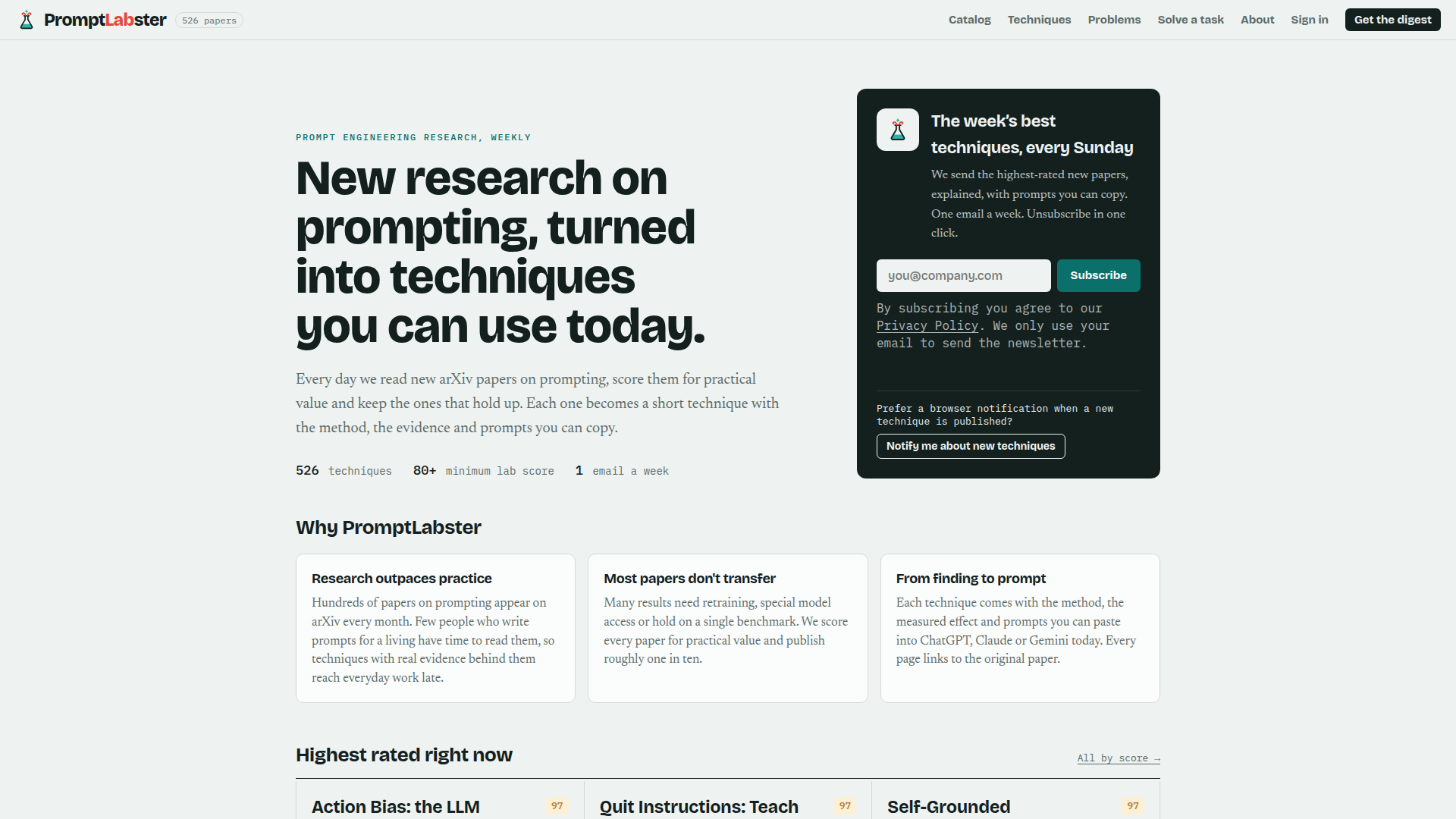
PromptLabster positions itself as the missing bridge between academic prompt-engineering research and everyday AI work. Every day its team reads new arXiv papers on prompting, scores each one for practical value against a minimum lab score of 80, and keeps roughly one in ten — the ones that actually transfer to real models without retraining, special API access or single-benchmark tricks. Those survivors become short technique pages containing the method, the measured effect, the caveats, a link to the original paper and, most importantly, ready-to-paste prompts. The site catalogs 526 techniques, browsable by capability (Quality Control, Self-Reflection, Code Generation, Chain-of-Thought, Structured Output, Multi-Agent Debate), by month, by rating, or through a dedicated task finder that matches a user's job to the right technique. Target audience: prompt engineers, AI product builders, developers running coding agents, data and research teams, technical writers and consultants who write prompts professionally but have no time to read papers. Core features include the searchable technique catalog with scores, curated monthly archives, the Solve-a-task finder, a weekly Sunday email digest of the highest-rated new papers, optional browser notifications for new techniques, and user accounts with sign-in. Content is evidence-first and jargon-light: each entry explains the paradox or failure mode being fixed, the exact prompt trick (for example Quit Instructions, Self-Grounded Verification, Contradiction Gate, Retrieval Status Flag), and quantified results such as fabrication cut 16x or audit accuracy rising from 4% to 45%. The user experience is clean, text-first and fast, with no paywalls, no clutter and one-click unsubscribe. Technically it is a lightweight static-style publication with tag filters, sorting by rating or month, account login, a privacy policy and email newsletter subscription.
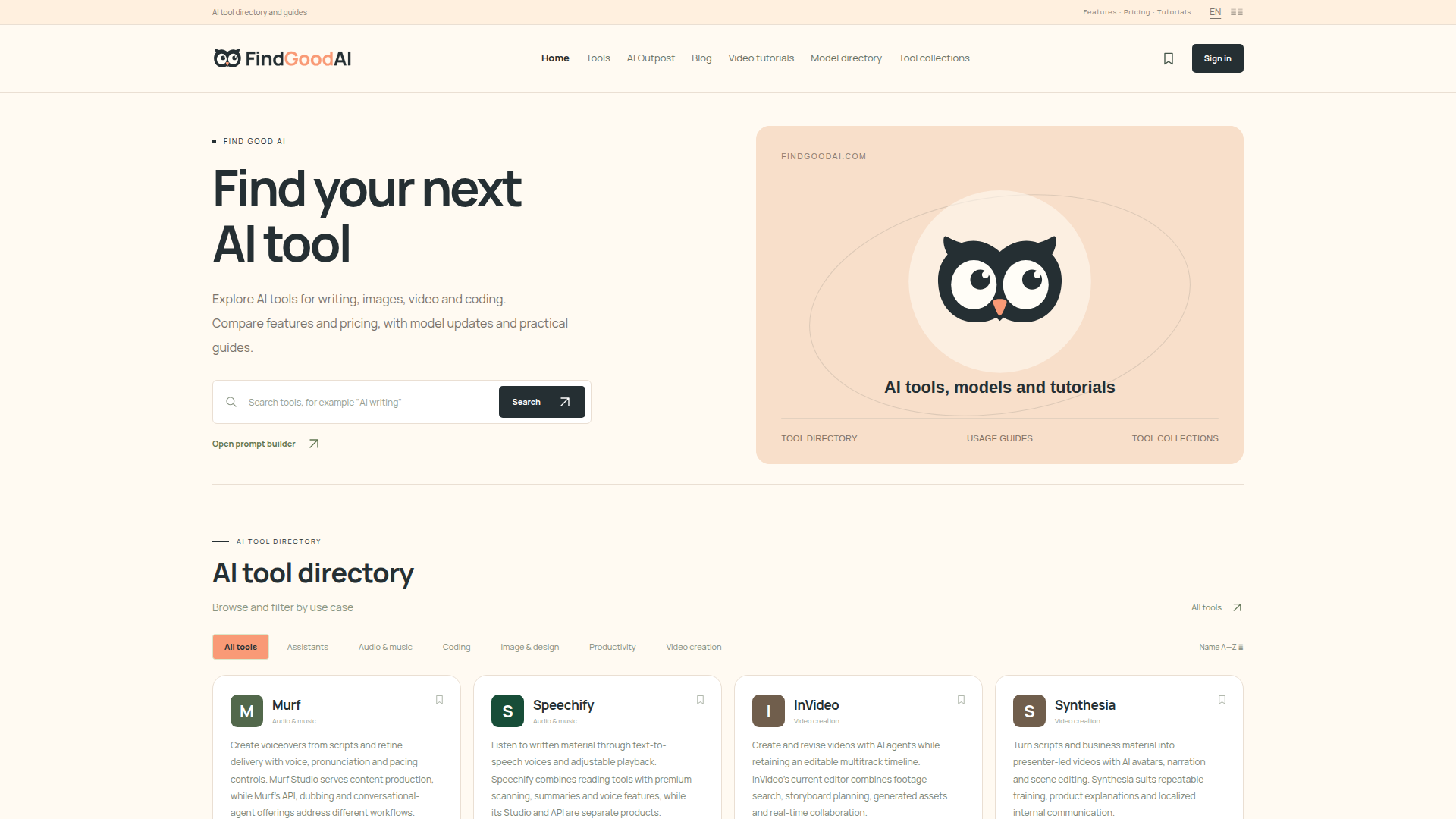
FindGoodAI is an independent AI tool discovery hub and directory designed to help individuals and teams navigate the fast-growing artificial intelligence landscape. Positioned as a practical starting point for evaluating AI software, it serves creators, marketers, developers, researchers, small-business owners, and curious learners who need to find, compare, and understand AI solutions. Core features include a filterable AI tool directory covering assistants, audio and music, coding, image and design, productivity, and video creation; a model directory with overviews and specifications; curated tool collections for tasks like office work, content production, and research; and saved tools for signed-in users. Content features include blog articles, practical guides, AI Outpost updates, and video tutorials that explain workflows, compare capabilities, and track model releases. User experience emphasizes simple category browsing, search, bookmarks, and clear English/Chinese language options. Technically, FindGoodAI organizes listings with tags, categories, pricing and feature summaries, while linking out to official product pages. It does not sell AI software directly; instead, it helps users make informed choices through independent directory review, editorial context, and discovery resources.
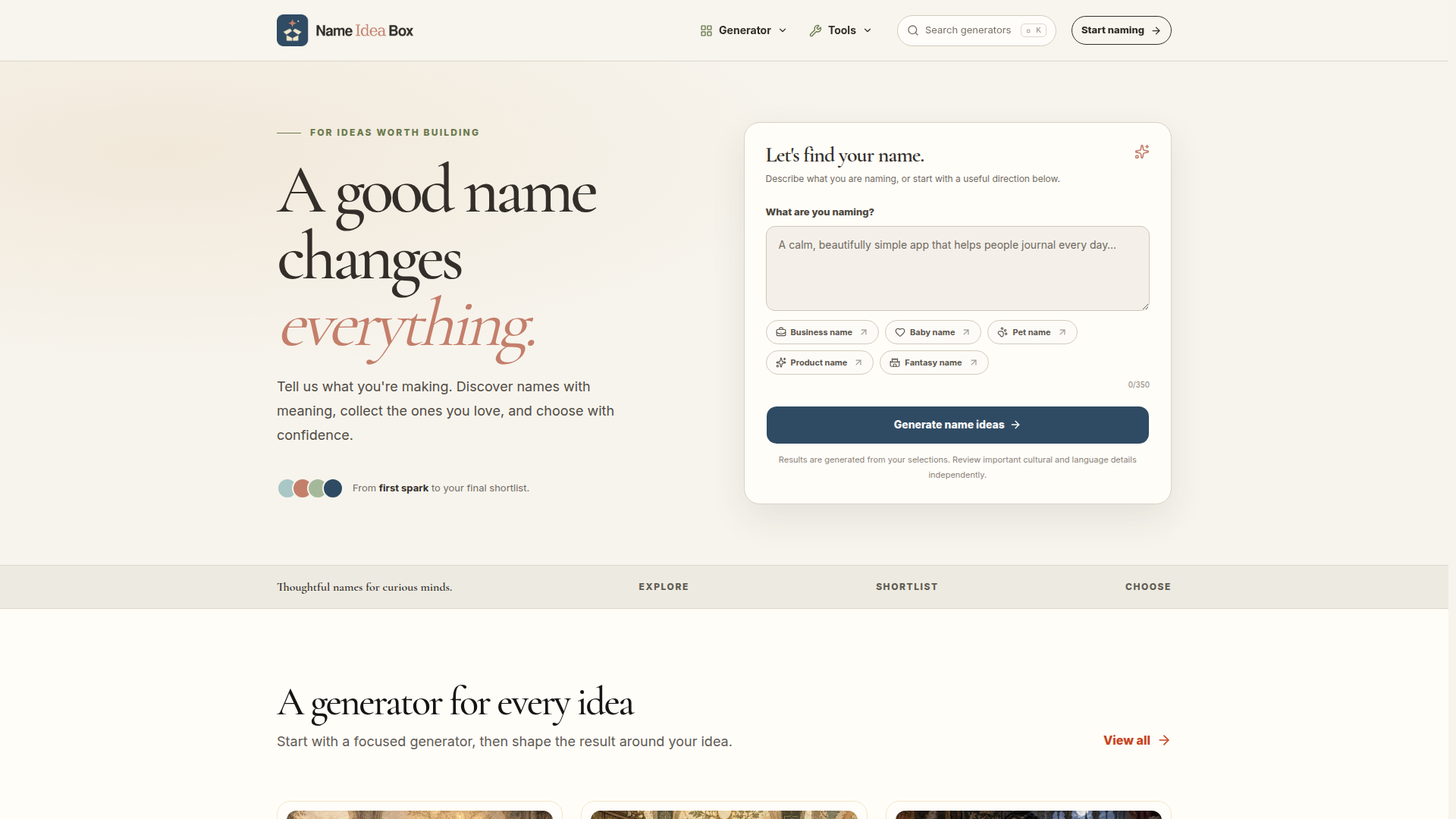
Name Idea Box is an AI-powered naming platform and brainstorming toolkit designed for anyone who needs a memorable, meaningful name. It positions itself as a generator for every naming need, combining category-specific AI tools with a shortlist workflow that helps users move from a rough idea to a confident final choice. The site serves entrepreneurs, startups, product managers, parents, pet owners, writers, game masters, role-players, content creators, and worldbuilders. Core features include dedicated generators for business, baby, pet, product, fantasy, city, planet, country, kingdom, and character names, plus language and culture-inspired generators such as Japanese, Korean, Russian, and German names. Users can describe what they are naming, choose a direction, generate ideas, save favorites, and compare two or three names side by side. The content also includes practical naming guides, such as a guide to unique baby names, and tools like 1000 Random Names. The user experience is clean and focused, with a prominent prompt form, category chips, search, and simple navigation. Technically, it uses AI to generate context-aware suggestions based on user inputs and selections. The site is free to use, requires no account for basic naming, and reminds users to verify cultural context, availability, and legal risk before committing. Overall, Name Idea Box is a lightweight, accessible resource for creative and practical naming projects.

Slide-Easy is a macOS desktop application that turns a single App Store, Google Play or website link into a full week of Instagram content for mobile apps. Its positioning is deliberately narrow and opinionated: instead of being a general-purpose AI social media suite, it is a marketing co-pilot built specifically for indie app makers and small studios who have to promote their own products on Instagram without a designer, copywriter or content budget. The target audience is solo developers, two-to-five-person app teams, and freelance app marketers managing client apps — people who already have an app live and care about installs but cannot justify $300+ per year on credit-metered tools. The core feature set covers the whole production chain in one window: the app reads a store page and real user reviews, learns how users actually phrase the problem the app solves, writes hooks and captions, renders AI character imagery and voiced videos locally, scores every post before showing it, then saves the finished assets or publishes them through Instagram's official API on a schedule. Content output includes Reels with voiceover, multi-slide carousels and stories drawn from more than 50 templates such as signs, phone screens, paper notes and social-post styles, with carousels able to close on real app screens. A notable content feature is honesty-by-design: every AI person is a locally rendered character shipped with a model card, and each post leaves with Instagram's AI label plus an 'AI character' caption line, so nothing pretends to be a real customer. User experience is built around a simple three-step loop — paste a link, approve or skip the week, then post — with a 7-post free trial, a one-click purchase, a key that works on two Macs, and a 14-day refund, so there is almost no commitment friction. Technical features are the differentiator: all generation (Z-Image Turbo, FLUX.2 Klein, Qwen3-VL-8B and Qwen3-TTS via Apple's MLX) runs on-device on an Apple Silicon Mac with 16 GB of memory and macOS 15+, so there are no server bills, no credits and no per-post metering, which is what makes the flat $49 lifetime price possible. Optional integrations let paying Claude or ChatGPT users swap in their own login as the writer, and a beta Meta developer app connection enables scheduled posting, comment replies, a weekly reach check that flags sudden drops, and a warm-up plan for brand-new accounts. The app is made by a single indie developer in Bengaluru, and the site leans hard into that transparency with plain-language FAQ answers, explicit limitations (no TikTok, no Windows, no Intel support) and a done-for-you $299/month service for founders who would rather not run it themselves.
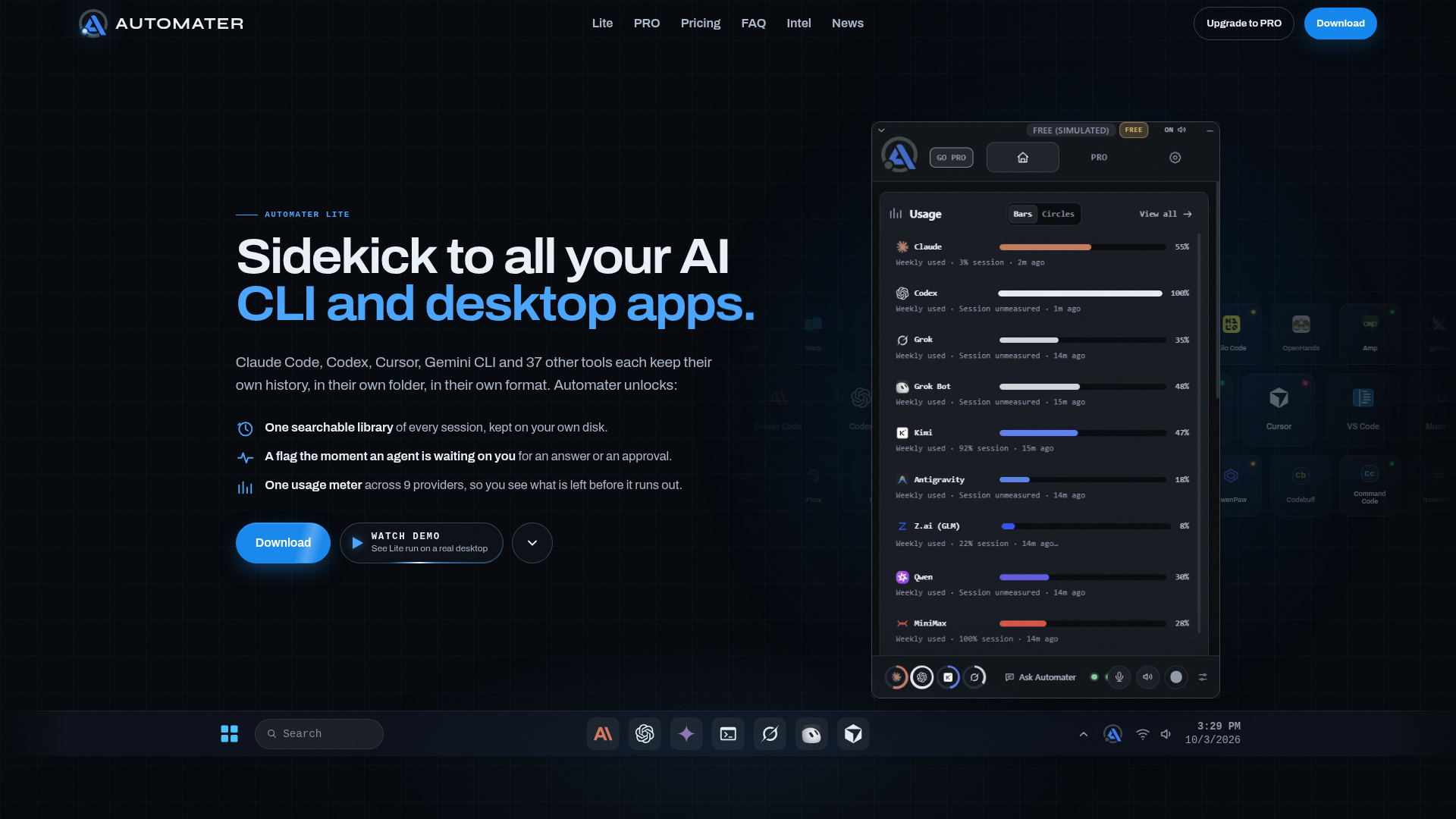
Automater is a desktop-first, local-first AI session manager built for developers who run several AI coding assistants at once and keep losing track of them. Its positioning is that of a single control panel, or sidekick, for the whole AI fleet on a machine: Claude Code, Codex, Cursor, Gemini CLI, Windsurf, Aider, OpenCode, Copilot, Kimi, Qwen Code and dozens of other tools each write their own transcripts in their own folder and their own format, and Automater folds all of them into one searchable library that never leaves the user's disk. The target audience is software engineers, agent power users, prompt engineers, indie builders and small dev teams who juggle five or more assistants a day and want to know what an agent is doing, what is waiting on them, and how much quota is left. Core features include a session library covering 45 session formats from 41 AI apps and CLIs with full-text search across vendors and one-click resume on the 11 CLIs that support it; Live activity with the amber Needs You flag that fires the moment an agent blocks on a question, permission prompt or approval; a usage meter that counts tokens locally and draws quota headroom for nine providers on one screen; Grok Bot chat import into the same library; a Detected AI apps card showing installed versus running tools; and a voice card that turns Ctrl Alt Space into on-device dictation via Parakeet, with Kokoro reading agent status back in a local voice. Content features follow a card-deck model: the panel is the app and each card is a feature, with an Explore Cards library, Automater Intel field guides and AI News alerts. User experience is tray-centric, with four working modes (from the tray, pinned to the desktop, auto-hide at the screen edge, or as a plain window), three themes (Blue, Carbon, Steel), adjustable opacity and reorderable Home cards that persist between launches. Technical features include local indexing with nothing uploaded, cross-platform builds for Windows, macOS and Linux, local and WSL terminal support, opt-in leaderboard publishing, and a genuinely free Lite tier that never expires alongside a paid PRO tier that adds the parts that act: Ask Automater chat with screen awareness, Files, Terminal, Leaderboard, AI News, Live Visualizer, Browser, Camera FX, inline replies to running sessions and cloud voice fallback. Automater keeps sessions, agents and costs organised and under the user's control rather than scattered across a dozen hidden folders.
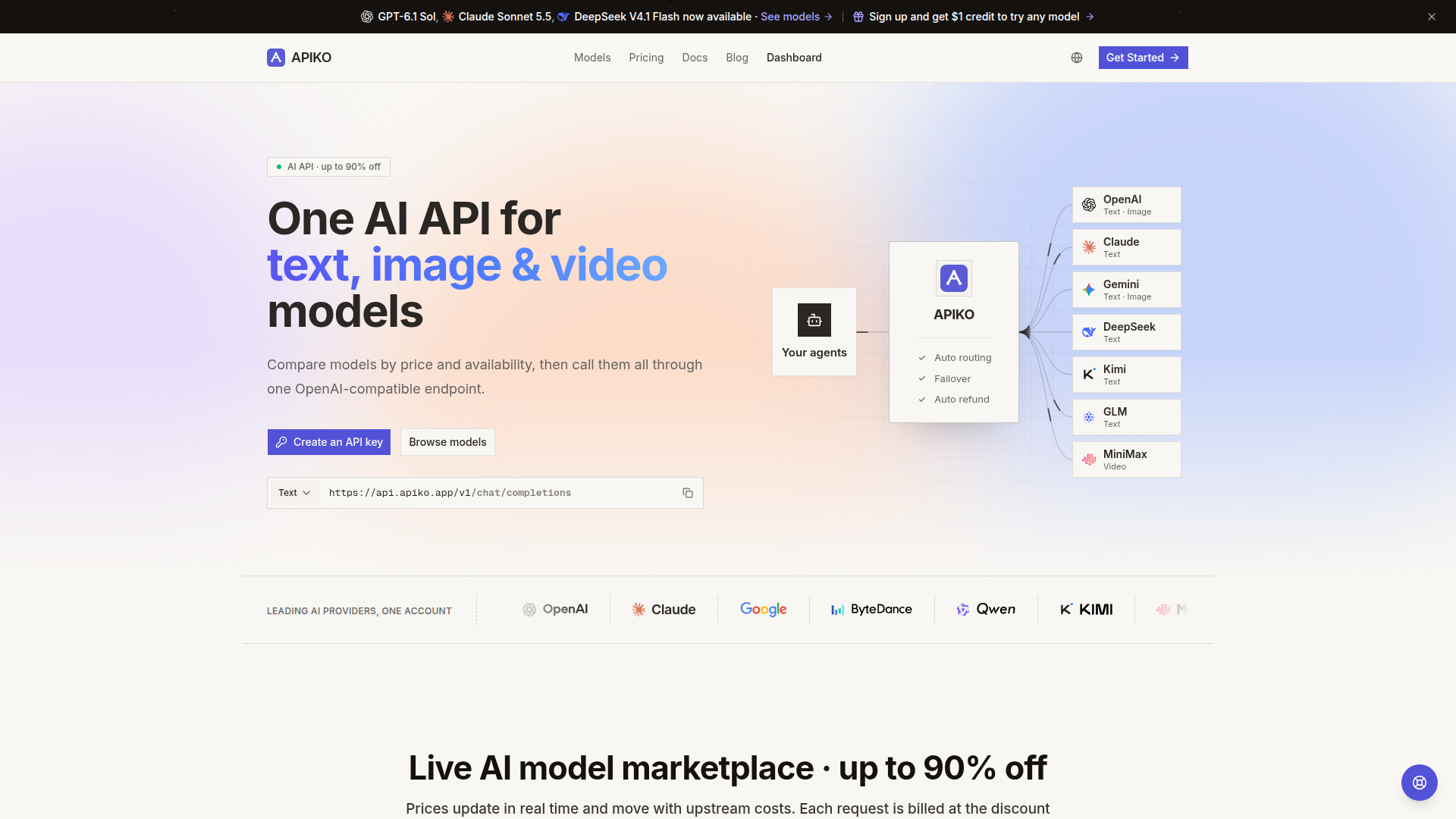
APIKO is a developer-first AI model aggregation platform and live marketplace that gives individuals, startups, and enterprises a single, OpenAI-compatible API endpoint for accessing the world's leading large language, image, and video models. Its core positioning is cost efficiency plus unification: instead of signing up separately with OpenAI, Anthropic, Google, xAI, DeepSeek, Z.AI, Moonshot AI, ByteDance and Alibaba, users create one APIKO account, generate one API key, and call every model through the standard https://api.apiko.app/v1/chat/completions route — meaning existing OpenAI SDK code works with nothing more than a base-URL and key swap. APIKO advertises savings of up to 90% versus list prices (for example GPT-6 Astra at $1 per 1M input tokens instead of $10, and Claude Opus 5.5 at $0.865 per 1M input tokens instead of $4), with prices that update in real time as upstream costs move and billing always applied at the discount in effect when a request is made. The target audience includes AI application developers, indie hackers, SaaS and agent builders, prompt engineers, research teams, and cost-conscious engineering departments that need multi-model flexibility without multi-vendor billing complexity. Core features include a live model marketplace with side-by-side list-versus-APIKO price comparison, five-minute-refreshed availability probes using real calls, automatic routing, failover and auto-refund so failed requests are not billed, per-model playgrounds for instant testing, context-window and cached-input pricing transparency, language switching, and a dashboard for API key management, usage and spend. Content features include a model catalog filterable by provider (OpenAI, Anthropic, Google, Grok, DeepSeek, GLM, Kimi, ByteDance, Alibaba), model detail pages, pricing tables with uptime/SLA indicators, documentation, and a blog. User experience is streamlined: a $1 sign-up credit lets newcomers try any model before paying, and onboarding takes minutes rather than days of procurement. Technically, APIKO is a routing and billing layer that abstracts away provider-specific auth, rate limits and regional price windows (such as DeepSeek's peak/off-peak Beijing-time pricing), providing observability, redundancy and unified token accounting across text, image and video modalities.
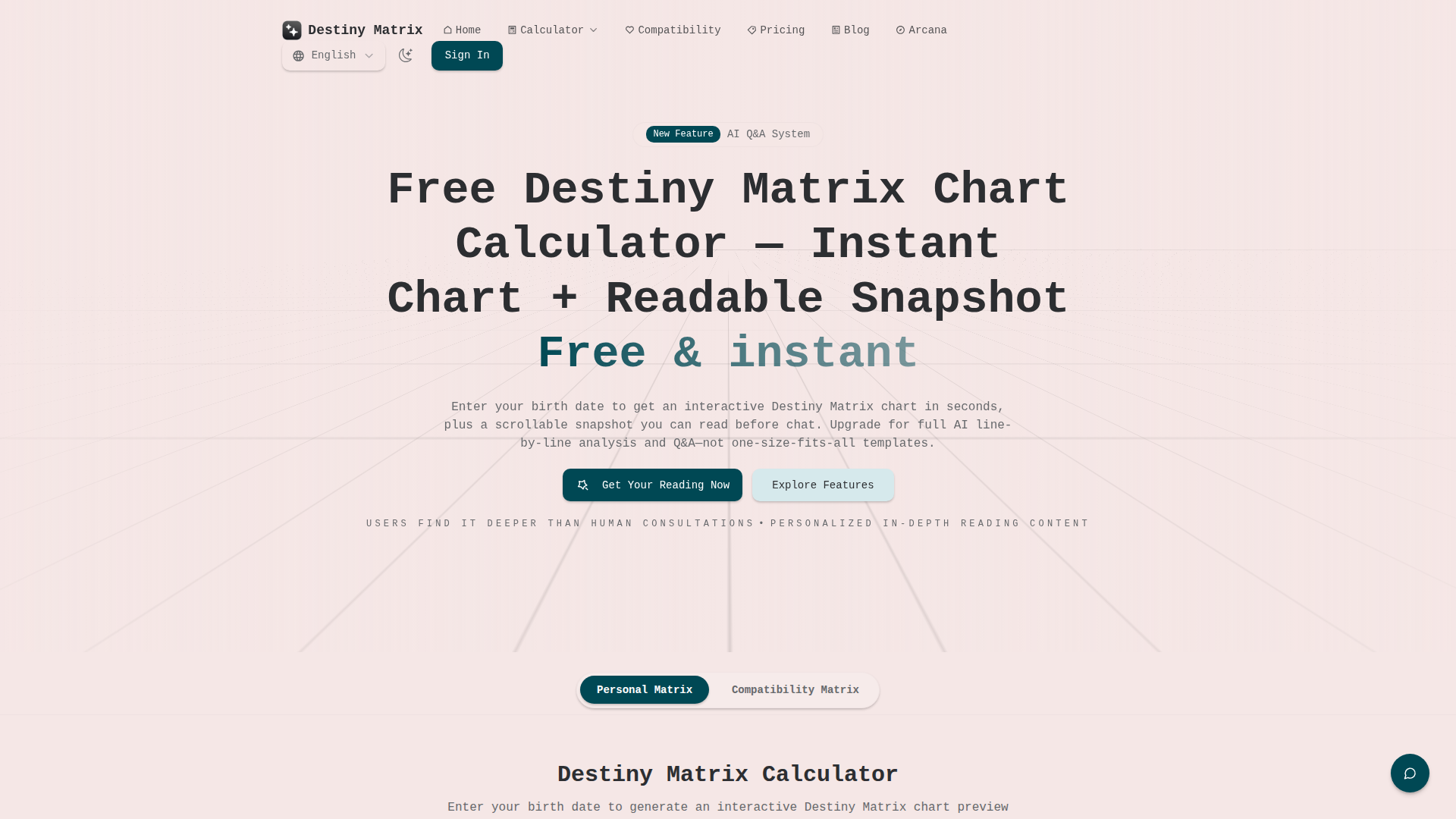
Destiny Matrix is an AI-powered numerology and self-discovery platform centered on the Destiny Matrix method. It positions itself as a smarter alternative to static numerology calculators and generic reports by using AI to analyze the interactions among 22 energies, including Life Path, Soul, Karmic Tail, love, money, and talent lines. Target audience includes numerology enthusiasts, tarot learners, relationship-focused users, spiritual seekers, coaches, therapists, and anyone interested in personalized self-insight without needing prior knowledge of arcana or chakras. Core features include a free instant Destiny Matrix chart calculator, Karmic Tail and Human Design calculators, compatibility analysis, energy-line visual interpretation, no-jargon simplified explanations, PDF export, and a premium AI Q&A system with 30+ conversation credits. Content features combine traditional numerology concepts with plain-language AI interpretation, daily-life recommendations, and multi-scenario guidance for career, relationships, wealth, and health. User experience is designed for zero learning curve: enter a birth date, view an interactive chart in seconds, read a free snapshot, then upgrade for deeper line-by-line analysis. Technically, calculations run locally in the browser for privacy, while AI handles personalized reading generation and interactive follow-up. The site also offers blog and arcana resources for ongoing learning.
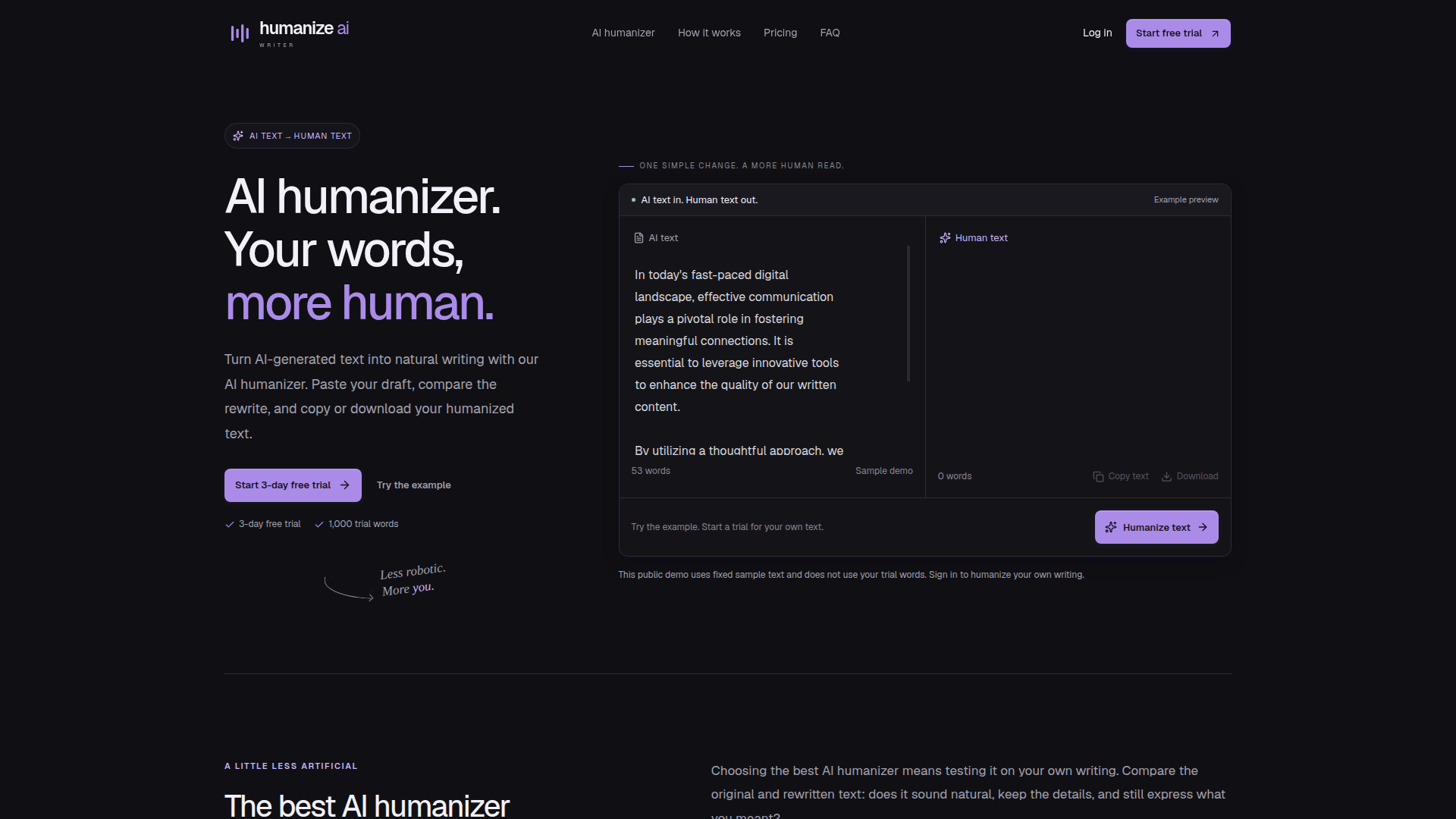
Humanize AI Writer is a focused web-based AI humanizer designed to transform AI-generated text into natural, human-sounding writing. Its website positioning is simple: a single-purpose tool that turns robotic or stiff AI drafts into more conversational, readable text. The target audience includes content writers, students, marketers, bloggers, and professionals who use AI tools like ChatGPT, Claude, or Gemini and want their final text to sound less artificial. Core features include a paste-and-humanize editor, side-by-side comparison of original and rewritten text, a public example demo, copy and download options, and clear word-based plans. Content features are deliberately straightforward: a three-step workflow, transparent trial limits, and concise FAQ answers. User experience emphasizes simplicity—paste, humanize, review, copy. Technical features include Google sign-in, a 3-day free trial with 1,000 words, a monthly word allowance, up to 20,000 characters per request, and subscription billing. The tool aims to preserve meaning but reminds users to verify facts, names, numbers, and citations. Pricing is subscription-based with Starter and Pro monthly plans, annual billing discounts, and no permanent free plan.
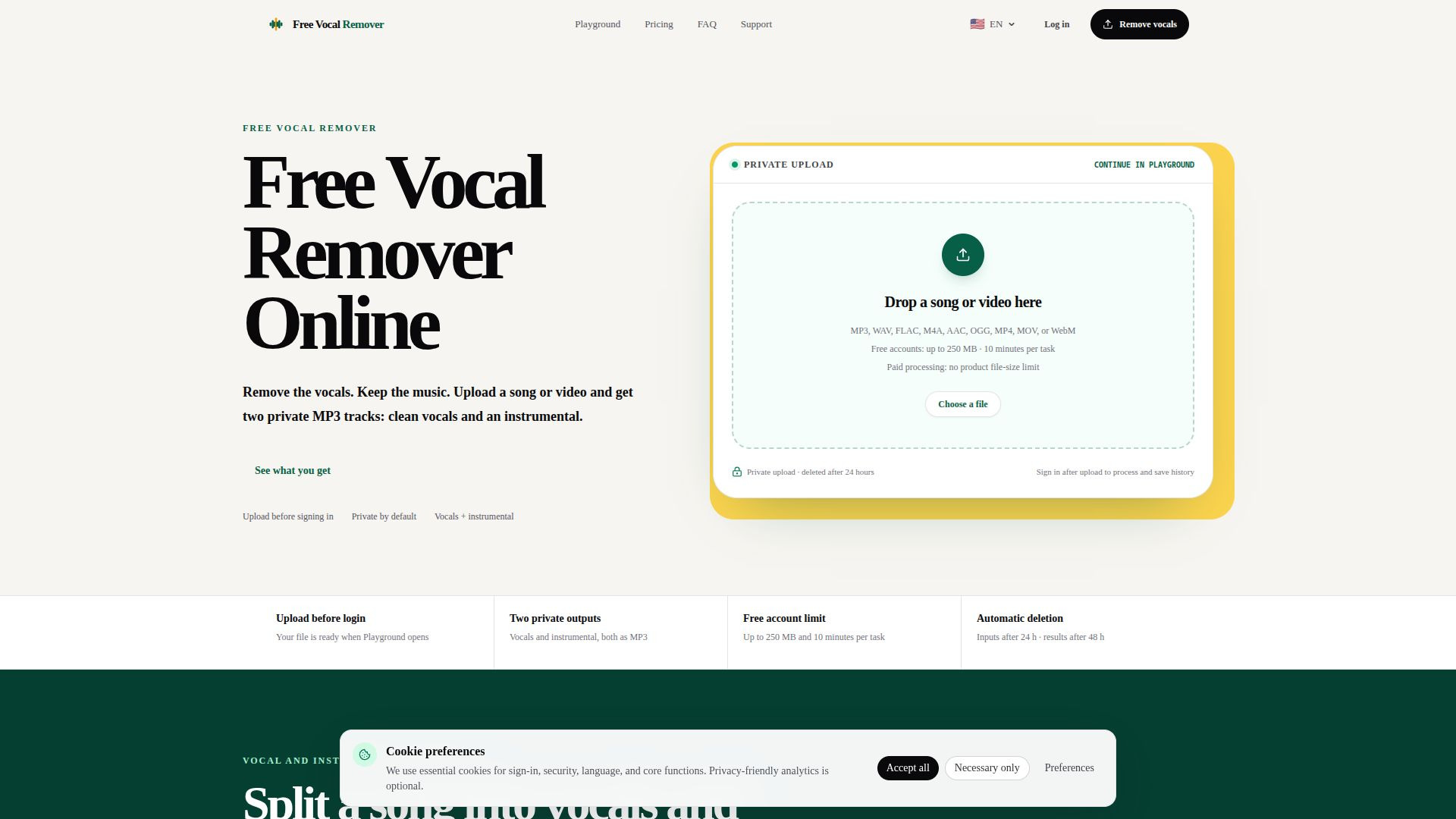
Free Vocal Remover is an online audio separation tool positioned as a fast, privacy-focused way to split music into vocals and instrumental tracks without installing software. It targets musicians, singers, producers, students, karaoke fans, and creators who need quick stem separation for practice, study, performance, or editing. Core features include upload before sign-in, automatic processing in a private Playground, two MP3 outputs, daily free processing seconds, paid priority queue, history access, and support for MP3, WAV, FLAC, M4A, AAC, OGG, MP4, MOV, and WebM files. Content features are practical and task-oriented, explaining the three-step workflow, queue types, file limits, retention policies, and use cases such as rehearsal and arrangement study. User experience emphasizes simplicity: drag and drop a file, sign in to claim it, watch progress, preview vocals and instrumental separately, and download either track. Technical features include ownership checks, expiring download links, automatic deletion of inputs after 24 hours and results after 48 hours, shared and priority queues with identical separation quality, and per-minute billing rules for paid processing. Overall, Free Vocal Remover combines free daily access with optional paid priority processing in a straightforward web app.
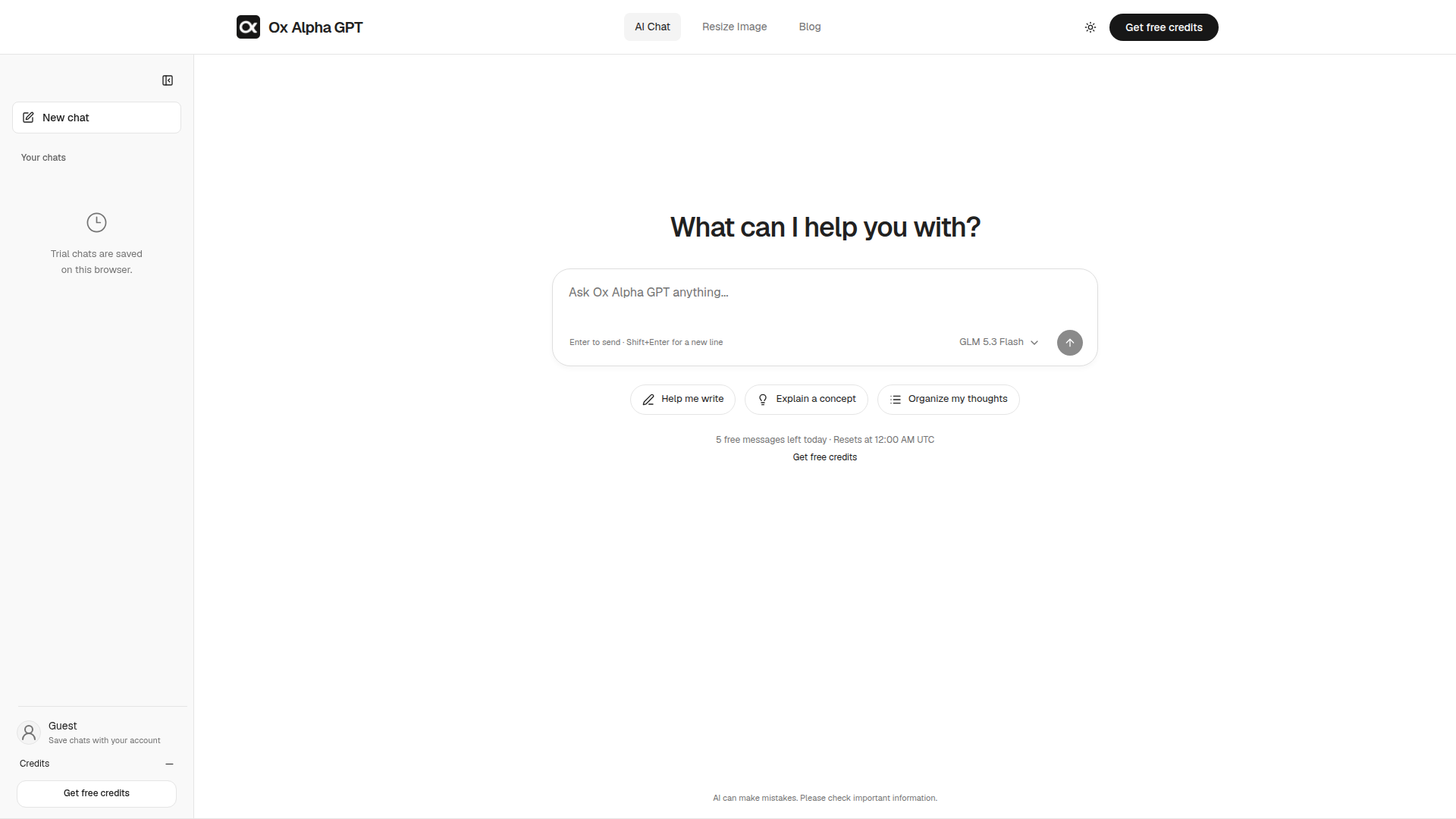
Ox Alpha GPT is an independent, browser-based AI chat platform built around GLM-5.3-Flash — the model originally previewed under the name "Ox Alpha" and developed by Z.ai. The site positions itself as a no-friction gateway to a large-context frontier model: visitors land directly in a chat interface, pick GLM 5.3 Flash from the model selector, and start prompting immediately without installing anything, registering an API key, or configuring developer tooling. Its core promise is accessibility — free AI chat for coding, writing, summarising, translating, and everyday reasoning, with a generous guest allowance before any commitment is required. In terms of website positioning, Ox Alpha GPT sits between a lightweight consumer chat playground and a model-comparison hub. It is explicitly not an official Z.ai property; it is a third-party front end that hosts multiple text models and exposes their pricing so users can compare cost against capability before sending a message. The underlying model specification is impressive and prominently documented: a 1,310,720-token context window, up to 131,072 output tokens, and text, image, and video input support with text output. Its target audience spans developers who need help debugging a snippet or reasoning through an architecture decision, students and self-learners who want concepts explained step by step, writers and knowledge workers polishing emails, drafts, and reports, and analysts who need long documents condensed into bullet summaries. Anyone evaluating new AI models — including the rumoured or newly released ones covered in the blog — is also a natural fit. Core features include guest chat with daily message limits, a signed-in mode that saves conversation history to an account and grants 10 free credits each day, a model selector showing available text models with input and output pricing, multi-turn follow-up refinement, a free browser-based image resizing tool (JPG, PNG, WebP, single or batch, processed locally on-device), and an editorial blog publishing model guides and comparisons. A published roadmap signals planned image, video, and audio generation. Content features lean practical and educational. Rather than abstract marketing, the site offers example prompts for bug hunting, decision making, editing, summarising, learning, and translation, plus a "How to get better answers" section covering context, output format, and iterative refinement. The blog covers model releases, benchmarks, pricing, and upgrade advice. User experience is intentionally minimal: a single chat surface with a sidebar for chats and credits, Enter-to-send with Shift+Enter for new lines, quick-start suggestion chips, and clear disclaimers that AI can make mistakes. Technical features include streaming text generation, conversation persistence tied to accounts, guest trials stored in browser storage, credit metering based on model choice and token usage (including reasoning tokens), anti-abuse verification and network-level shared limits, and client-side image processing that never uploads user files. Overall, Ox Alpha GPT is best understood as a free-tier-friendly, model-agnostic AI chat workspace with transparent cost signals, a strong emphasis on writing and coding assistance, and a growing knowledge base about the fast-moving AI model landscape.
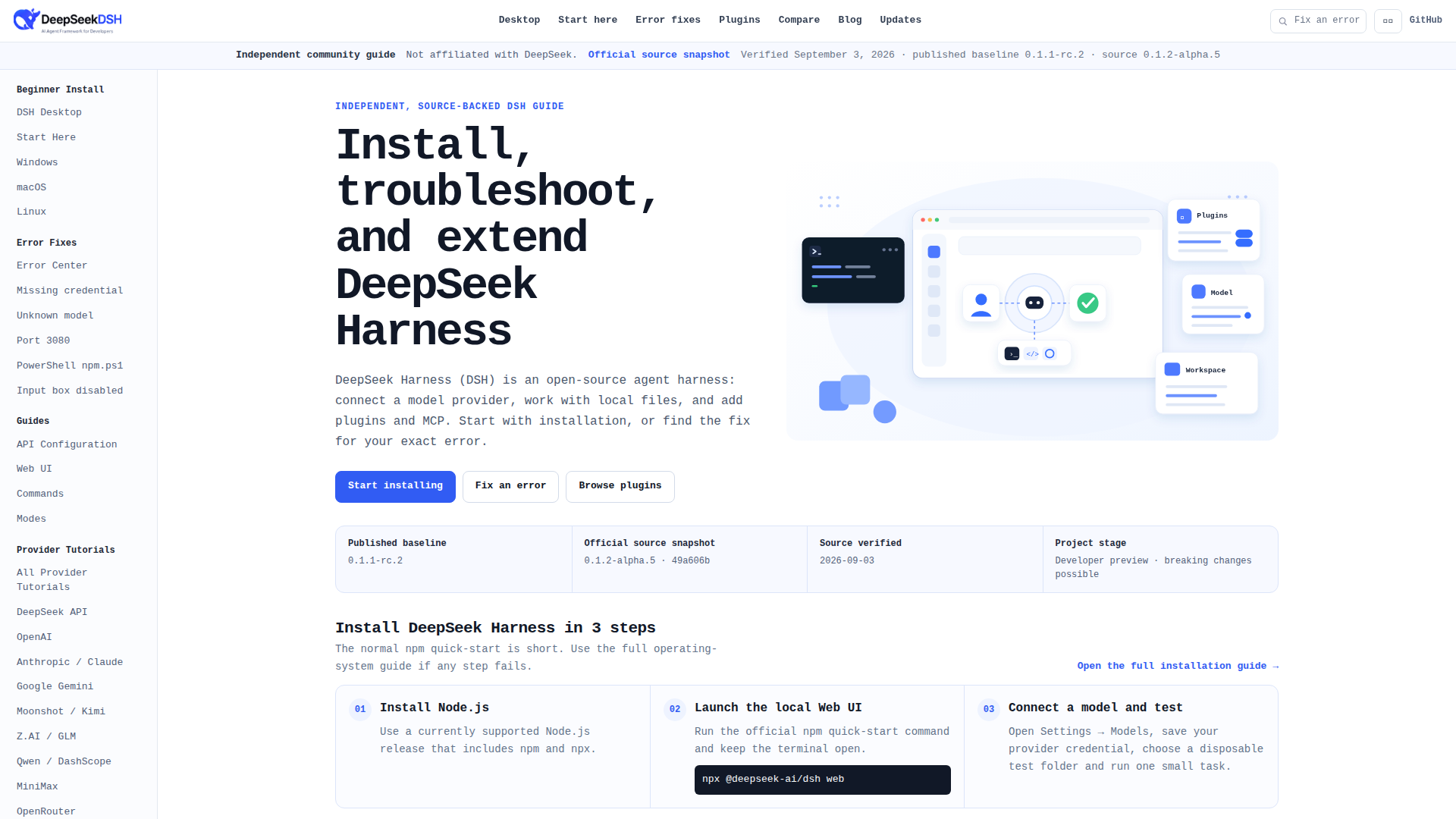
DeepSeek Harness (DSH) is an open-source agent harness that provides the runtime layer around large language models: provider and model selection, session history, workspace access, tool execution, approval boundaries, and plugin-composed capabilities. This independent community guide, deepseekdsh.com, is not affiliated with DeepSeek and focuses on helping developers install, troubleshoot, and extend DSH across Windows, macOS, and Linux. Its target audience includes AI developers, engineers, technical operators, and advanced users who want to run a local Web UI, connect providers such as DeepSeek, OpenAI, Anthropic, Gemini, Moonshot, Z.AI, Qwen, MiniMax, OpenRouter, Groq, and Together AI, and automate coding or workspace tasks. Core features include OS-specific installation tutorials, an error center with fixes for MISSING_CREDENTIAL, UNKNOWN_MODEL, port 3080 conflicts, PowerShell npm.ps1 issues, workspace permission errors, and disabled composer problems; plugin and MCP integration directories; provider setup guides; extension-point documentation; agent comparisons; desktop app notes; and community IM guides for Telegram, Discord, WeChat, WhatsApp, and Feishu. Content is structured as source-backed, version-aware documentation with a published baseline, official source snapshots, verified dates, and clear warnings about third-party components. User experience emphasizes quick-start paths, task-oriented navigation, searchable error pages, and success-state explanations. Technically, the site covers local Web UI workflows, npx quick-start commands, Node.js requirements, API credential configuration, proxy and network setup, running from source, custom providers, and plugin development. It is a free community resource rather than a commercial SaaS product.
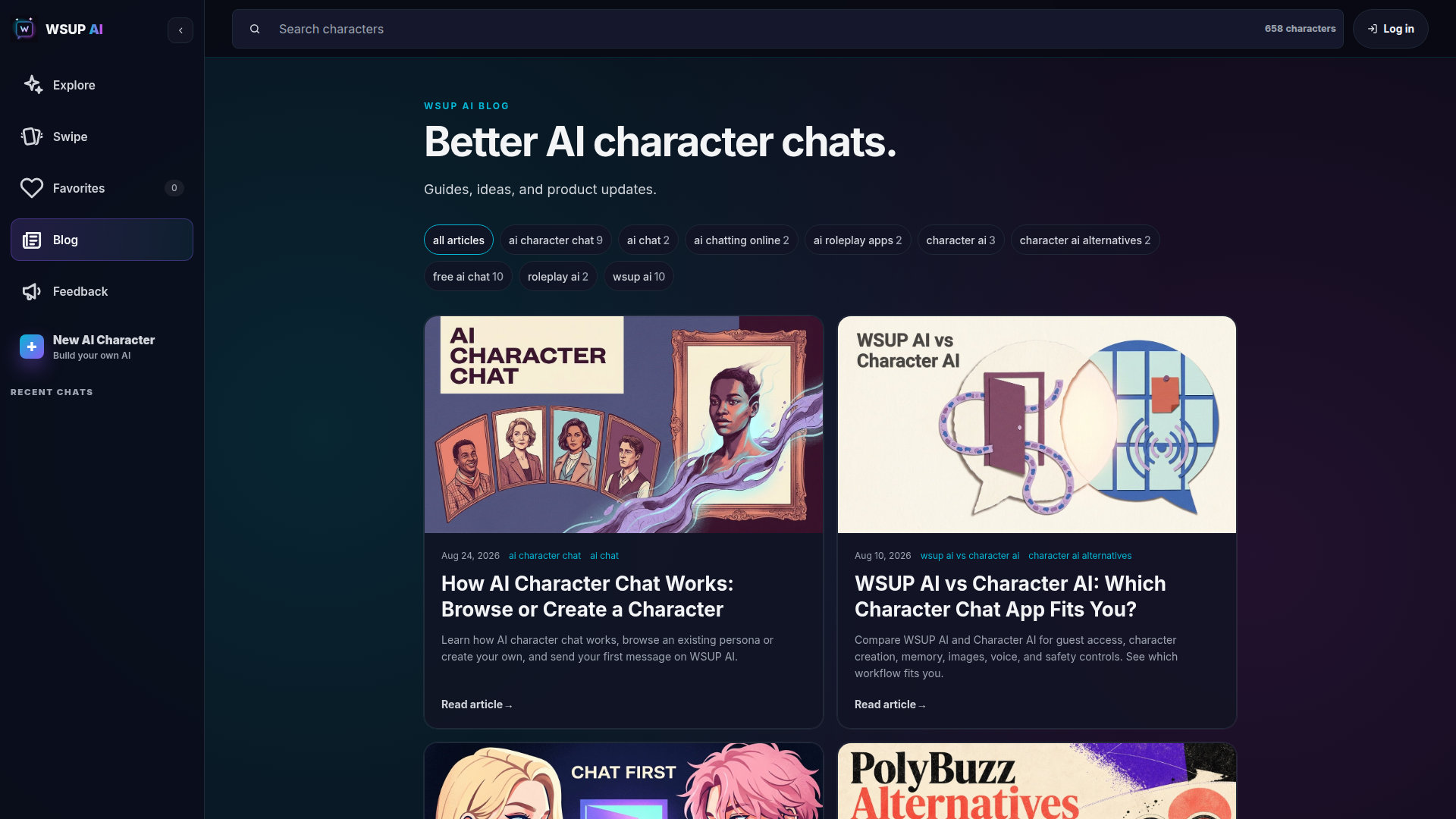
WSUP AI is a browser-based AI character chat platform designed for fast, flexible roleplay and companionship without a complicated setup. Its website and blog focus on helping users browse existing AI personas, create original characters, and start conversations directly in the browser, with guest access available before registration. Core features include custom character creation, favorites, swipe-based discovery, voice replies, image responses, motion previews, and privacy controls such as a Private setting. The content is aimed at people exploring AI roleplay, anime-style characters, fantasy scenarios, mature or spicy chats, AI companions, and alternatives to apps like Character AI, Janitor AI, and PolyBuzz. WSUP AI also publishes editorial guides, comparison articles, product updates, and practical tips on topics including AI chat without sign-up, private AI chat, voice-enabled chat, and better character creation. Its positioning is lightweight, independent, and user-controlled: users can try chats as guests, then log in when they want to save or personalize their experience. The blog acts as both an education hub and a product resource, explaining how AI character chat works, how to evaluate privacy, and how to get more out of roleplay. Overall, WSUP AI combines accessible AI character chat with ongoing editorial content and community feedback.
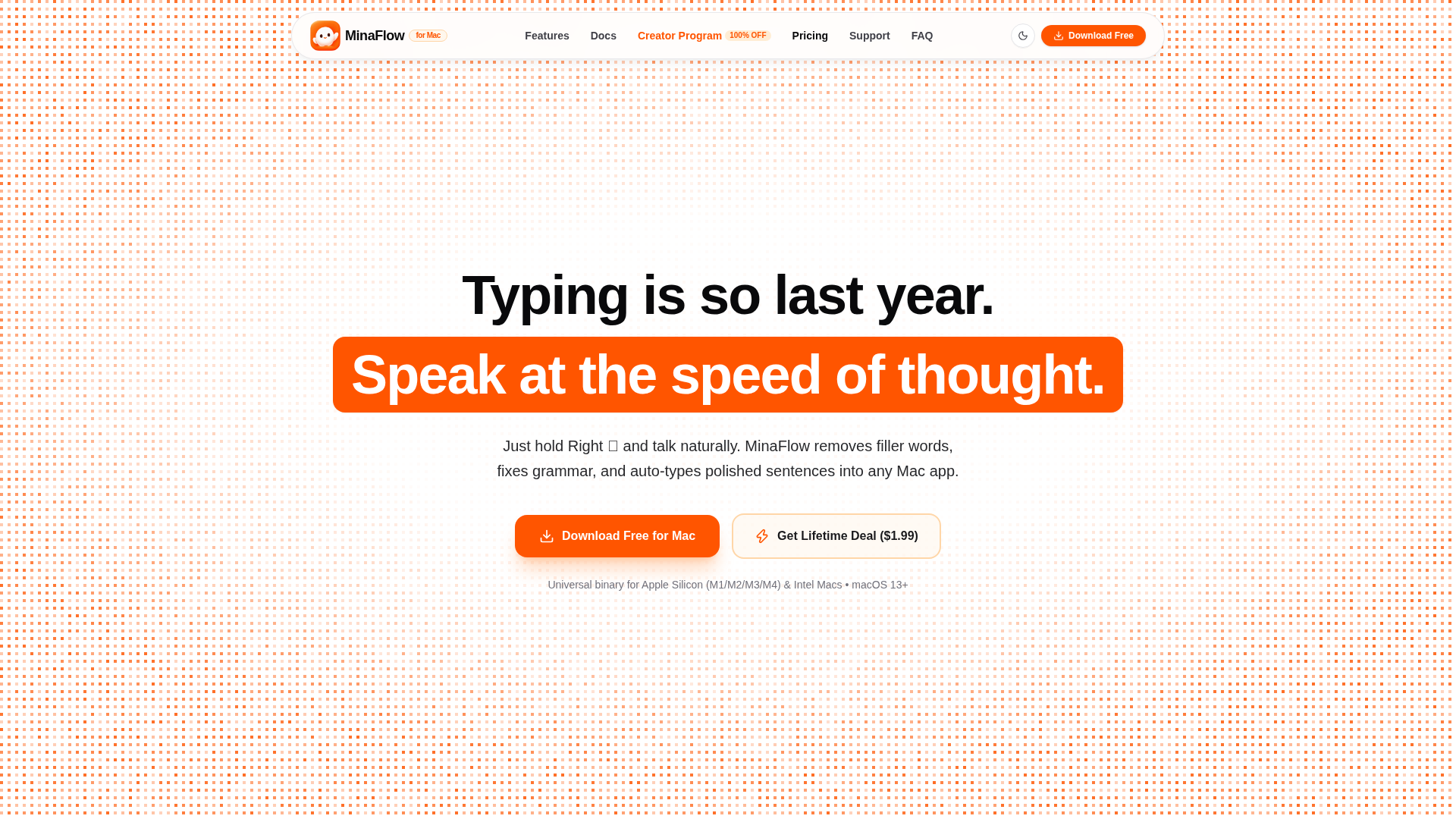
MinaFlow is a macOS-native AI voice dictation and typing assistant positioned as the fastest, privacy-first alternative to subscription speech-to-text tools. It is designed for Mac users who want to write, reply, code, and take notes without touching the keyboard, including writers, developers, founders, support teams, students, creators, and professionals who value speed and data privacy. The core promise is simple: hold Right Command, speak naturally, and MinaFlow auto-types polished text into any app. Its core features include filler-word removal, grammar correction, punctuation cleanup, Highlight-to-Edit for rewriting selected text by voice, spoken shortcuts for links and snippets, subtle audio chimes, a flexible HUD, context-aware tone formatting for Slack, Mail, and IDEs, and support for 100+ languages. Content-wise, the site offers a detailed comparison table against Wispr Flow, Apple Dictation, and MacWhisper, transparent pricing, a creator program, docs, support, and FAQ. User experience focuses on zero separate windows, zero clipboard clutter, a bottom-pill or camera-notch HUD, and setup in about 60 seconds. Technically, MinaFlow is built natively in Swift with Apple accessibility APIs, supports Apple Silicon and Intel Macs on macOS 13+, runs local Whisper models offline, and optionally connects to providers like Groq, Cerebras, Deepgram, OpenAI, Anthropic, OpenRouter, and Ollama through a BYOK model.

OurToken.AI is a unified and comprehensive LLM API platform designed to simplify and optimize access to multiple leading artificial intelligence language models. It positions itself as an enterprise-ready solution, providing developers and businesses with a single, consistent interface to interact with models from top providers like OpenAI, Anthropic, GLM, DeepSeek, MiniMax, Kimi, and Qwen. The platform eliminates the complexity of managing separate integrations, API keys, and billing flows for each provider. Its core value proposition is delivering affordable, stable, and comprehensive AI capabilities through cost-effective pricing, often at a significant discount compared to official rates, and transparent usage tracking. The target audience includes developers building AI-powered applications, startups seeking to manage costs, and enterprises requiring reliable multi-provider access. Content features a detailed model gallery for easy comparison of capabilities and pricing, along with developer-friendly documentation. The user experience is streamlined with a unified API endpoint and a dashboard for monitoring usage. Key technical features include cached input support for efficiency, Claude Code & Codex compatibility, and a system built for intelligent prompt routing to match each task with the most suitable model based on capability, price, and availability.

AiZolo is an innovative platform positioned as an All-in-One AI Subscription service and comparison workspace. It targets AI enthusiasts, professionals, and creators who are tired of managing and paying for multiple separate AI tool subscriptions. The core offering consolidates access to premium AI models like GPT-4, Claude, Gemini, and Perplexity into a single, affordable dashboard. Key features include side-by-side AI model comparison, AI-powered content generation tools for video, image, and audio, and workspace utilities like a smart prompt manager, AI memory, and custom API key support. The platform emphasizes a unified user experience designed to boost productivity, reduce costs, and simplify the AI workflow. It operates on a freemium model with a free tier and a low-cost Pro plan, providing significant savings compared to purchasing individual services.

APIMaster.ai is a specialized platform providing verified, discounted AI API keys from major providers like OpenAI, Claude, and DeepSeek. It positions itself as a cost-effective, reliable marketplace for developers and businesses needing access to cutting-edge LLMs. The target audience includes AI developers, startups, and enterprises in regions with payment restrictions. Core features include fingerprint-verified APIs to prevent model substitution, smart routing for the cheapest available channels, and auto-failover for maximum uptime. Content is focused on transparent pricing, real-time provider rankings, and detailed documentation. User experience is streamlined with a simple dashboard for key management and balance top-ups. Technically, it offers a fully OpenAI-compatible endpoint, making integration seamless with existing tools like LangChain and Cursor.

Elf Names Wiki is a premier digital resource and AI-powered platform dedicated exclusively to the creation, exploration, and understanding of elven names within fantasy contexts. It positions itself as a comprehensive encyclopedia and advanced name-generation tool for storytellers, gamers, and fantasy enthusiasts. The target audience includes Dungeons & Dragons players, fantasy authors, video game character creators, and world-builders seeking authentic, lore-accurate names. Core features revolve around an intelligent AI generator that tailors names to specific sub-races, styles, and character details, backed by a vast database of names with meanings and pronunciations. Content features include deep-dive lore articles on naming traditions across major settings like Lord of the Rings, D&D, Elder Scrolls, and Warcraft. User experience is streamlined for exploration, offering curated name lists and intuitive filtering. Technical features leverage AI models trained on thousands of fantasy names to produce linguistically coherent and meaningful outputs, elevating it beyond basic random generators. The platform serves as a one-stop hub for anyone needing inspiration, education, or a perfect name for their next elven character.

AIToHuman is a specialized AI text humanization platform designed to transform AI-generated content into natural, human-sounding writing. Positioned as the most powerful free AI to human text converter, it serves writers, students, and professionals who use AI responsibly. The core mission is to keep users' original ideas while fixing the delivery, enabling them to create content that bypasses AI detection without sacrificing quality. Its target audience includes students drafting academic papers, content writers scaling production, and business teams polishing internal documents. Core features leverage advanced neural language processing to analyze over 40 linguistic markers, breaking predictable sentence patterns and introducing natural variation in tone and pacing. The platform offers a privacy-first experience with real-time processing, zero data storage, and GDPR compliance. Users benefit from fast, unlimited conversions with no sign-up required, making it an indispensable tool for anyone needing to enhance the credibility and readability of AI-assisted content.

文字数カウントは、日本語テキストの文字数、バイト数、行数をブラウザ上でリアルタイムかつ正確に測定する無料オンラインツールです。そのウェブサイトのポジショニングは、ユーザーのプライバシーを完全に保護しながら、ライティング、プログラミング、学術研究など多様なニーズに対応する便利なユーティリティを提供することにあります。ターゲットユーザーは、学生、ブロガー、コンテンツクリエイター、プログラマー、翻訳者など、文字数制限や正確なテキスト分析を必要とする幅広い層です。コア機能として、詳細な基本統計(文字数、行数、段落数)、多様な文字エンコーディング(UTF-8, Shift-JIS等)に基づくバイト数計算、ひらがな・カタカナ・漢字などの文字種別の分類カウントを提供します。コンテンツの特徴は、リアルタイムでの統計更新、目標文字数設定による進捗管理、結果のコピーやCSVダウンロード機能、そして.txtや.csvなどのファイルからの直接テキスト読み込みに対応している点です。ユーザーエクスペリエンスは、直感的なインターフェース、レスポンシブデザインによるあらゆるデバイスでの利用可能性、そしてサーバーにデータを送信しない完全なクライアントサイド処理によるプライバシー保護によって優れています。技術的特徴として、JavaScriptによるブラウザ内での高速なテキスト処理を実現し、ユーザーのデータを安全に保ちます。

ToolFame is a comprehensive online directory for discovering the best AI, SaaS, and other online tools. With a focus on providing a curated list of resources, ToolFame helps users easily find the right tools to enhance productivity, creativity, and efficiency in various domains. The platform features listings across numerous categories, including AI, video, audio, image, writing, data analysis, social media, and more, catering to a wide range of professional and personal needs. ToolFame aims to be the go-to resource for finding new tools and staying up-to-date with industry trends, offering a user-friendly interface and a wealth of information to help users make informed decisions.

Upscayl is an open-source AI image upscaling tool designed to enhance image resolution with ease. It caters to creators, businesses, designers, artists, and developers by transforming low-resolution images into high-quality visuals. Supporting desktop and cloud platforms, it offers features like batch upscaling and various AI models to suit different image types. With a focus on both speed and simplicity, Upscayl makes advanced image enhancement accessible to everyone, ensuring better quality and clarity for all your visual needs.

Clever AI Humanizer is an advanced AI-driven platform designed to transform AI-generated text into natural, human-like writing, adept at bypassing AI detection. It's tailored for students, content creators, marketing professionals, and businesses aiming to enhance content authenticity. Its core features include intelligent text humanization, professional-grade quality output, and support for multiple languages, making it versatile for diverse content needs. The platform ensures content preserves its original meaning and SEO value while enhancing readability and natural flow. Featuring customizable humanization styles and a user-friendly interface, Clever AI Humanizer stands as a robust solution for anyone looking to create undetectable AI content.

AIBoom.Tools is a curated directory of AI tools and SaaS products, designed to help users discover valuable resources quickly. Unlike algorithm-driven listings, every tool is hand-reviewed to ensure it functions as advertised and fits appropriately within its category. The platform offers a searchable interface with detailed tool profiles, including screenshots, pricing information, and direct links to the tools. It primarily targets users seeking to find efficient and reliable AI solutions across various domains. For creators, AIBoom.Tools provides a space to list their AI tools, offering a profile page with a dofollow backlink and exposure to potential users. Whether you're browsing or listing, AIBoom.Tools aims to streamline the AI discovery process.
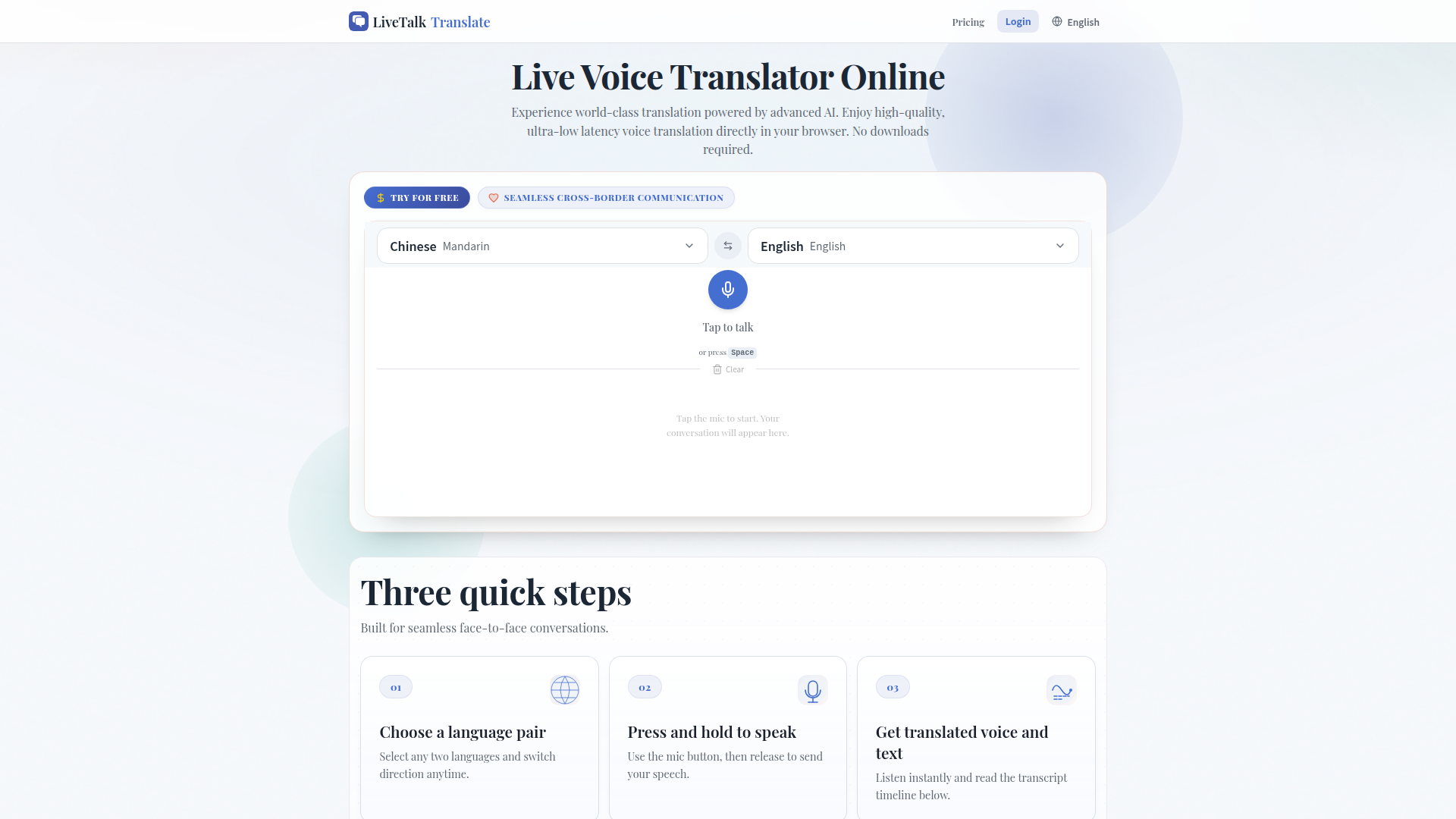
LiveTalk Translate is a cutting-edge online platform that provides real-time voice translation powered by advanced AI. It enables seamless cross-border communication by offering high-quality and ultra-low latency translation directly in your browser, eliminating the need for downloads. Excellent for travel, bilingual meetings, and connecting with loved ones, this tool supports numerous languages and offers a user-friendly experience with its instant voice output and readable conversation timeline. LiveTalk Translate is designed for daily conversations, ensuring smooth and accessible communication in various scenarios.

MaxClaw is a cloud-hosted AI agent by MiniMax, designed to offer a seamless AI experience without the complexities of server management or API key handling. Built upon the OpenClaw framework and powered by the MiniMax M2.5 model, it provides users with an accessible, efficient, and deeply integrated AI assistant. Focused on productivity and complex workflow automation, it caters to a broad range of users, from individuals seeking simple AI assistance to developers building complex automated workflows. MaxClaw offers instant deployment, multi-platform integration, long-term memory, customizable personas, a powerful toolchain, and radical cost efficiency.

PassWithProof is an AI-powered writing assistant that helps users create and enhance content that sounds genuinely human. Unlike other AI writing tools that produce robotic and formulaic content, PassWithProof utilizes proprietary models trained on real human data to eliminate AI patterns and create natural, engaging writing. It serves as an ultimate writing assistant, AI humanizer, and AI detector, ensuring the output is high-quality, plagiarism-free, and reflects your unique voice, suitable for professional and academic use while encouraging integrity and adherence to guidelines.

GLM 5 is a free AI platform powered by the latest GLM AI model from ZhipuAI, offering state-of-the-art multimodal capabilities. It excels in natural language understanding, code generation, and creative content production. This platform provides free access to enterprise-grade AI, featuring ChatGLM for AI chat, GLM 5 image generation, and GLM 5 video creation. With over 10,000 users daily, GLM 5 represents a major leap in AI, consistently outperforming GLM 4.5 with faster processing and higher output quality, making it ideal for content creation, marketing, and education alike.

Use AI is a multi-model AI chat assistant that provides access to over 25 AI models, including GPT-5, Claude, and Grok, all in one platform. It is designed to enhance the AI experience by offering powerful features such as multi-LLM access, model selection by task, voice-enabled commands, and support for multiple languages. Use AI aims to provide a seamless and efficient AI interaction experience, making it the perfect assistant for any task.

Team9 is an AI workspace built on OpenClaw, enabling you to hire and collaborate with AI staff like real teammates. It offers a zero-setup, managed OpenClaw experience, connecting you to the Moltbook ecosystem of AI agents. Prioritizing data sovereignty and control, Team9 allows you to deploy OpenClaw instantly, automating tasks, monitoring systems, and managing knowledge bases without complex configurations, making it ideal for teams valuing privacy, control, and seamless AI integration.

Kimi K2.5 is a groundbreaking open-source multimodal model developed by Moonshot AI, designed to deliver state-of-the-art AI capabilities at a fraction of the cost. With 1 trillion parameters and a 256K context window, Kimi K2.5 excels in visual coding, processes text, images, videos, and PDFs through a unified model. Kimi K2.5 offers a cost-effective solution for startups and enterprises, providing unmatched cost efficiency at approximately $0.39 per million input tokens, significantly cheaper than other AI models. Kimi K2.5's agent swarm capabilities enable complex multi-step workflows, driving innovation across various applications. It is set to democratize AI accessibility.

ClawdBot AI is a self-hosted personal AI assistant designed to perform real-world tasks for developers and power users. Unlike typical chatbots, ClawdBot manages emails, browses the web, runs scripts, and automates workflows across various platforms like WhatsApp, Telegram, and Discord. It runs locally on your machine, ensuring data privacy and control. With support for multiple LLMs and an extensible architecture, ClawdBot empowers users to create custom skills and automate complex processes. Its open-source nature encourages community contributions and continuous improvement.

APIXO is an affordable, all-in-one API platform designed to streamline the integration of AI models into your projects. It offers a unified API that supports leading models like Sora, Veo, Flux, and GPT, eliminating the complexity of managing multiple SDKs. APIXO focuses on cost efficiency with transparent pricing and best-value routing, which automatically selects the most cost-effective provider. It also ensures high reliability through automatic failover and comprehensive health checks. Ideal for teams that need AI in production, APIXO provides detailed usage analytics, project-level safety features, and developer-friendly billing with no monthly fees, making it easier and more efficient to build and scale AI applications.

ContentPod is an AI-powered content creation platform that transforms conversations into diverse content formats. Utilizing advanced AI models like GPT 5.2, Vertex AI, and Sora 2, it provides a suite of 16+ tools for creating SEO-optimized blog posts, social media content, infographics, videos, and more. It caters to content teams, marketers, and entrepreneurs looking to streamline their content creation process, save time, and maintain brand consistency with features like real-time voice AI, a brand library, and video generation capabilities, saving over 10 hours per week.

Transcribe to Text is an advanced AI-powered platform designed to convert audio and video files into accurate text transcriptions. Supporting over 120 languages and multiple file formats, it's ideal for professionals, content creators, and businesses needing fast, reliable transcription services. Its key features include speaker identification, word-level timestamps, and multiple export formats. It stands out with its AI-driven accuracy, speed, and comprehensive language support. The platform also offers translation support for Pro users, enhancing its utility for global content creation. Transcribe to Text provides both free and paid plans, catering to casual users and those requiring extensive transcription capabilities.

Flux 2 Klein AI is a comprehensive AI-powered creative studio, seamlessly integrating state-of-the-art image and video generation capabilities. It enables users to effortlessly transform text and images into high-quality visuals and engaging video content suitable for social media, marketing, and professional storytelling. With a unified workflow and intuitive interface, Flux 2 Klein AI provides total creative control, allowing users to fine-tune their results and rapidly generate industry-standard outputs up to 4K resolution.

ToolRain is an AI tools directory designed to help users discover the best AI applications across various categories. It serves as a comprehensive resource for finding both free and paid AI tools, ranging from writing and design to workflow automation. The platform caters to a wide audience, offering curated collections, category-based browsing, and a search function for easy navigation. With features like user submissions, a blog, and pricing information, ToolRain aims to be the go-to directory for users seeking the perfect AI tool to enhance their productivity and creativity.

Veo 3.1 AI Video Generator is an advanced AI-driven platform designed to transform text and images into high-quality cinematic videos. Powered by Google's Veo 3.1 model, it offers a cost-effective solution for creating marketing campaigns, social media content, and educational videos. The platform simplifies video creation, making it accessible to beginners and professionals alike. Key features include text-to-video conversion, image-to-video animation, and customizable settings for duration, aspect ratio, and resolution. With commercial usage rights included, users can generate watermark-free videos suitable for various professional applications, all within minutes.

iGPT is a context engine designed for agentic and enterprise workflows, providing a unified API that integrates various data sources like emails, documents, and web data. It accelerates context retrieval and processing, enabling quick access to actionable insights for reasoning and automation. With features like real-time ingestion, attachment processing, and hybrid retrieval, iGPT eliminates the complexities of building RAG systems, offering a streamlined solution for enterprises. It ensures enterprise-grade security with zero data training, RBAC, and flexible deployment options, making it suitable for diverse use cases, from decision intelligence to audit compliance.

APIPod is an enterprise-grade AI API aggregation platform that unifies access to 100+ top AI models, including GPT-5.2, Veo 3.1, and Nano Banana. It offers a single API endpoint for various AI modalities like LLM, image, video, and audio, eliminating the complexity of integrating with multiple AI providers. Designed for developers seeking stability, efficiency, and cost-effectiveness, APIod provides key features that include intelligent multi-channel routing, real-time health monitoring, and an observability platform for performance and cost optimization, APIPod empowers developers to build everything from simple chatbots to complex multimodal workflows.

EmojiTranslator is a free, registration-free tool for translating between text and emojis. It features bidirectional translation allowing users to convert text to emojis and vice versa, using AI language models for intelligent recognition. Main features include easy copying, simple integration, and universal compatibility. The platform is designed to enhance social media posts, add fun to personal messages, and create engaging content, ensuring user data privacy and offering a seamless user experience. It supports multiple languages including English, Chinese, Japanese, and Russian.

Gochu is a free, uncensored AI chat platform designed for private and romantic conversations. It offers a no-filter AI experience without requiring sign-up, positioning itself as a Character AI alternative with a focus on user privacy and immersion. Targetting users seeking realistic AI companions, Gochu provides features like AI girlfriends with voice and photos, instant responses, and diverse personalities. It emphasizes eco-friendly AI models and responsible adult entertainment, diverging from competitors by offering zero data processing and promoting a sustainable model.

SyntrofAI is the world's first Multi-Agent Operating System, providing a personal, organic agentic framework. It allows users to design, execute, and share AI workflows with full transparency. SyntrofAI offers features like a neural hybrid architecture, low latency (<10ms), air-gapped privacy, and the ability for AI agents to decide their own workflows and coordinate across intelligent teams. The platform allows AI agents to accumulate memory persisting forever; it evolves with every interaction, providing transparent, controllable, and infinitely extensible autonomous artificial intelligence.

Okara is a Private AI Chat platform designed for public thinkers, including creators, founders, writers, researchers, and professionals who prioritize both intelligence and privacy. It offers access to 20+ AI models and open-source image generators within a secure, encrypted workspace. Users can seamlessly chat, create, and research across multiple AI systems without losing context, ensuring data protection. Unlike many AI platforms, Okara doesn't use your conversations or uploads to train AI models, providing a confidential and versatile AI experience suitable for sensitive professional workflows.

BananaPrompt is a curated library of AI image and video prompts, designed to accelerate the creative workflow of Nano Banana Pro users and those on other AI platforms. It moves beyond generic advice by providing exact wording, parameters, and context behind successful, real-world outputs. BananaPrompts offers practical starting points for content creation, including social posts, marketing visuals, concept art, and video storyboards. Creators can browse, copy, adapt prompts, and learn prompting techniques. It fosters a learning environment by showcasing the strategies behind high-quality results, enabling users to master AI tools through proven methods.

CodeWiki revolutionizes code documentation by automatically scanning repositories, generating hyperlinked docs, and injecting live diagrams powered by Gemini AI. It supports public and private repos, making onboarding faster, and library reviews efficient. CodeWiki ensures documentation remains current by regenerating it after every commit. With features like a Gemini chat agent and interactive navigation, CodeWiki provides a unified platform that integrates seamlessly within Google Cloud, streamlining code understanding and collaboration.

Audio2Text AI is an AI-powered audio to text converter designed to provide fast and accurate transcriptions. Supporting over 120 languages and 21 different audio and video formats, it caters to a wide range of users. Its key features include enterprise-grade accuracy, automatic speaker identification, precise timestamps, and the ability to handle large files up to 6GB. The platform requires no registration for initial use, offering 5 minutes of free transcription to new users. Audio2Text AI aims to transform audio and video content into easily accessible and collaborative text formats, enhancing productivity for content creators, businesses, and researchers alike, with secure data handling and flexible subscription plans.

EverMind offers an innovative Memory OS for Agentic AI, providing long-term memory infrastructure to empower AI agents, enabling them to remember, adapt, and evolve. By overcoming LLMs' limitations of context window and frequent 'amnesia,' EverMind introduces a persistent and coherent memory system. This enables deep personalization, temporal continuity, and the evolution of intelligent agents. Its Four-Layer Architecture, inspired by human memory, facilitates seamless integration with external systems, transforming memory into active application and providing stable contextual understanding.

Clean Paste is an AI-powered text cleaner designed to remove AI watermarks and hidden metadata from text. It ensures content passes AI detection tests and maintains a natural, human-like quality, providing an invaluable resource with instant results. With a focus on accessibility, it's 100% free, there are no usage limits or sign-ups required, and it offers a seamless experience for various users, including students, content creators, and professionals who want to ensure the authenticity and integrity of their work. The platform has earned recognition from leading platforms and communities in the AI and tech space.

Defapi is a leading AI model API gateway, unifying access to AI models at lower costs. It allows developers to integrate capabilities from OpenAI, Anthropic, and Google through a single API. Defapi offers cost optimization, enterprise-grade security, real-time monitoring, and global coverage, and is designed to be developer-friendly with comprehensive SDKs and documentation. It supports Large Language Models, Vision AI Models, Audio AI Models, and Specialized APIs. Providing One-Stop Access, Developers can reduce time and cost with Defapi's transparent, user-friendly solutions.

AIToolFame is a comprehensive online directory dedicated to showcasing and discovering the best AI tools available. It serves as a platform for both users seeking innovative AI solutions and developers aiming to promote their AI creations. The site offers a curated collection of AI tools across various categories, including video, audio, image, and more, enabling users to easily find tools tailored to their specific needs. With features like featured tools and the latest additions, AIToolFame keeps its users updated with the most trending AI products, fostering a community-driven environment for AI enthusiasts.

AI Humanizer is a cutting-edge online tool designed to transform AI-generated text into natural, human-like content effortlessly. It specializes in removing robotic patterns while preserving the core message, making content undetectable by AI detectors. With unlimited free usage, no sign-up requirements, and support for multiple languages and styles, it serves students, content creators, marketers, and professionals who need authentic-sounding text. The platform offers customization options for tone adjustment, built-in AI detection checks, and supports various file formats for seamless integration into any workflow.

ImageTranslate.AI is a cutting-edge AI-powered platform that specializes in instant image text translation across 130+ languages while preserving original layouts. Designed for professionals and businesses, it offers precision translation, batch processing, and commercial use capabilities. The tool excels in e-commerce localization, marketing materials translation, and document processing, maintaining original fonts, styles, and visual elements. With advanced OCR technology, context-aware AI translation, and specialized business modes, it's the ultimate solution for global content adaptation.

ShadowGit is an innovative tool that provides automatic code change tracking and AI-powered debugging assistance. It serves developers by saving every code change automatically, enabling instant restoration of working code, and giving AI tools access to complete code history for smarter suggestions. The platform integrates seamlessly with existing development workflows while maintaining 100% local storage of code history for maximum privacy. Target users range from solo developers to engineering teams looking to enhance their AI-assisted coding experience.

Avoid.so is an advanced AI humanizer platform that transforms AI-generated content into natural human-like text to bypass detection by all major AI detectors like GPTZero and Turnitin. It serves students, content creators, businesses, and researchers who need authentic content while preserving original meaning. With enterprise-grade security, multilingual support, and real-time processing, Avoid.so ensures 99.8% AI detection bypass success across 50+ languages while maintaining cultural nuances and context.

Openfabric.ai is a decentralized Layer 1 blockchain platform designed to revolutionize AI application development by connecting AI innovators, data providers, infrastructure providers, and service consumers. It offers a planetary-scale network that enables the creation and deployment of decentralized AI applications with enhanced scalability, security, and community collaboration. The platform leverages blockchain technology, advanced cryptography, and novel infrastructure to lower technical barriers and foster fair market competition. Openfabric.ai targets developers, enterprises, and AI enthusiasts seeking to build, monetize, or utilize cutting-edge AI solutions in a decentralized ecosystem.

PrompTessor is a leading AI-powered platform specializing in prompt analysis and optimization. It serves as a valuable tool for professionals and enthusiasts seeking to enhance their interactions with AI systems through expertly crafted prompts. The platform offers comprehensive analysis with detailed metrics, actionable improvement suggestions, and multiple optimized prompt variations. Designed for prompt engineers, content creators, and AI users, PrompTessor helps unlock the full potential of AI conversations through its intelligent analysis engine, secure handling of prompts, and performance tracking capabilities.

YouTube Transcript Generator is a specialized platform for converting YouTube content into structured text. Positioned as a comprehensive transcription and analysis tools for both casual and professional users, it serves content creators repurposing material, educators adapting videos into learning resources, researchers dissecting interviews, and language learners improving comprehension. Core features include instant transcript extraction, AI-driven video summarization, and seamless caption translation. Content features like timestamps, multi-format downloads, and interactive AI chats enhance user experience. The technology relies on advanced machine learning models to transcribe videos with or without captions, catering to any device via responsive design. A user-centric interface allows immediate access without registration, making YouTube content universally searchable and actionable.

Supermemory™ is a universal memory API designed for the AI era, enabling developers to personalize LLMs for their users without building retrieval systems from scratch. It offers seamless integration with existing stacks, enterprise-grade performance at any scale, and secure, compliant data handling. Supermemory™ is built for developers who need low-latency, scalable memory infrastructure for their AI applications, supporting various data types and formats with minimal setup.

TOKENOMY is a cutting-edge platform designed to optimize AI token usage for developers and content creators. It provides precise token calculations, cost analysis, and performance optimization tools across major AI models. The platform offers a suite of tools including token calculators, speed simulators, memory calculators, and energy usage estimators. With its developer-friendly APIs and comprehensive documentation, TOKENOMY empowers users to maximize AI performance while minimizing costs. The platform serves AI professionals, developers, and businesses looking to efficiently manage their AI token economy.

i10X is an AI-powered platform that provides access to a wide range of specialized AI agents and tools designed to assist with tasks such as copywriting, customer support, research, productivity, and more. It offers a single subscription to access multiple AI models and specialized tools, making it easier for users to automate and scale their operations efficiently.

legml.ai is a pioneering French Large Language Model (LLM) designed specifically for French enterprises, offering open-source AI solutions with enterprise-grade security and customization capabilities. Built to enhance business operations through advanced language understanding and integration, it provides real-time audio translation, state-of-the-art French LLMs, and comprehensive benchmarks. Ideal for businesses seeking to leverage AI for improved communication, data analysis, and customer service. Key features include native French language support, on-premise or cloud deployment, and continuous model updates.

Deep Infra is a machine learning platform that enables users to run top AI models using a simple API on a pay-per-use basis. It offers low-cost, scalable, and production-ready infrastructure, allowing developers and businesses to deploy models faster and cheaper than developing the infrastructure themselves. With features like low latency, cost-effectiveness, serverless deployment, and auto-scaling, Deep Infra simplifies ML operations. It provides access to a wide range of models for text generation, text-to-speech, text-to-image, and automatic speech recognition, making it an ideal solution for various AI application needs.

LLMule is a decentralized, community-powered P2P network designed to democratize AI computing. It allows users to run AI models locally, maintaining complete data privacy, or connect to a community network of shared models. Positioned as an alternative AI infrastructure owned by its users, LLMule offers a transparent, open-source platform where AI is accessible to everyone. It seamlessly integrates with tools like Ollama and LM Studio, empowering users to access a diverse library of AI models shared within the community and share their compute, broadening AI access and collaboration.

CopyFrog is an AI-powered content creation platform designed for marketers, bloggers, and copywriters. It enables users to generate unique images, ad copy, product descriptions, and more, streamlining the content creation process. With features like text generation, image editing, and an AI chat bot, it enhances creativity and productivity. Perfect for individuals and businesses seeking efficient content solutions, CopyFrog sets itself apart with highly customizable outputs and an intuitive user experience, making it a go-to for digital content creation.

Question AI is a transformative educational tool designed to prioritize student learning through advanced AI technologies. With features like essay creation, study set analysis, and various AI-driven homework assistance tools, it caters to students seeking personalized academic support. The platform effectively integrates resources to enhance student productivity and engagement, making studying a less stressful experience. It is particularly beneficial for high school students aiming to optimize their study habits and improve their understanding of complex subjects through tailored assistance.

Weavel is an innovative platform designed to automate prompt engineering and LLM optimization, making the process 50 times faster than traditional methods. It targets developers and businesses utilizing large language models (LLM) in their applications. With core features such as prompt optimization, performance metrics comparison, and easy integration, Weavel improves user experience by streamlining complex coding tasks. Technical features include user-friendly documentation and a quick start guide. It's tailored for users who want to enhance their LLM applications efficiently and effectively.

Aurore.ai combines gaming and work through an AI-powered companion that engages users in meaningful conversations. Designed for gamers and professionals alike, it provides strategic assistance, entertainment, and enhanced productivity. Aurore adapts to individual preferences, ensuring a personalized experience across various tasks. With its innovative AI features like screen visibility and voice interaction, Aurore transforms mundane activities into exciting ventures, making it an ideal companion for both leisure and work.

Helicone is a cutting-edge platform designed for developers engaged in building production-ready LLM applications. It's focused on observability, providing tools to monitor, debug, and enhance these applications effectively. Developers can use it to ensure smooth deployment and performance optimization. With capabilities ranging from real-time logging to customizable experiments, Helicone aids in the entire LLM lifecycle. By offering deep insights and integration options, it appeals to developers looking for a robust solution in AI application development. The community-driven approach and strong documentation further enhance its usability and practicality.

Ultra AI is an innovative AI DevOps platform designed to seamlessly connect users with 12+ AI providers and over 200 models. Ideal for businesses seeking an effective AI command center, it offers powerful tools for prompt management, caching, analytics, and a user-friendly playground for testing different AI models. Ultra AI empowers organizations to optimize their AI costs and performance, making AI accessible, efficient, and affordable. With various pricing tiers, including a free forever option, Ultra AI caters to startups, enterprises, and individuals eager to harness the power of AI in their products.

Bardeen AI is an innovative workflow task automation software designed to simplify everyday tasks for teams and individuals. Utilizing cutting-edge AI technology, it enables users to automate repetitive tasks, enhance productivity, and streamline operations across various applications. Whether you are in sales, marketing, or project management, Bardeen AI empowers you to eliminate busy work, improve efficiency, and focus on strategic objectives, revolutionizing the way you work and interact with technology.

Not Diamond is an advanced AI model routing platform designed for developers. It provides intelligent recommendations that optimize model selection, enhancing accuracy and reducing costs. Tailored for those working with LLMs, its architecture allows users to quickly identify the best-suited model for a given task, promoting efficiency and simplicity. The platform offers robust security features, insightful documentation, and community feedback, making it an ideal choice for developers seeking meaningful AI applications without the overhead of manual model management.

OpenLIT is an open-source platform designed for AI engineering that focuses on the observability of Generative AI and Large Language Models (LLMs). With tools for managing prompts, error detection, performance monitoring, and secure API key handling, OpenLIT enhances the AI development workflow. It integrates seamlessly with OpenTelemetry for application tracking, allowing developers to make informed decisions based on comprehensive metrics and insights. OpenLIT is geared towards ensuring privacy and empowering developers with the ability to host the service themselves, providing a transparent view of operations.

Scoopika is a powerful platform designed to assist developers in building multimodal LLM-powered applications rapidly. With its open-source toolkit, it delivers features such as error recovery, streaming responses, and handling of different input modes. Ideal for both individual developers and small teams, Scoopika provides an affordable way to create scalable AI solutions tailored to various business needs.

Featherless.ai is a serverless LLM hosting platform designed to provide seamless access to a wide range of Hugging Face models without the hassle of managing infrastructure. Targeted at developers, researchers, and businesses, it enables instant access to over 3000 compatible AI models, making it easy to integrate powerful language models into applications. The platform emphasizes user privacy, providing anonymous and secure access with no logs. With varied pricing tiers including Basic, Premium, and scalable options, Featherless caters to both personal and enterprise-level needs while promoting open-source AI development.

Godmode AI is a pioneering web platform that empowers users to harness the power of AI agents, leveraging technologies such as autoGPT and babyAGI. Designed for individuals and businesses seeking to automate repetitive tasks, Godmode provides an advanced solution by integrating state-of-the-art GPT-3.5 and GPT-4 models. The platform aims to democratize access to powerful AI technologies, enabling users to explore diverse applications ranging from personalized recommendations to complex problem-solving scenarios. As a result, Godmode is strategically positioned to cater to both tech enthusiasts and professionals looking to streamline their workflows with enhanced efficiency.

Prompt Octopus is an innovative web-based tool for comparing prompts using OpenAI GPT models. This platform is ideal for content creators, developers, and AI enthusiasts who need to refine their prompt engineering skills. It allows users to analyze multiple prompt versions side by side, enhancing their understanding of how different inputs can influence AI responses. The user-friendly interface and real-time feedback empower users to experiment with prompts and elevate their AI interactions.
