Alle KI-Tools entdecken
Entdecken Sie alle besten und neuesten KI-Tools auf ShowMeBest.ai, täglich aktualisiert.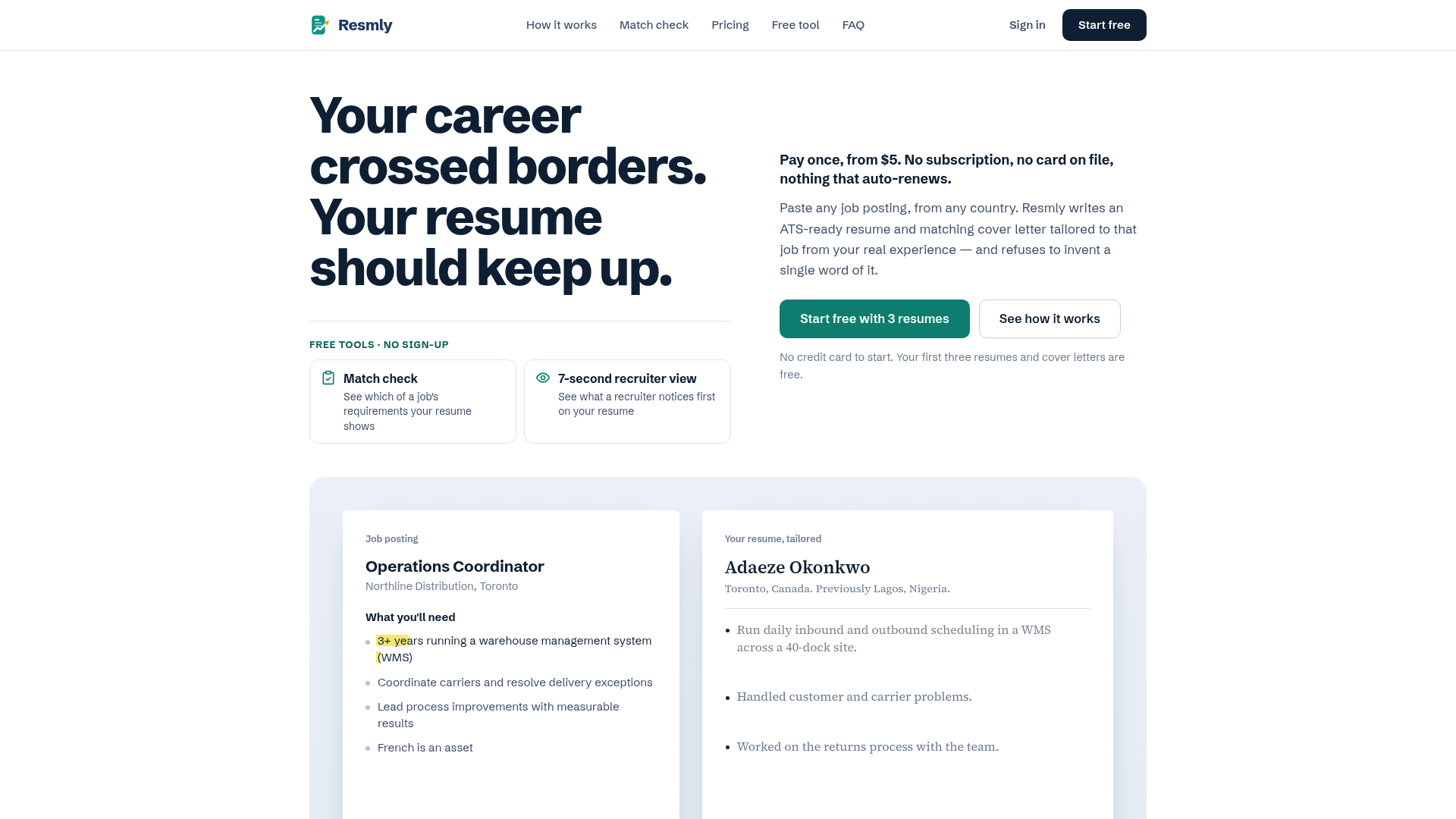
Resmly is an AI-powered resume and cover letter tailoring platform designed for global job seekers who need to adapt their applications to specific job postings while maintaining complete honesty. Its core positioning is a practical, credit-based tool that turns a user's real experience into an ATS-ready resume and matching cover letter for any role, industry, or country. The target audience includes international candidates, career changers, skilled immigrants, and active job seekers applying across borders who want to avoid subscriptions and generic templates. Core features include a one-time profile builder, job posting analysis, tailored resume generation, matching cover letters, ATS score and gap analysis, PDF/Word export, and application tracking. Content features emphasize transparency: Resmly never invents employers, titles, dates, numbers, degrees, certifications, or inflated seniority; every rewritten line traces back to user-provided facts. User experience is streamlined: start free with three generations, no credit card, paste a job posting, review output in about a minute, edit without paying twice, and use free no-signup tools like Match Check and 7-second Recruiter View. Technical features include browser-side file reading for the free tools, AI-driven grounding checks, ATS parsing compatibility, single-column layout, priority processing on higher tiers, and 12-month credit validity. Pricing is flexible and non-subscription: free initial credits plus one-time Starter, Growth, and Pro packs from $5 to $16.99.
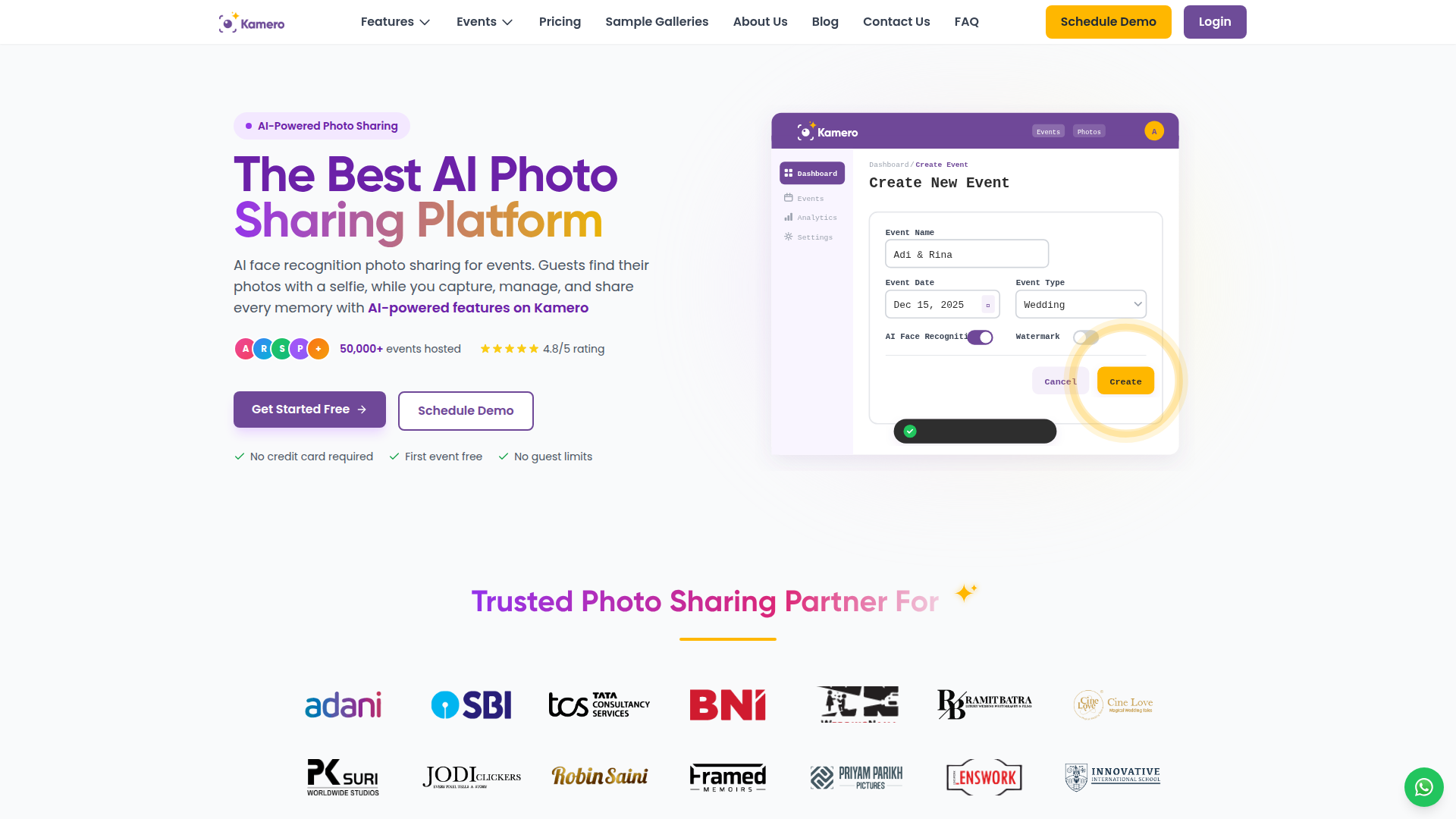
Kamero is an AI-powered photo sharing platform designed for events, with face recognition at its core. Positioned as a smarter alternative to traditional gallery delivery and subscription-only photo-sharing tools, Kamero serves photographers, event organizers, institutions, corporate teams, schools, colleges, and live event promoters. Its target audience includes wedding photographers, studios, event managers, and brands that want faster photo delivery, stronger engagement, and measurable lead generation. Core features include AI face recognition that lets guests find photos with a selfie, dedicated guest uploads, photo shortlisting, watermarking, multi-level privacy access, custom app notifications, video link integration, Kam-Sync live camera uploads, and AI image enhancement. Content features include sample galleries, event-category pages, a blog, FAQs, free image tools, and resources for photographers. User experience emphasizes instant access without forced guest sign-ups, QR-code entry, mobile and web viewing, and simple four-step event setup. Technical features include real-time face indexing, bulk and background uploads, desktop apps, privacy PINs, automated invoicing, branded QR codes, custom domains, and whitelabel app development. With 50,000+ events hosted and 200M+ faces scanned, Kamero focuses on seamless, privacy-first, brandable event memory sharing.
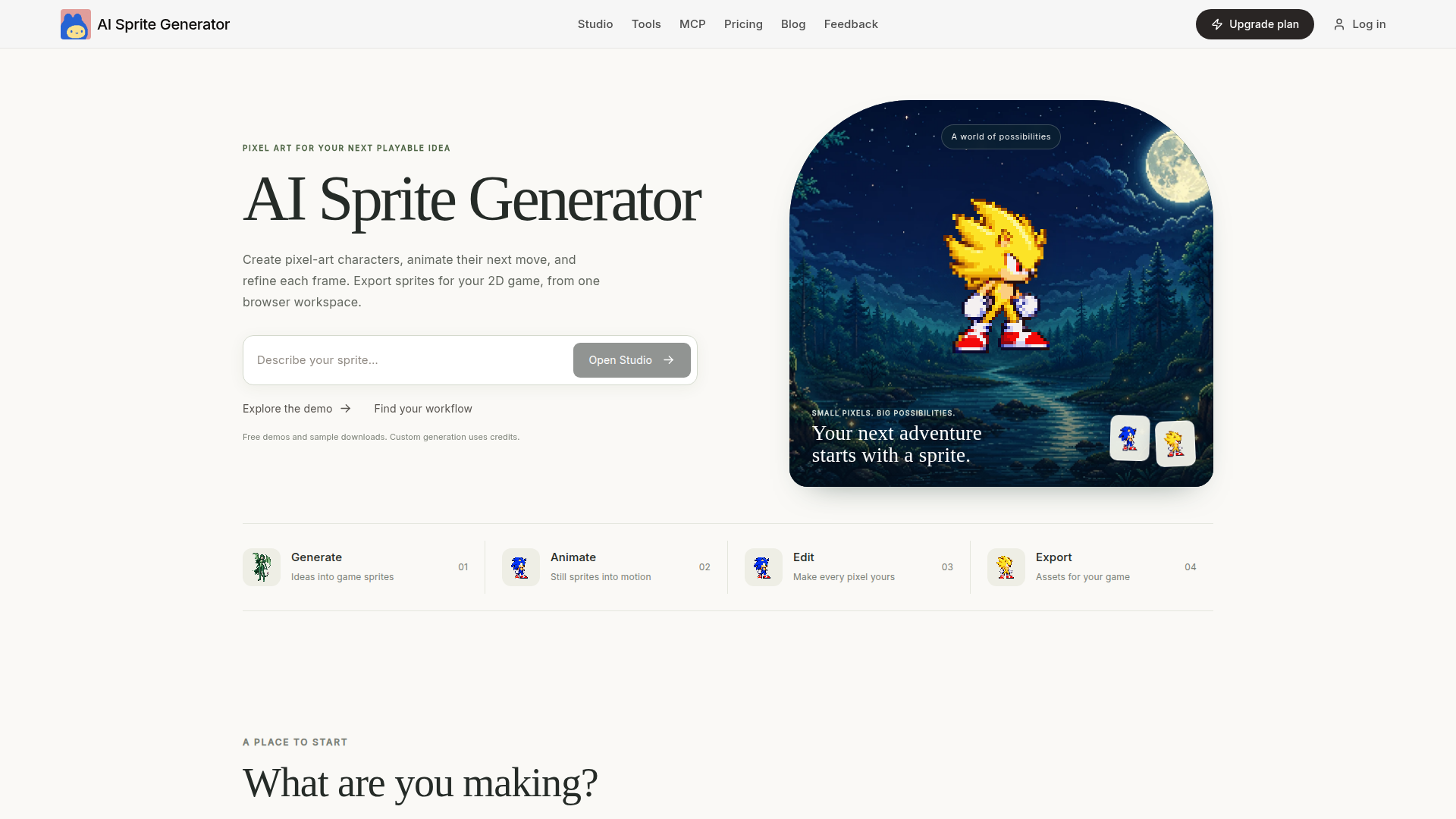
AI Sprite Generator is a browser-based creative workspace for producing pixel-art sprites and animations for 2D games. Positioned as an end-to-end studio for indie developers, game jam participants, and small studios, it combines AI character generation, sprite animation, pixel-level editing, and asset export in one place. Target audiences include solo developers, hobbyists, prototyping teams, and creators using engines like Unity, Godot, and GameMaker. Core features include text-to-sprite generation with adjustable canvas size, perspective, and style references; idle, walk, and attack animation previews; an in-browser pixel editor with brush, eraser, color, and reset controls; PNG, sprite sheet, and GIF exports; and MCP integration for Claude Code, Codex, and Cursor. Content features include interactive demos, sample prompts, downloadable sample assets, guides, and a blog. User experience emphasizes quick iteration: describe a character, generate, animate, refine, and export without leaving the browser. Technical features include a credit-based system, API key access, JSON frame data, ZIP exports, and engine-ready PNG sheets. The site offers free demos and sample downloads, while custom generation requires an account and credits, with subscription and one-time pack options.
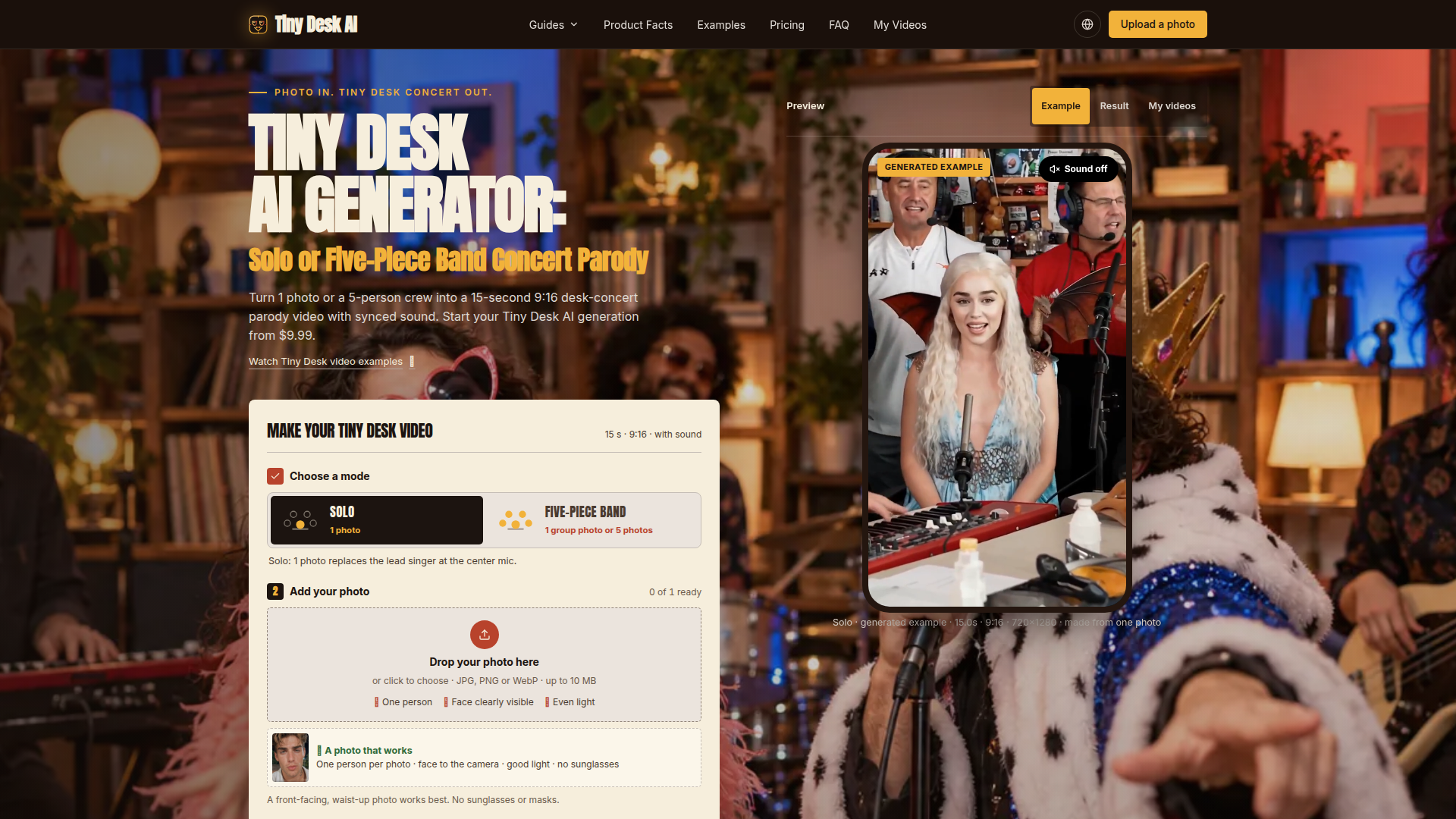
Tiny Desk AI is a specialized AI video generator that transforms 1 to 5 photos into a 15-second 9:16 vertical parody video of the viral Charlie Wilson Tiny Desk concert performance of 'Outstanding'. Positioned as a dedicated tool for the TikTok and social media trend, it targets solo creators, groups of friends, office teams, and anyone wanting to create personalized concert parodies without editing skills. Core features include Solo mode (1 photo) and Band mode (up to 5 people), authentic live audio, shot-by-shot recreation of camera angles, and a watermark-free MP4 output. The service emphasizes one-time pricing with no subscription, starting at $9.99 per video, with credits that never expire and automatic refunds for failed renders. Content features extensive guides, tutorials, comparisons, and meme lore to educate and engage users. The user experience is streamlined: choose a mode, upload photos, and download the video in under 4 minutes. Technically, it uses advanced AI for face mapping and audio synchronization, ensures privacy with 24-hour photo deletion, and processes payments via Stripe. Tiny Desk AI is an independent parody tool, not affiliated with NPR or Charlie Wilson.
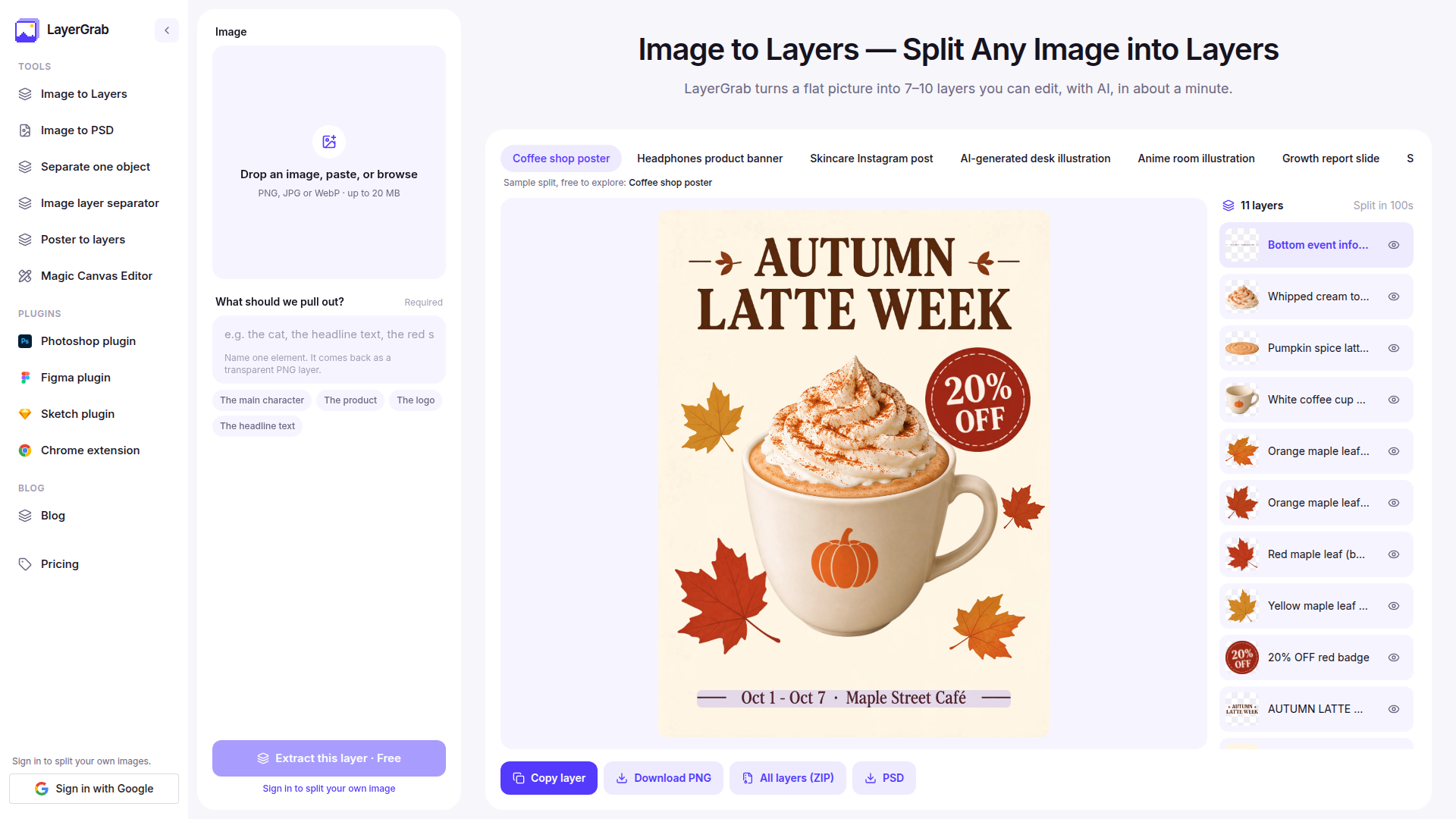
LayerGrab is an AI-powered image-to-layers web application that turns a single flat picture — a poster, product banner, ad, screenshot or AI-generated illustration — into a stack of editable, individually named transparent layers in roughly one minute. Its Website Positioning is a productivity and reverse-engineering tool for visual designers: instead of manually cutting elements out of a flattened file, users upload a PNG, JPG or WebP (up to 20 MB), and the AI identifies every distinct element, returns each one as a transparent PNG on its own layer, and reconstructs the background behind it so nothing leaves a hole when an element is moved. Each layer is labelled in plain English (for example “Yellow Price Tag $129” or “Mint green adjustable desk lamp”) rather than “Layer 1”, so users can find what they need instantly. Output is flexible: copy a single layer to the clipboard for Figma, Photoshop or Canva, download one layer as PNG, or export the whole stack as a ZIP of transparent PNGs or a fully layered PSD. Its Target Audience is designers, marketers, social media creators, e-commerce teams and small shops who work with assets they did not create and no longer have the source file for — stock graphics, client deliverables, competitor ads, AI images and screenshots. Core Features include a browser-based splitter, a “Separate one object” mode where you name the element you want, a dedicated Image-to-PSD pipeline, a poster-to-layers workflow, a Magic Canvas Editor, and native plugins for Photoshop, Figma and Sketch plus a Chrome extension that splits any image on the web from a side panel using the same account and credits. Content Features include a large gallery of real, verifiable splits (coffee shop poster with 11 layers, sportswear flat-lay with 16 layers, growth report slide with 12 layers), a blog with comparisons and guides such as the Canva Magic Layers alternative, LlamaGen and Qwen-Image-Layered write-ups, and localised pages in Japanese, Spanish, Portuguese, Russian, Korean and Traditional Chinese. User Experience is deliberately frictionless: no sign-up is needed to explore the sample splits, the workflow is a four-step upload–split–pick–export loop, and a free split is included with every account. Technical Features include AI segmentation and inpainting-style background fill, deterministic layer naming, export to PNG/ZIP/PSD, plugin integrations that insert layers as a named group in one undo step, and honest documentation of limitations such as lost cast shadows and non-editable text layers. The site also compares itself favourably with Canva Magic Layers by supporting larger images, PSD/ZIP export and desktop design tools.
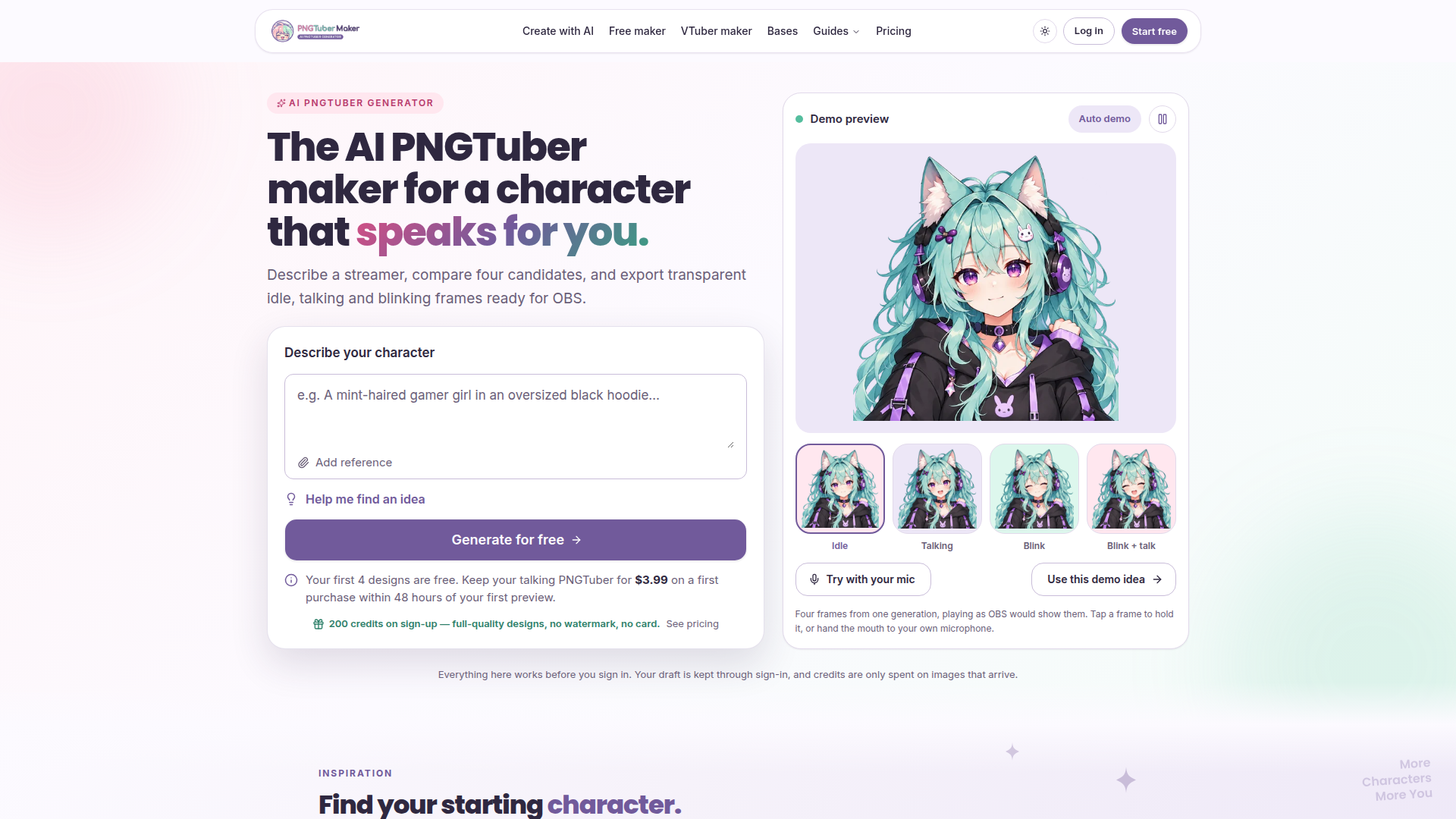
PNGTuber Maker is a browser-based AI generator that turns a written description or a reference image into a fully stream-ready PNGTuber character. Rather than a full rigged VTuber avatar, it specialises in the lightweight PNGTuber format popular with streamers: four matching transparent PNG frames (idle, talking, blinking, and talking-plus-blinking) that can be dropped into OBS or Streamlabs as Image sources and driven by a free audio-reactive plugin. The workflow is deliberately short — describe your character or pick an inspiration preset such as panda hoodie, soft goth or cool wolf girl, compare four AI-generated candidate designs, choose a favourite, and export a four-frame pack at 1024×1024 with a consistent size so the frames line up with no manual alignment. Its target audience is streamers, content creators, YouTubers, Twitch and TikTok Live personalities, Discord community users and hobbyists who want a custom on-screen persona but have no drawing skills, no budget for commissioned art and no patience for complex rigging software. Core features include text-to-character prompting, reference-image upload with 'Inspired by it' or 'Keep the likeness' modes, an in-browser microphone test that animates the mouth from live voice loudness, an expression collection of up to 24 editable states per character built from eyes, brows, mouth, cheeks and effects chips, a character history for remixing earlier designs, and transparent no-watermark commercial-use exports. Content-wise the site mixes the generator itself with a practical knowledge hub — guides on how to make a PNGTuber, adding a PNGTuber to OBS, PNGTuber versus VTuber comparisons, and a what-is-a-PNGTuber primer — plus a browsable gallery of real outputs. User experience is unusually honest and friction-light: prompting, styles, reference uploads, the mic test and a watermarked talking preview all work before you sign in, your draft survives sign-in, every credit cost is displayed before you confirm, failed generations are refunded in full, and there is no subscription lock-in. Technically it is a pure web application with no install required, using a server-side AI image provider for generation while all microphone processing stays local in the browser, so audio is never recorded, stored or transmitted. Pricing is credit-pack based and one-off rather than recurring: 200 free credits on sign-up, a first-purchase offer of 400 credits for $3.99 within 48 hours of your first preview, and larger packs such as the $9.90 Starter pack, with credits never expiring and one finished character working out at roughly $2.38.
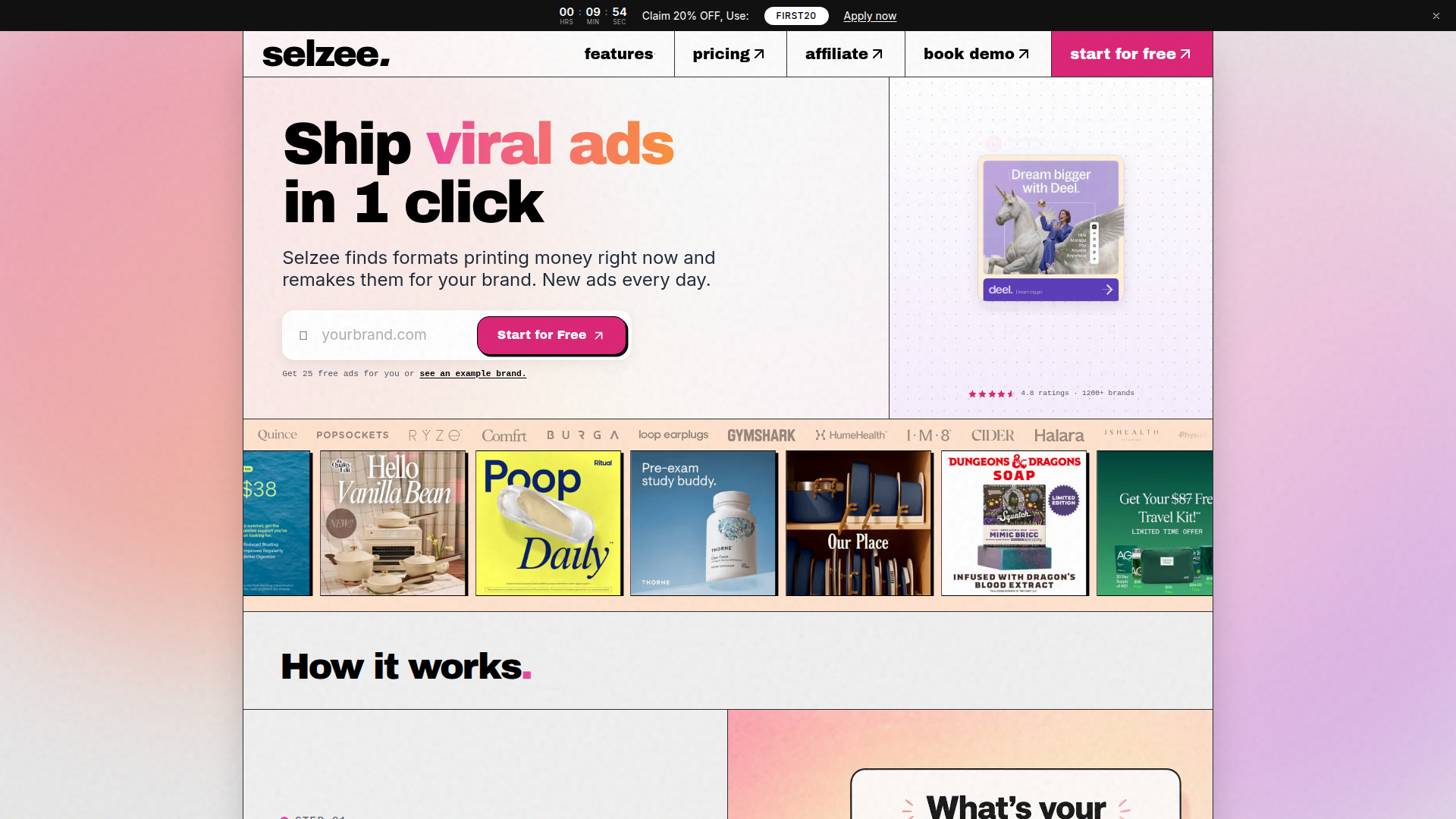
Selzee is an AI ad generator built specifically for ecommerce and DTC brands, apps and local businesses that need far more creative than their team can produce. Its positioning is deliberately narrow and practical: instead of generating generic "AI ideas", Selzee does the creative research first — scanning the market, competitors and ad libraries to find the static ads that are winning right now — and then remakes those proven formats for your brand, shipping new ads every day. You start by simply dropping your website URL; Selzee reads your logo, colours, fonts and products straight from your site, so every output is already on-brand without a designer in the loop. On the content side, each ad is recreated with its own angle, offer, review or headline, and the platform shows the original creative alongside its proof: start date, how long it ran, which platforms it appeared on, how many variations it scaled to and an estimated CPM. Users approve the ads they like, edit any headline, colour or product shot by asking in plain language, then ship approved creatives to Meta, Instagram, TikTok and Pinterest in one click or schedule them as organic posts. The user experience is intentionally lightweight: onboarding is a single URL field, a public gallery shows real ads shipped for real brands, and a library of free tools such as a break-even ROAS calculator, CTR and CPM calculators, image resizers and hook generators sits alongside the core product. Technically, Selzee runs a daily-refreshing library of winning ads, learns from the creatives you reject, exposes an MCP server so it can be used inside Claude and ChatGPT, and integrates with Shopify as well as Google Cloud, Microsoft and NVIDIA partner programmes. With a free starting tier, credit-based subscription plans from $75/month for one brand through to custom enterprise pricing, it fits solo founders, growing DTC teams and agencies managing many client brands.
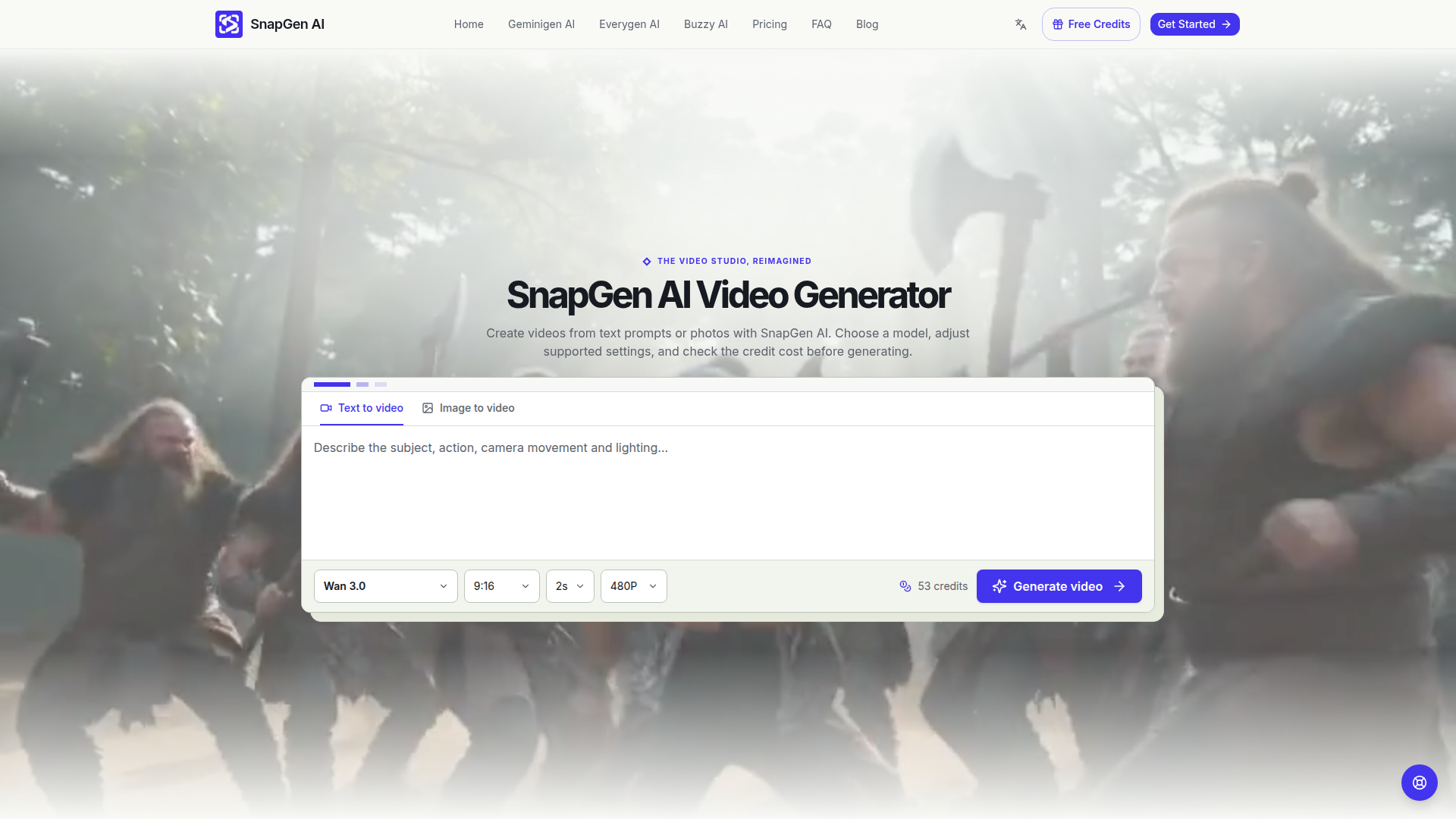
SnapGen AI (snapgenai.io) is a browser-based AI video generation studio that turns text prompts or still photos into short, cinematic video clips without any editing software or installation. Positioned as an accessible, credit-based creative tool for the AI video era, the platform lets anyone move from an idea to a downloadable clip in three steps: write a prompt or upload a starting image, choose a video model and settings, then generate, preview and download. Its target audience spans social media creators, short-form video producers, marketers, indie storytellers, designers prototyping concepts, and curious newcomers exploring generative AI for the first time. Core features include text-to-video generation (guided by subject, action, lighting and camera movement), image-to-video animation where a photo becomes the first frame, and support for multiple leading models such as Wan, Veo, Seedance and Grok Imagine, each with its own duration, resolution, aspect ratio and reference-image limits. A transparent credit system is central to the experience: the exact credit cost is displayed next to the generate button before submission, and users can claim free daily check-in credits (8/8/8/12/8/8/12, totaling 64 credits across seven consecutive days) or purchase one-time packs and subscription plans. Content features include a curated video gallery for inspiration, illustrated creation guides, practical blog posts on free credits and video cost calculation, and scenario-based use cases such as cinematic storytelling, travel and landscape footage, and urban atmosphere shots. The user experience is designed around experimentation and budget awareness — adjust settings, review the quoted cost, and refine one part of the prompt at a time. Technically, SnapGen AI runs entirely in the browser, supports PNG, JPEG and WebP uploads up to 4 MB each, automatically enables sound on compatible models (Veo 2 is silent), refunds credits for confirmed failed or canceled tasks, and reminds users to download results since provider links may expire. Commercial use depends on model terms, applicable law and input rights, and SnapGen AI states it does not guarantee exclusive copyright or third-party clearance.
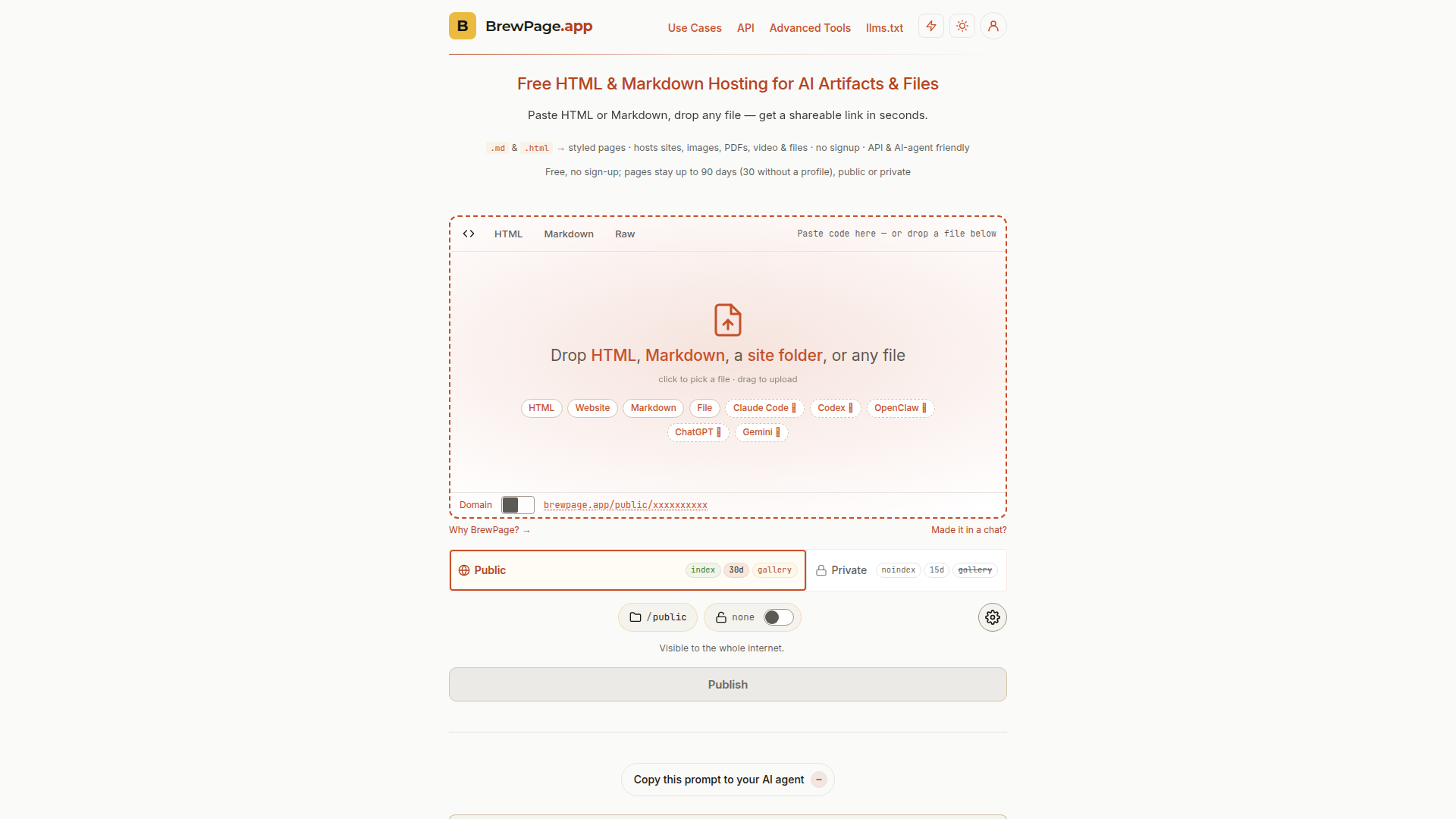
BrewPage is a free, instant hosting service for HTML, Markdown, and files, purpose-built for AI-generated artifacts and rapid sharing. Its positioning is zero-friction publishing: paste HTML or Markdown, drop a file or site folder, or call an API, and get a shareable HTTPS link in seconds. The target audience includes AI users, developers, prompt engineers, data scientists, students, educators, no-code creators, and teams that need to share reports, demos, dashboards, documentation, and AI outputs without setting up a repository or account. Core features include HTML and Markdown rendering, multi-file ZIP site hosting, 60+ file types such as images, PDFs, Office documents, video and audio, password protection, public or private namespaces, customizable TTL from 15 to 90 days, KV and JSON storage, a REST API, an MCP server, a Claude Code skill, and an OpenAPI spec. Content features include AI-agent prompt snippets, platform comparisons, usage guides, FAQ sections, API references, and a public gallery. User experience is mobile-friendly and account-free, with clear publish settings, owner tokens, management links, view stats, and optional profiles for longer storage. Technical features include free HTTPS hosting, API-first automation, MCP and agent integrations, S3-compatible file storage, rate limits, and flexible privacy controls.
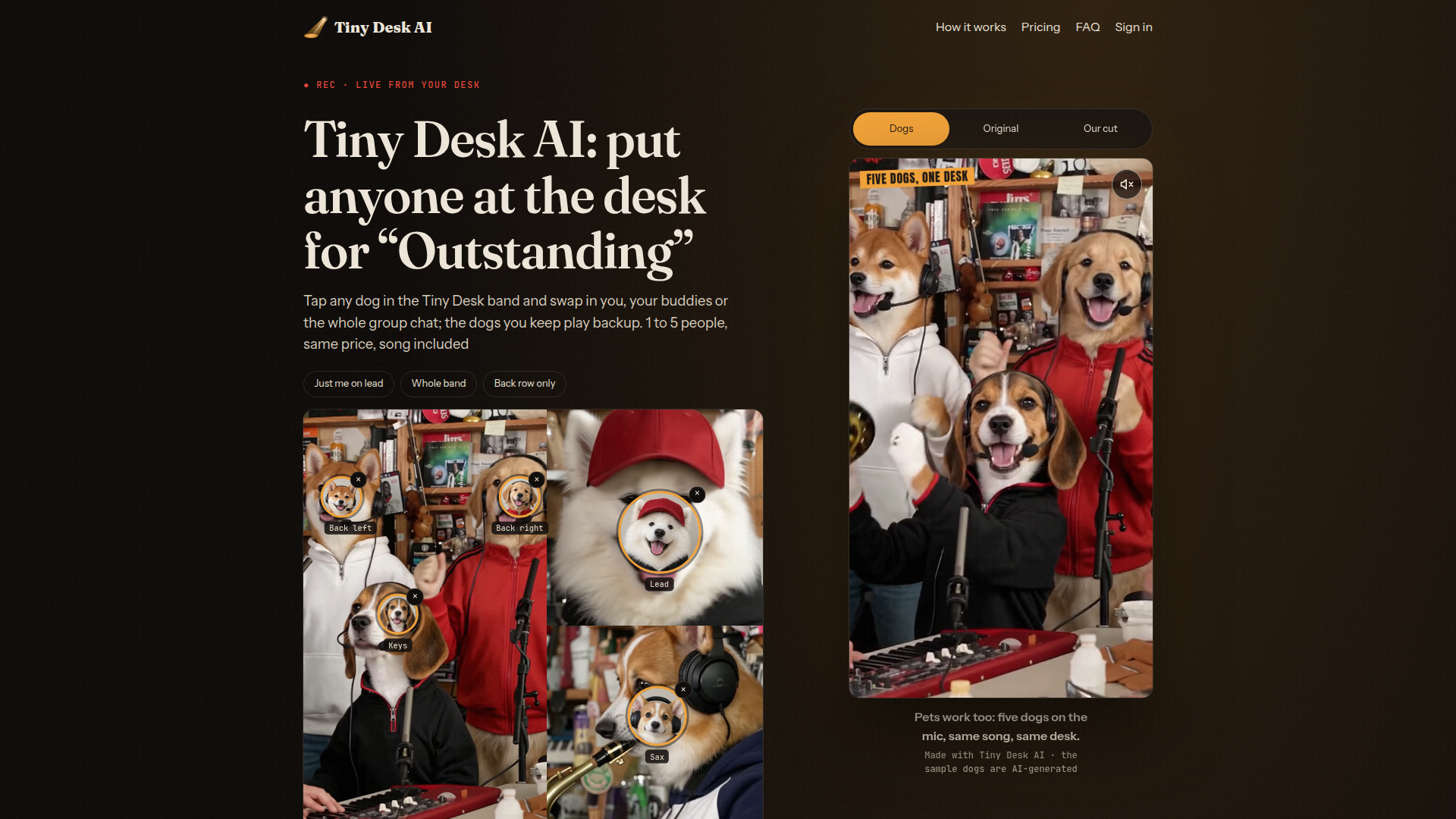
Tiny Desk AI is a specialized AI video generator and fan-made meme tool for creating parody videos based on the viral “Outstanding” Tiny Desk trend. The site lets users place themselves, friends, coaches, players, celebrities, or group-chat members into an approximately 18-second vertical 9:16 MP4 that recreates the last moments of Charlie Wilson's 2023 NPR Tiny Desk performance, including the band, the big laugh lead-vocal close-up, the sax solo, and the final band shot. Users tap any of five on-stage dog placeholders, upload one clear front-facing photo per spot, tick the parody confirmation, and generate the clip. Tiny Desk AI is aimed at TikTok and Instagram creators, sports fans, meme pages, friend groups, and anyone who wants a quick viral-style parody without editing skills. Core features include one-to-five-person casting at the same price, face swapping into lead vocals, sax, keys, and two backing spots, Kuaishou Kling 4.0 edit-mode rendering at 720p, automatic inclusion of the “Outstanding” song, a silent backup copy for platforms that mute audio, no watermark, and credits that never expire. The workflow is intentionally simple: no CapCut, template file, or prompt is required. Videos usually render in 7–10 minutes, and users can close the tab and return later. Pricing is one-time, with packs of 1, 3, or 10 videos; failed renders refund credits automatically. The site emphasizes parody, requires all subjects to be 18 or older, asks users not to present videos as real, and states it is an independent fan tool not affiliated with NPR, Tiny Desk Concerts, Charlie Wilson, or The Gap Band.
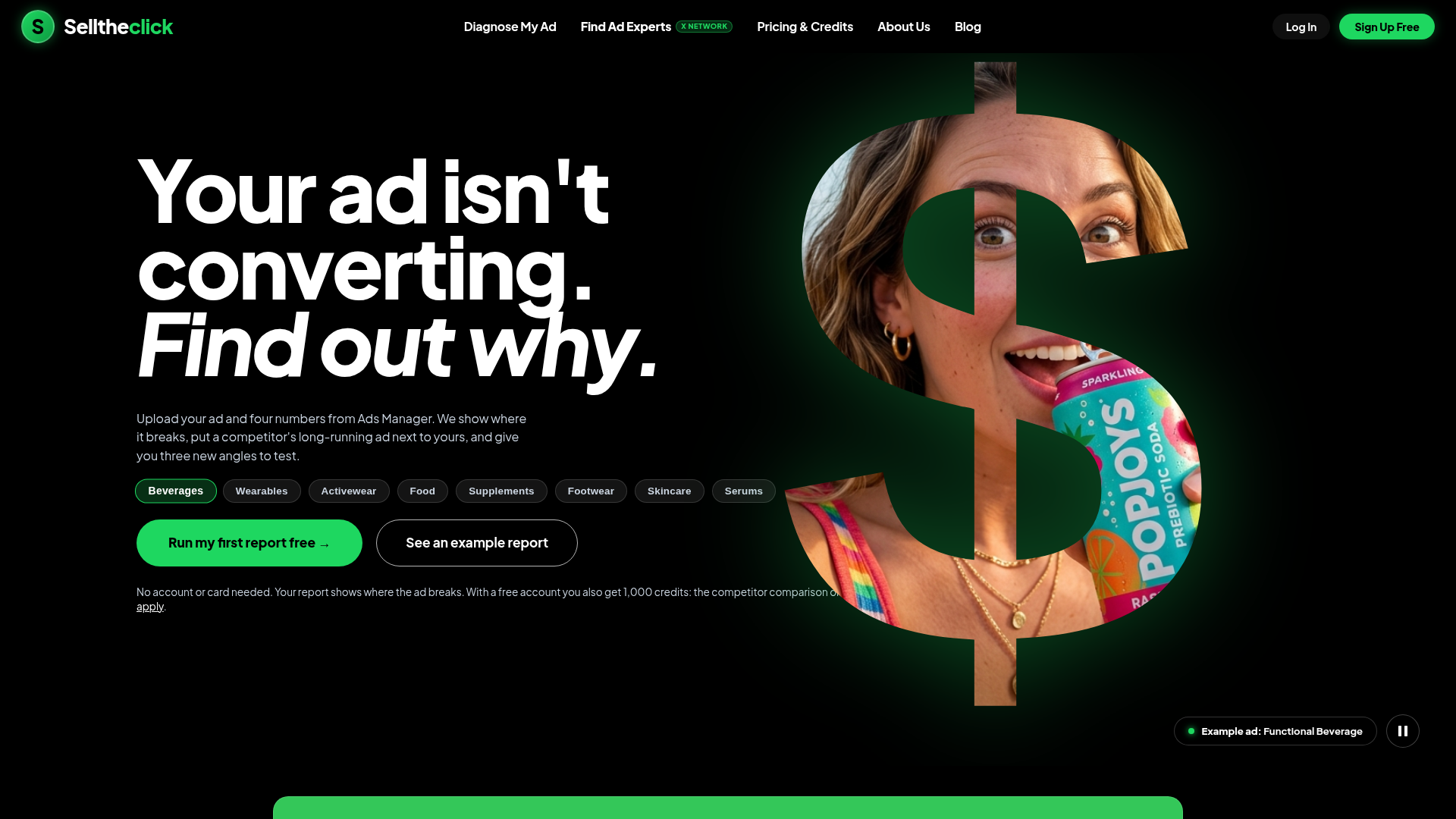
SellTheClick is an AI-powered ad diagnosis platform designed for direct-to-consumer (DTC) brands, ecommerce founders, and performance marketers who need to understand why their ads are not converting. Positioning itself as a 'DTC Creative Intelligence Player,' it goes beyond traditional analytics by combining the user's own ad metrics with real competitor ads and buyer insights. The core workflow is simple: upload your ad and four key numbers from Meta Ads Manager. The tool then identifies where the ad breaks—before the click, after the click, or on price—using benchmarks from Triple Whale's 40,000+ ecommerce brands. It pulls a competitor's longest-running live ad from Meta's Ad Library and compares hooks, angles, offers, and calls to action word-for-word. It also surfaces real buyer questions from Reddit and Google searches, quoted verbatim, to highlight messaging gaps. Users receive three new angles to test, each with an opening line, required proof, and a test plan. Additional features include 'Survive Andromeda' (ad similarity check to avoid Meta treating variations as the same ad), 'Keep or Kill' (decide which ads to scale or pause), and 'Find Winning Angles' (see what competitors keep paying to run). The platform offers free reports with a free account, plus subscription plans for higher volume and advanced features. Content includes an extensive blog with direct-response guides, teardowns, and playbooks on topics like the 7-second hook rule, creative clustering, and Meta's Andromeda algorithm. Free tools include ROAS calculator, CPM calculator, ad similarity checker, and overspend checker. The user experience is built around quick, actionable insights with transparent methodology: every line is either measured from your numbers, quoted from a real ad, or clearly marked as AI interpretation. Technical features include integration with Meta Ad Library, Reddit, Google search data, and AI-driven analysis. The target audience includes DTC founders, creative strategists, media buyers, and agencies. SellTheClick aims to replace guesswork with data-driven creative decisions, helping brands scale winning ads and cut wasted spend.
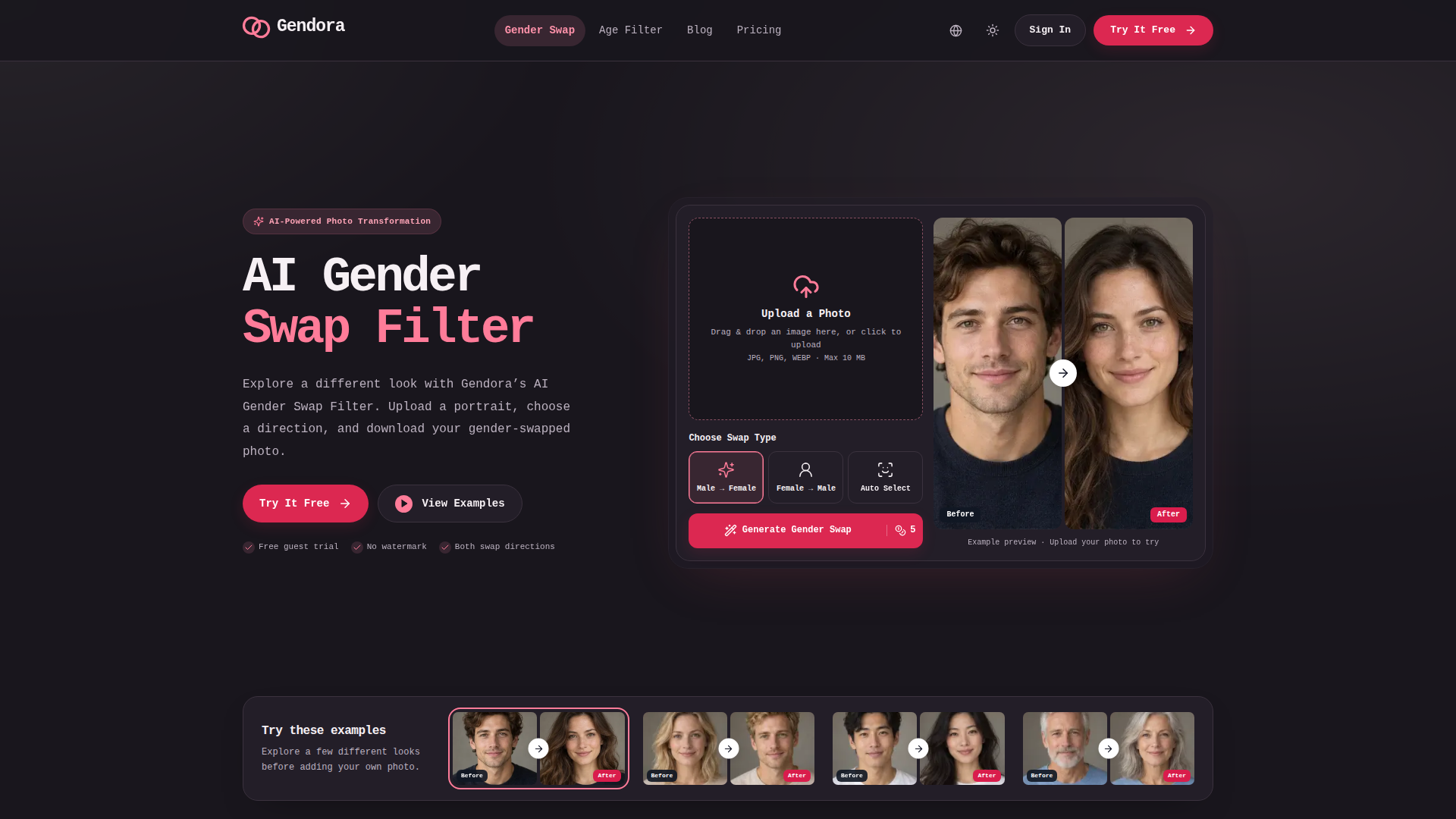
Gendora is a browser-based AI photo transformation studio whose flagship tool is an AI Gender Swap Filter that reimagines a portrait as a masculine or feminine version of the same person. Rather than applying a fixed face overlay like typical social-media camera effects, Gendora sends the uploaded photo and a chosen direction (Male → Female or Female → Male) to a generative image model that redraws facial features, hair, lighting, and surrounding details together while aiming to preserve identity, expression, and composition. Positioned as a lightweight, no-install creative utility, it targets casual users, cosplayers, writers, character designers, VTuber and avatar creators, couples, and social-content makers who want a fast, shareable "what if" portrait. Core features include drag-and-drop uploads of JPG, PNG, or WebP files up to 10 MB, an auto-select swap direction, an average model processing time of about 16 seconds, support for resolutions up to 3840 × 2160, free guest trials with no watermark, and a credit-based system where each standard edit costs 5 credits. Content-wise the site pairs the editor with curated before-and-after example galleries, an educational explainer on how generative gender swapping differs from social filters, use-case inspiration blocks (couples, siblings, cosplay, fictional characters, campaign concepts), and a companion AI Age Filter, plus a blog, FAQ, and clearly published privacy, terms, and cookie policies. User experience is deliberately minimal: a single-page flow of upload, choose direction, generate, download, with reassurance messaging about user control and a 7-day photo retention policy, no model training on user images, and no required app install. Technically the service is cloud-hosted, model-agnostic in presentation, credit-metered, and privacy-forward, though results vary with photo quality and no strength slider or person selector is offered, so results are framed as imagined appearances rather than real-world predictions.
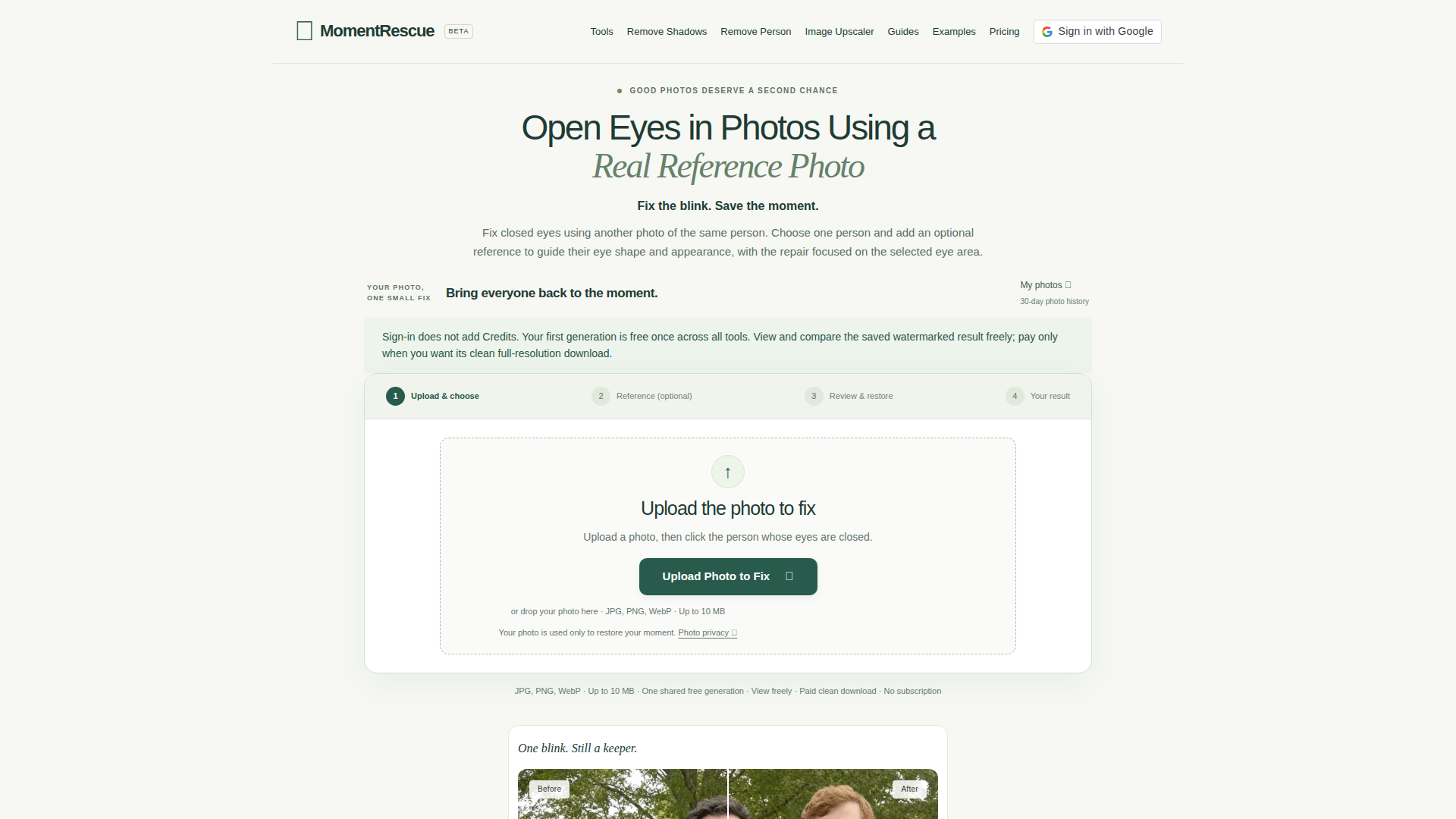
MomentRescue is an AI-powered online photo rescue toolkit designed to save otherwise perfect photos from small, frustrating flaws like closed eyes (blinks). Its flagship Open Eyes tool uses artificial intelligence together with an optional real reference photo of the same person to repair closed eyes while keeping the original expression and identity as intact as possible. The website positions itself as a browser-based, no-app solution for anyone who has captured a meaningful moment but discovered that someone blinked. Target audiences include families, friends, event attendees, wedding and graduation photographers, social media users, and anyone with valuable group shots, portraits, travel memories, or photos of children that cannot easily be retaken. Core features include Open Eyes, Remove Glasses Glare, Remove Shadows, Remove Person from Photo, AI Image Upscaler, and Remove Stray Hair. Each tool offers a shared free generation across all tools, watermarked preview, and paid clean full-resolution download using one-time Rescue Credits. Content features include step-by-step guides, before-and-after examples, a reference photo checklist, FAQs, and detailed privacy explanations. User experience is streamlined: upload a photo, select the person, optionally add a reference photo, generate, compare before and after, and download a new PNG. The process runs in desktop and mobile browsers, supports JPG, PNG, and WebP up to 10 MB, and stores photos privately for 30 days for account history. Technical features include in-browser face detection and final assembly, selective face crops sent to fal.ai for AI processing, Google sign-in, Stripe payments, no subscription, non-expiring credits, and a focus on localized eye-area repair rather than whole-face replacement. MomentRescue emphasizes honest limitations, privacy, and user control, making it a practical niche tool for rescuing blinks and other small photo defects.
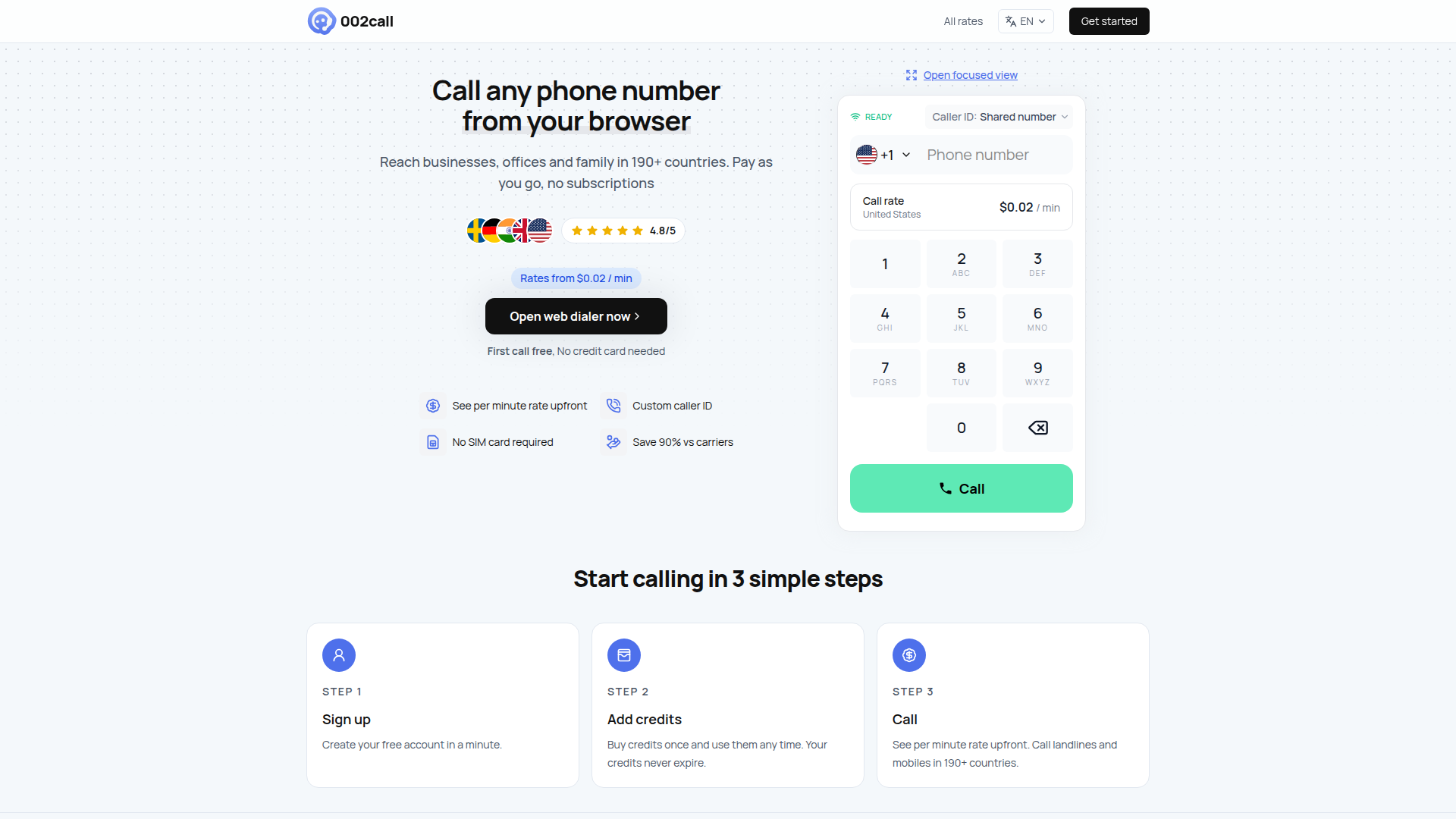
002Call is a browser-based international calling service that lets users place calls to landlines and mobile phones in over 190 countries directly from a web browser, without downloading an app, installing software, or using a SIM card. Positioned as a simple, pay-as-you-go alternative to traditional telecom carriers and free messaging apps, it focuses on reaching regular phone numbers such as banks, airlines, hotels, offices, and family members who may not use VoIP apps. Target users include travelers, expats, digital nomads, remote workers, small businesses, and anyone who needs affordable international calls from a laptop, tablet, or smartphone. Core features include a web dialer, upfront per-minute rates starting at $0.02/min, custom caller ID, a free first call, credit packages from $5, $10, and $20, non-expiring credits, a full refund guarantee, and 24/7 human support. Content features include country-specific calling pages, all-rates comparison, dialing guides, country codes, a time zone converter, blog resources, and alternative comparisons to Skype, Google Voice, Viber Out, Rebtel, and magicJack. The user experience is minimal: sign up, add credits, and call in three steps, with no setup and calls rounded to the nearest minute. Technically, 002Call uses WebRTC for real-time browser calling, encrypted protocols for privacy, and Stripe for secure checkout without storing payment details, while relying on the user's internet connection for call quality.

LanoX is a multi-model AI API platform that gives developers, AI application teams, and content creators unified access to leading AI models — including ChatGPT (GPT), Claude, Gemini, Grok, Qwen, DeepSeek, GLM, and NVIDIA Nemotron — through a single OpenAI-compatible API key. Instead of juggling separate provider accounts, keys, and invoices, users point their tools at the LanoX base URL (https://api.lanox.ai/v1), paste one API key, and keep their existing OpenAI-style request structure, so migration is mostly a one-line change. The platform spans text, image, and video models, and publishes transparent usage-based pricing in USD with no monthly fee and no subscription; select models are marked free, and promotional credits are offered under specific campaigns. A public catalog page lists every model plus discounts versus going direct to providers (up to roughly 87% off ChatGPT, 93% off Grok, 81% off Gemini, and about 70% off Claude, GLM, and DeepSeek tiers). LanoX is clearly built for technical users: integration documentation, Codex and Claude Code setup guides, and recommended CC Switch configuration make onboarding fast, while an enterprise path serves teams that need higher concurrency, dedicated models, or custom terms. A referral rewards program lets users earn uncapped, permanently linked commission when friends register and spend on paid models. Data privacy is a stated priority — prompts and responses are not stored and are never used for training, sale, or marketing. Headquartered by Hong Kong Yuanhua Network Technology Co., Limited, LanoX also lists offices in the UAE, Turkey, the USA, Hong Kong, and mainland China, with support reachable at [email protected].
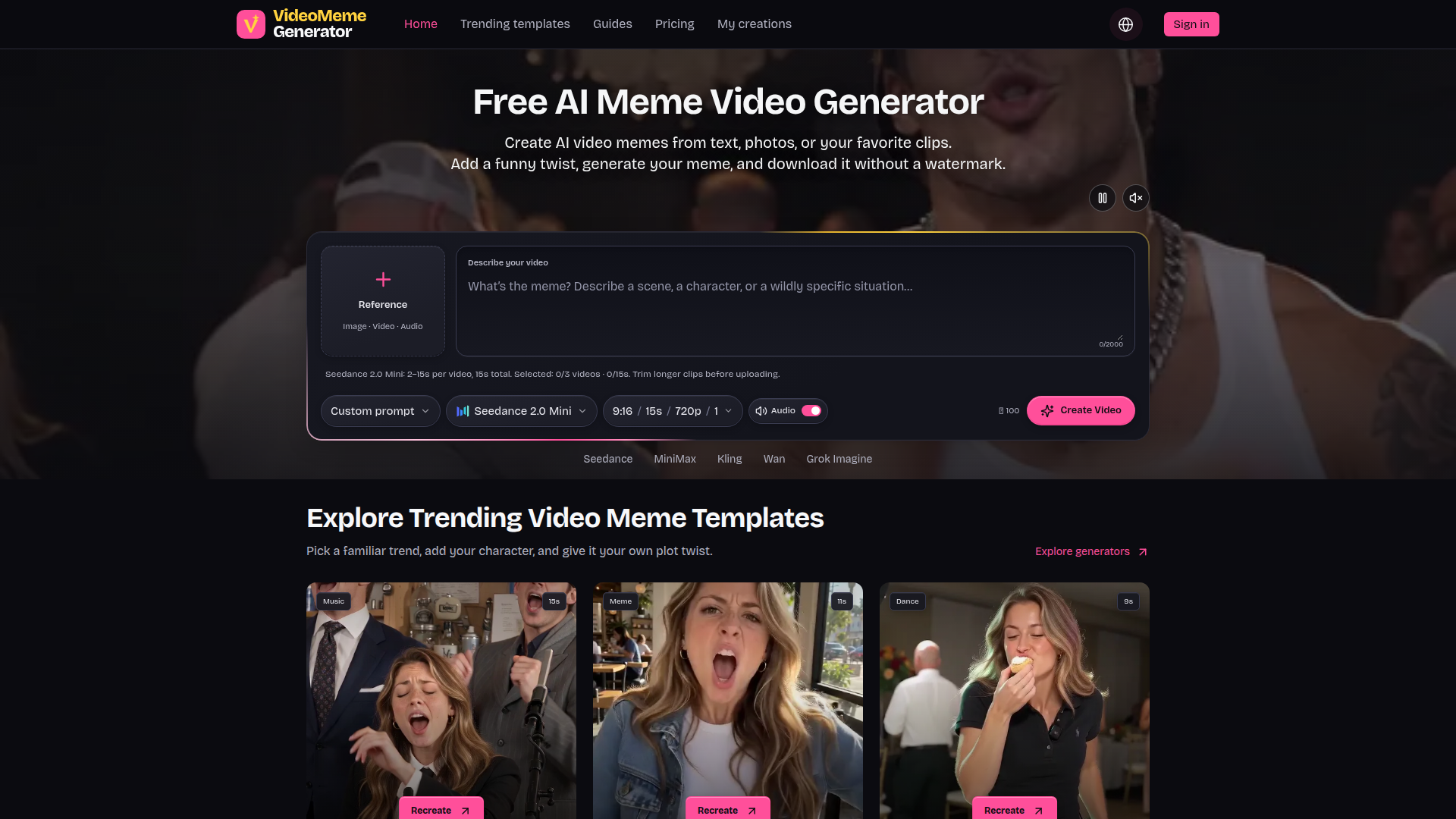
VideoMemeGenerator is a browser-based AI video meme creation platform that turns text prompts, photos, or short clips into shareable, watermark-free video memes. Positioned as a free-to-try, pay-as-you-go tool for casual creators, social media users, meme enthusiasts, pet owners, and small marketing teams, it removes the need for editing software or app installs. Core features include photo-to-video meme generation, clip remixing, text-to-video meme prompts, trending template recreation, and support for multiple AI models such as Seedance, MiniMax, Kling, Wan, and Grok Imagine. Users can upload JPG, PNG, or WebP images up to 10 MB, or MP4 clips up to 200 MB, then describe the action, reaction, and punchline. The platform offers regularly updated meme templates for dances, sports moments, rap trends, funny pets, and viral reactions. User experience is optimized for mobile browsers, making vertical videos for Reels, Shorts, and TikTok. Technically, generation runs in the cloud and usually completes in about three minutes; results appear in My creations. New accounts receive 10 welcome credits, and paid credit packs or optional subscriptions are available. Videos are downloadable without a watermark, and failed or canceled generations refund credits. Overall, it is an accessible, trend-driven AI video meme generator for anyone who wants to create funny, social-ready content quickly.
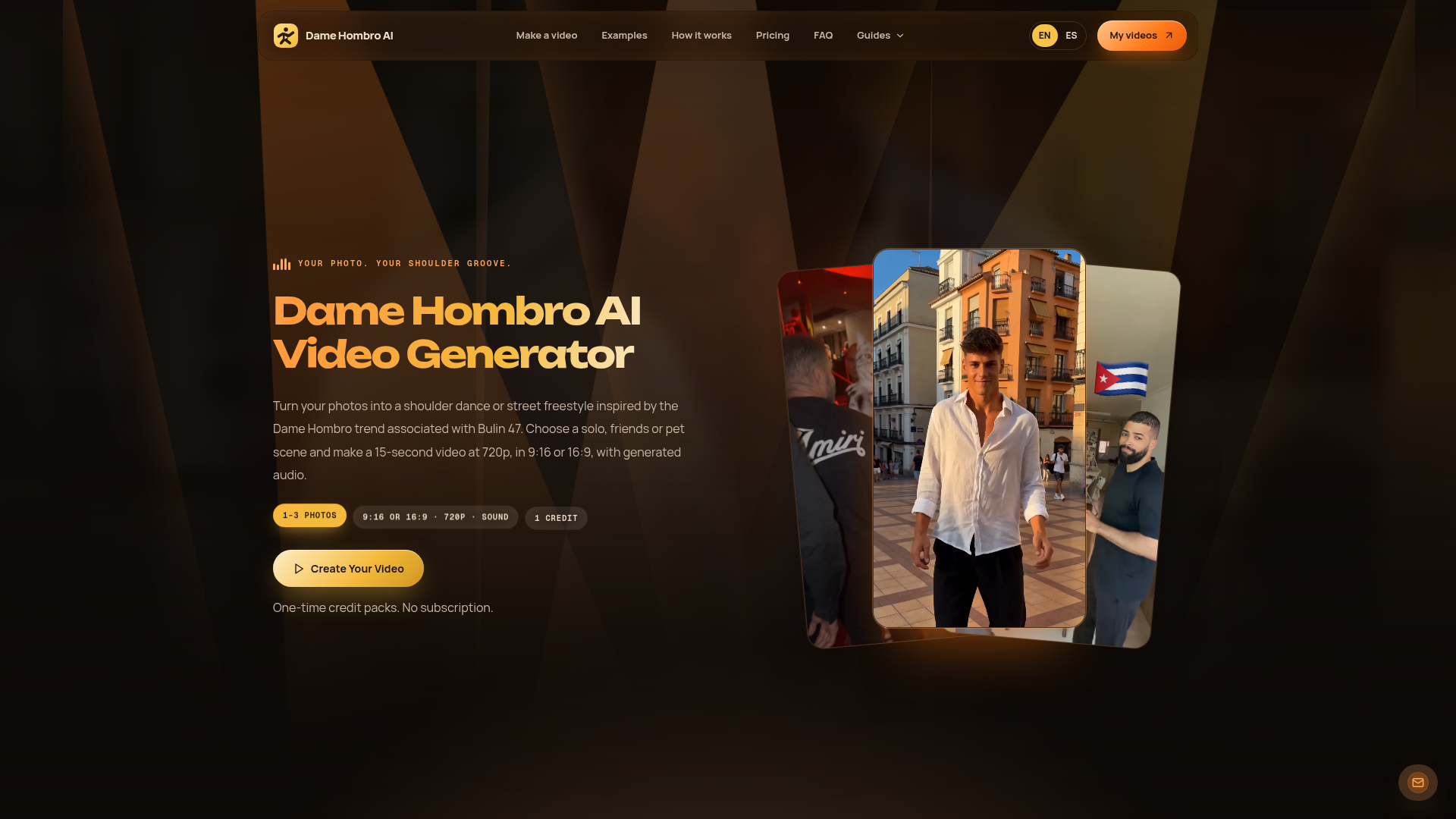
Dame Hombro AI is a specialized AI photo-to-dance video generator and creative studio built around the viral Dame Hombro shoulder-dance trend associated with Bulin 47. Positioned as an independent, browser-based tool for quickly producing short social-ready dance clips, it transforms ordinary portraits into 15-second, 720p videos with AI-generated instrumental and ambient audio. The target audience includes social media creators, meme and trend enthusiasts, friend groups, pet owners, and anyone who wants a personalized dance video without editing skills, artist footage, or an original song file. Core features include 14 scene templates (solo, friends, cat, dog, plaza, street, night freestyle, and Bulin 47-inspired presets), 9:16 vertical or 16:9 widescreen output, support for one to three photos per generation, labeled cast roles, and downloadable MP4 results. Content features include trend guides, photo tips, casting ideas, and a how-to walkthrough. User experience is streamlined: choose a template, sign in, upload photos, confirm consent, and generate. Technical features include automatic photo orientation correction, resizing, credit-based generation, and a My Videos library. Pricing is one-time credit packs with no subscription, and unused credits never expire.
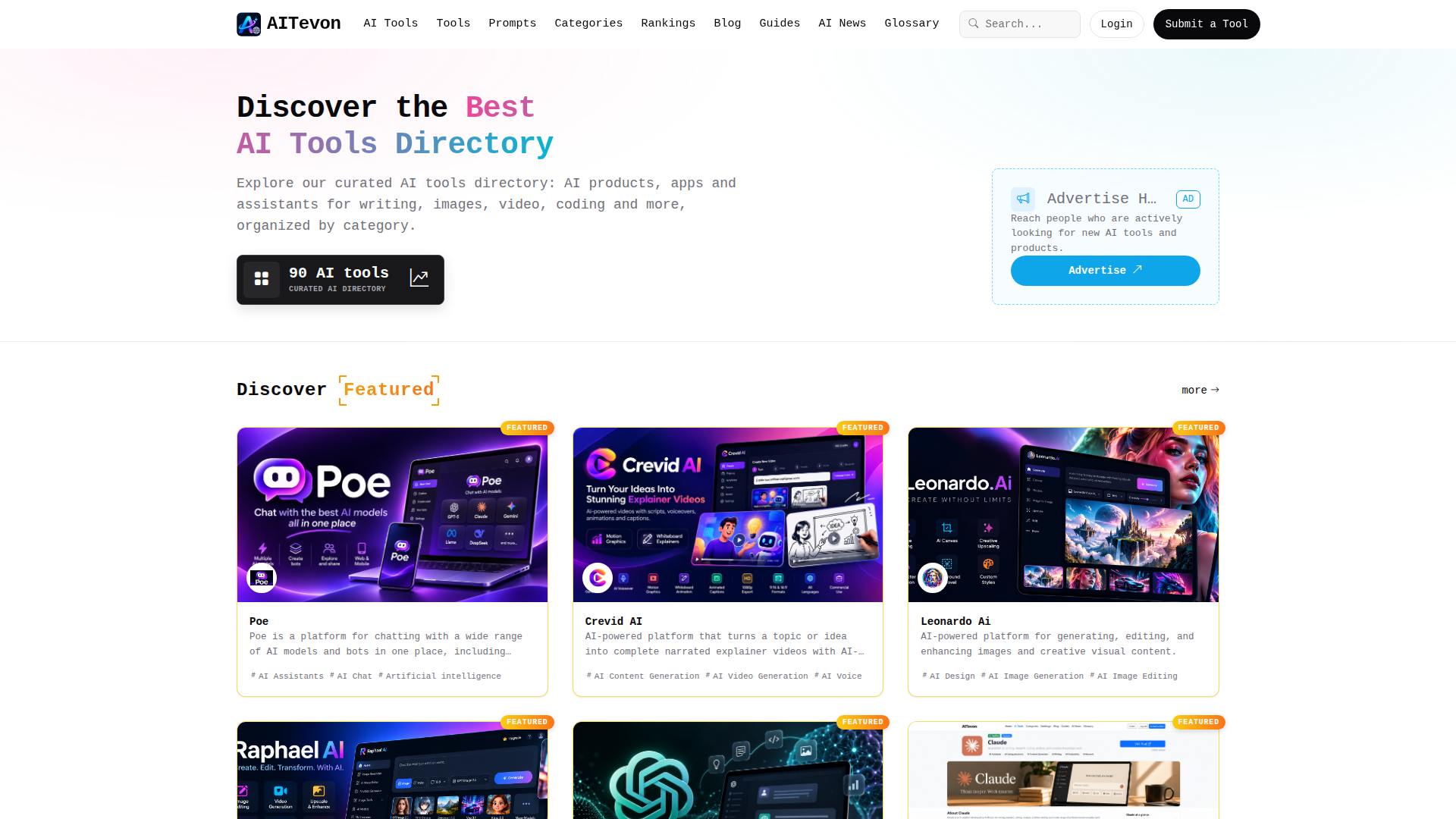
AITevon is a comprehensive and curated online directory dedicated to artificial intelligence (AI) tools, products, apps, and assistants. The website serves as a central hub for discovering the best AI solutions across various categories, including writing, image generation, video creation, coding, productivity, and more. With a focus on quality and usability, AITevon handpicks each tool, ensuring that users have access to reliable and innovative AI technologies. The platform is designed for a wide audience, ranging from individual creators, marketers, and developers to businesses and enterprises seeking to leverage AI for enhanced efficiency and creativity. Core features include an organized catalog, featured and trending sections, user-friendly search and filtering, detailed tool descriptions, and direct links to each tool's website. Content is regularly updated with new additions, ensuring users stay informed about the latest AI advancements. The user experience is streamlined, with intuitive navigation, category-based browsing, and a clean, modern interface. Technically, AITevon is a web-based platform optimized for performance and accessibility, requiring no downloads or installations. It also offers additional resources such as prompts, guides, blog articles, AI news, and a glossary, making it a one-stop destination for AI enthusiasts and professionals. The site encourages community engagement through tool submissions and advertising opportunities, fostering a dynamic ecosystem around AI innovation.
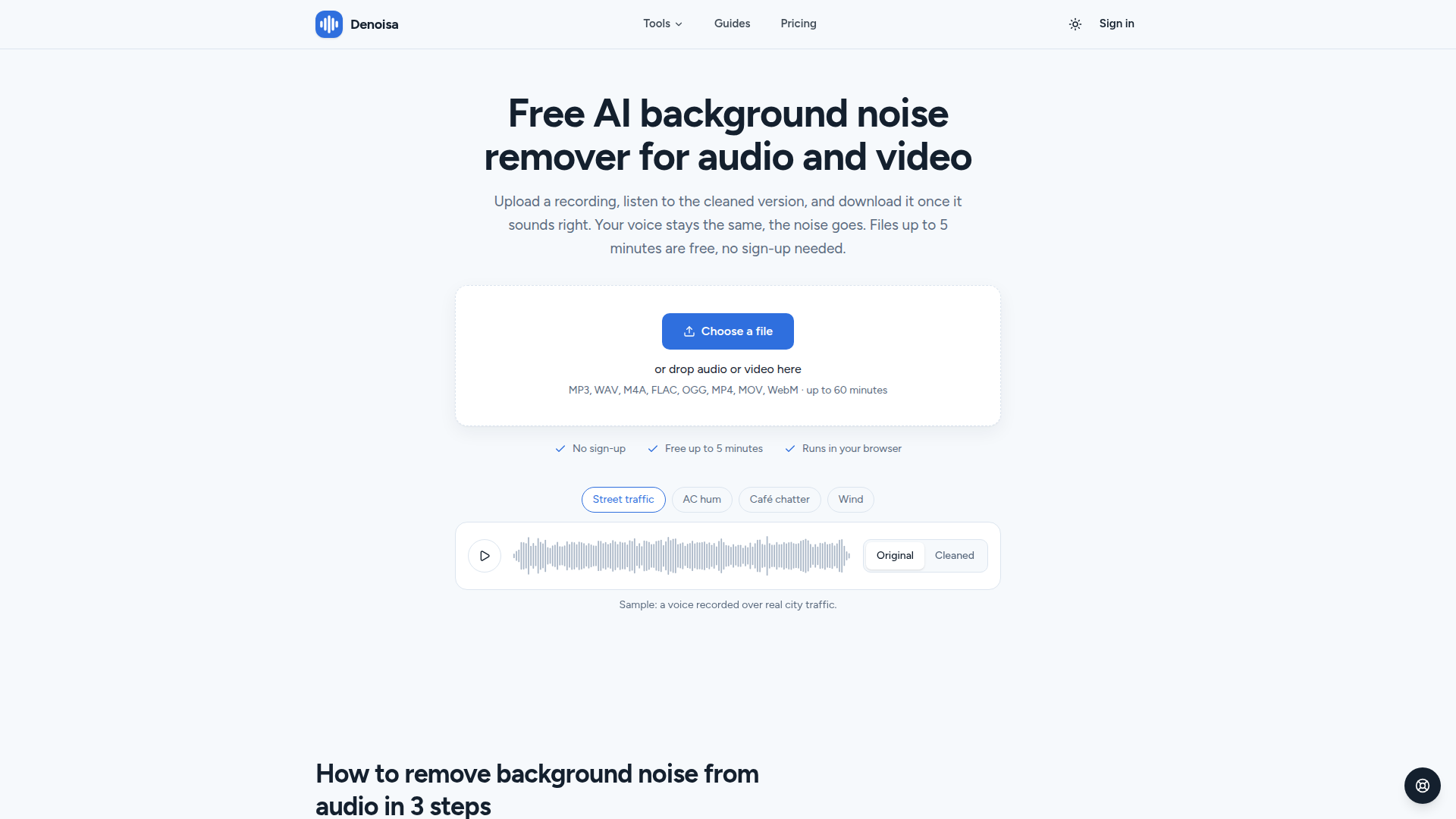
Denoisa is an AI-powered online tool that removes background noise from audio and video recordings. Positioned as a user-friendly, browser-based solution, it requires no software installation and offers a free preview without sign-up. The target audience includes video creators, podcasters, interviewers, and anyone who records audio in noisy environments such as streets, cafés, or home offices. Core features include one-upload noise removal, support for multiple audio and video formats, and a choice between Standard (browser-based, privacy-focused) and Enhanced (server-based, stronger) processing. Content features include step-by-step guides, comparisons with other tools, and real-world noise examples. User experience emphasizes simplicity, privacy, and fair billing with credits that never expire for packs. Technical features include AI models trained on speech, such as DeepFilterNet 3 for Standard mode, ensuring natural voice preservation. The tool runs in the browser, and for Enhanced mode, files are automatically deleted after 24 hours, ensuring privacy. Denoisa is ideal for cleaning up recordings from TikTok, YouTube, podcasts, interviews, and more.
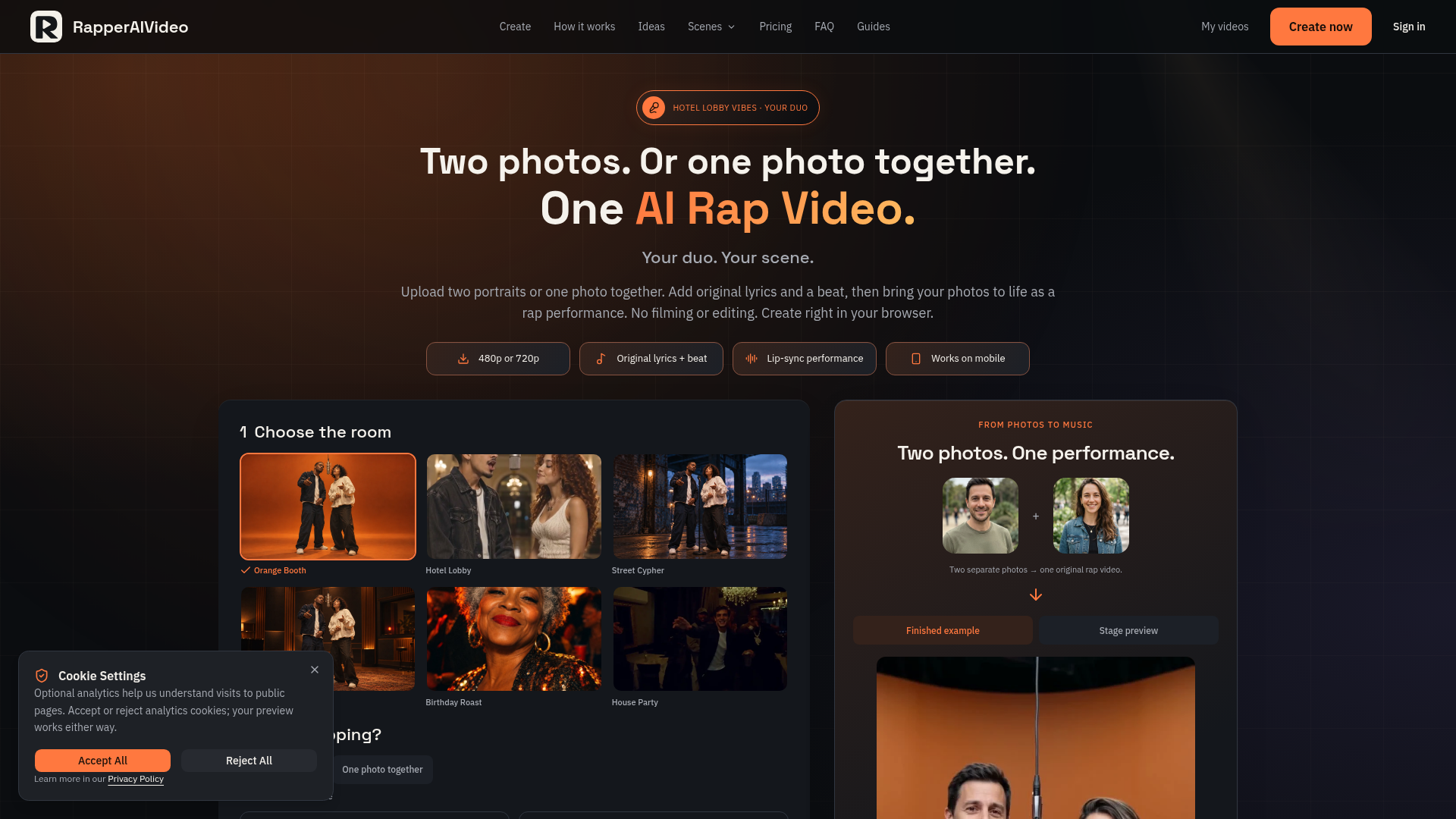
RapperAIVideo is a browser-based AI video studio that turns ordinary photos into short, original rap performances. Positioned as a consumer-friendly 'photo-to-rap-video' generator, it sits between novelty AI avatar apps and full music-video production tools: you upload one or two portraits, choose a themed rap scene, add lyrics or a beat, and receive a 5–15 second lip-synced performance without filming, casting, or editing. Its target audience is broad and social-first — friends, couples, families, teams, pet owners, and content creators who want a personalized video for a birthday, roast, anniversary, group-chat inside joke, or team win. Core features include six hand-built rap scenes (Orange Booth, Hotel Lobby, Street Cypher, Studio Booth, Birthday Roast, House Party), support for two separate selfies or one photo together, dedicated solo and pet performance modes, an original lyric-writing tool with occasion prompts (birthday shout-out, how we met, who cooks better, team win), original rap audio generation, optional user-supplied audio reference, and output in 480p or 720p at 5, 10, or 15 seconds in vertical (9:16) or landscape frames. Content features lean heavily on inspiration: an idea gallery with dozens of example performances, scene landing pages, a rap lyrics generator, a rapper name generator, blog guides, and a detailed FAQ. The user experience is a guided three-step flow — add your people, set the scene, drop your rap — with a free stage preview, a transparent credit quote before rendering, a saved draft, a My Videos library, and mobile-friendly downloading so clips can be posted directly to TikTok, Instagram Reels, YouTube Shorts, or a group chat. Technically, everything runs in the browser with no install, uses a credit-based render system with failed renders returning credits, and stores finished videos in an account library; current limits include 720p as the top resolution (1080p not yet on sale), 18+ photo subjects, and consent/permission confirmation at render time.
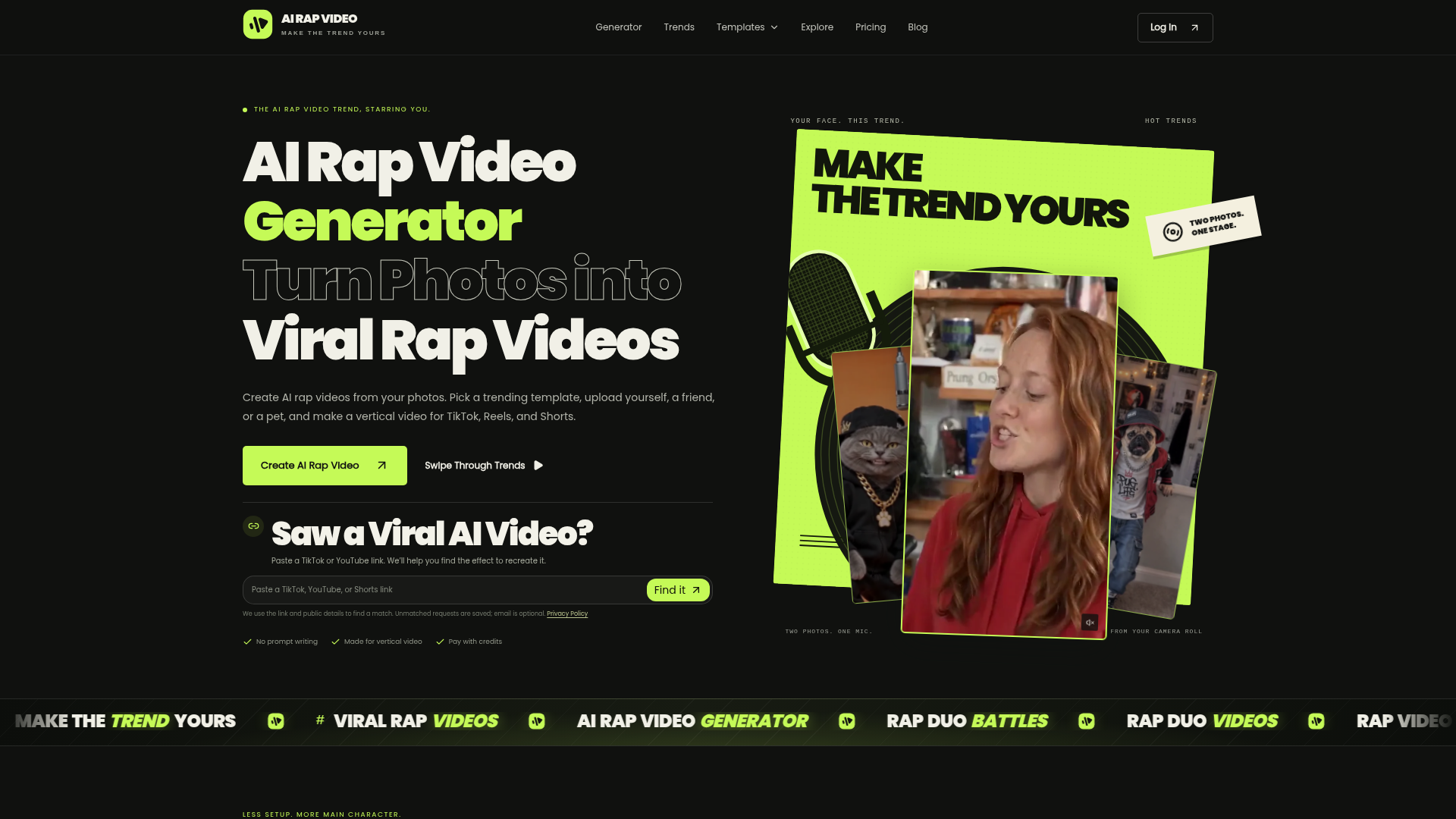
AI Rap Video Trend is a browser-based AI video studio that turns ordinary photos into short, viral-style rap performances. Positioned as a consumer-friendly creative tool for the social-video era, the site lets anyone become the star of a rap video without cameras, editing software, or prompt-writing skills. Its target audience is broad: TikTok, Instagram Reels, and YouTube Shorts creators chasing trending audio formats, friend groups and coworkers making inside-joke clips, pet owners, meme accounts, and casual users who simply want a shareable 'main character' moment. Core features include a curated template catalog organized by trend (Tiny Desk AI, Hotel Lobby AI, Migos AI, Walk It Like I Talk It AI, Boombox Rap AI, Choosin Texas Emo AI, and many more), a flexible cast system supporting solo, duo, trio, quartet, and quintet performances with clearly labeled upload slots for each performer, configurable output settings such as 720p resolution, 15-second duration, 9:16 vertical aspect ratio, and optional AI audio, plus a unique 'found a viral video?' tool where users paste a TikTok or YouTube link to discover a matching effect. Content features include how-to guides, blog articles, caption and hashtag idea packs, and a full-screen trend feed for swiping through example clips one at a time. The user experience is mobile-first and deliberately low-friction: no prompt engineering, transparent credit costs shown before submission, refunds of reserved credits on confirmed failures, and the ability to leave the studio while rendering continues. Technically, the platform is a cloud AI generation pipeline with account-based credit accounting, watermark-free downloads, 10 MB JPG/PNG/WebP uploads, and persistent credit balances that never expire. Monetization is refreshingly simple: one-time credit packs rather than subscriptions, with an entry-level new-user offer of $5.90 for a single 10-second 720p video and packs from $9.90 for 50 credits up to $79.90 for 500 credits, plus free browsing of all templates and guides.
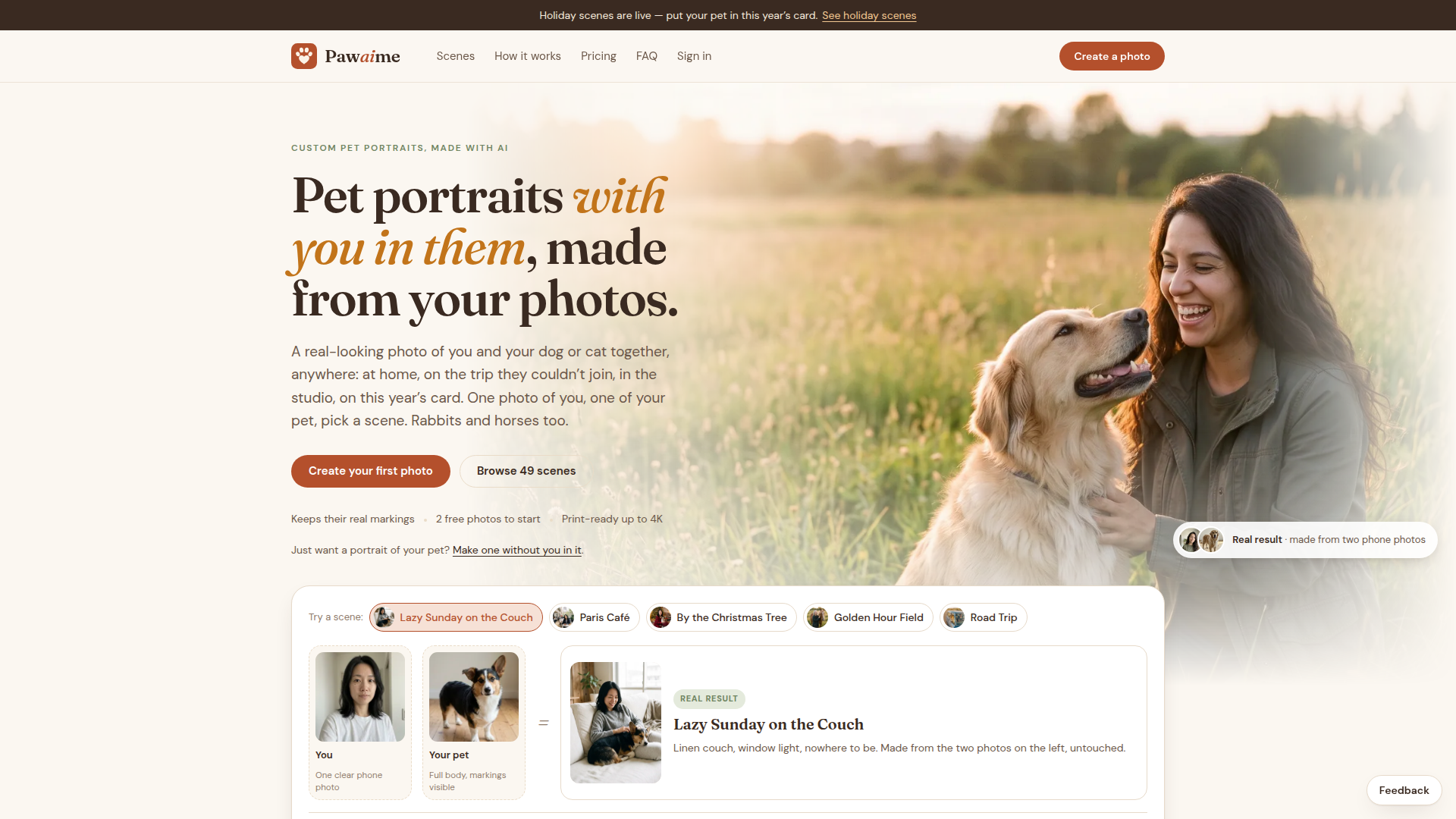
Pawaime is an AI-powered pet portrait platform that creates realistic, print-ready photos of owners together with their pets. Its positioning is a simple, emotional alternative to expensive pet photography: upload two everyday phone photos—one of you and one of your dog, cat, rabbit, horse or bird—then choose from 49 curated scenes or describe your own. Target audiences include pet parents, gift buyers, holiday-card makers, memorial keepsake seekers, and multi-pet households. Core features include breed, coat, marking and size preservation; scene categories for cozy home, studio, travel, holidays, big moments, in memory, art styles, and pet-only portraits; 1K, 2K and 4K downloads; and a credit-based pricing model with free starter credits. Content features real AI-generated examples and practical guidance without prompt writing. User experience is three-step, mobile-friendly, and fast, with no complex editing. Technical features rely on third-party AI providers such as Google Gemini, automatic deletion of uploaded photos after generation, account storage for finished images, and credit tracking. Pawaime emphasizes privacy, print quality up to 12×16 inches, and making pets present in moments they could not attend.
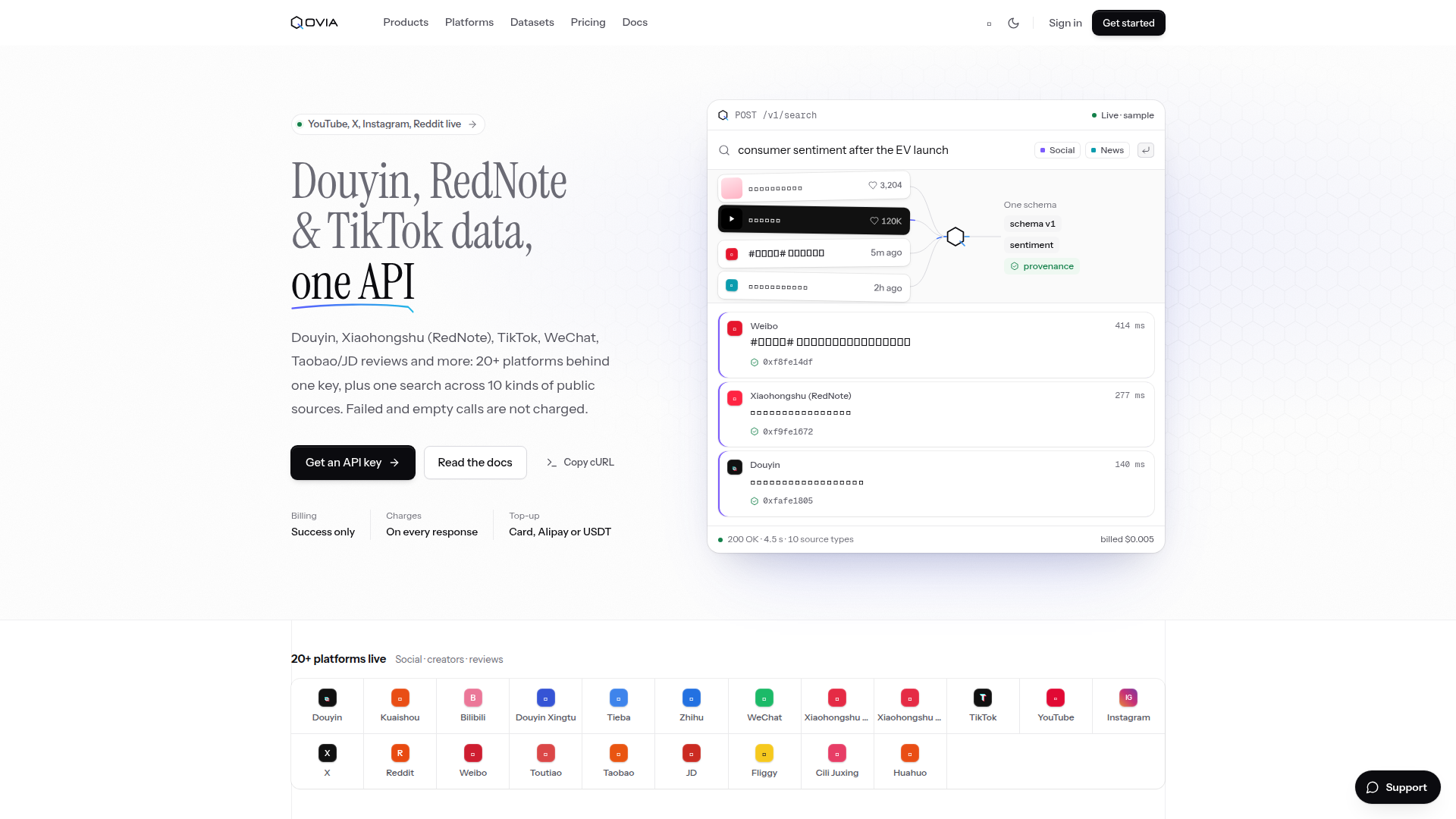
Qovia is a unified social and e-commerce data API platform that gives developers, data teams, growth marketers and AI builders a single key to reach more than 20 Chinese and global content platforms. Its positioning is deliberately narrow and practical: instead of selling dashboards or manual reports, Qovia sells programmatic, pay-per-call access to structured public data from Douyin, Xiaohongshu (RedNote), WeChat Official Accounts & Channels, TikTok, Kuaishou, Bilibili, Weibo, Zhihu, Toutiao, Tieba, YouTube, Instagram, X, Reddit, TikTok-adjacent creator marketplaces like Douyin Xingtu and Xiaohongshu Pugongying (Huahuo and Cili Juxing), plus e-commerce review data from Taobao/Tmall, JD and Douyin Shop and hotel reviews from Fliggy. The target audience is primarily technical: API-first startups, AI agent developers, social listening and brand-monitoring vendors, market research agencies, cross-border e-commerce sellers, MCNs and creator-economy tooling companies that need China-market data but do not want to build and maintain signing algorithms, proxy pools, banned-account farms and per-platform parsers. Core features include 100+ endpoints under one credential, a cross-platform Search API that queries 10 kinds of public sources in a single request, social and creator data (posts, comments, engagement metrics, creator profiles, hot lists, hashtag videos), product reviews with rating, SKU, follow-ups and seller replies, and built-in sentiment tagging (positive / neutral / negative) that can be filtered. Content features are notable for normalisation: every result — post, video, note, review or search hit — is returned with one shared schema (id, platform, text, metrics, sentiment, published_at and the original link), so switching platforms requires no new parser and no code change. User experience is developer-centric, with copy-paste cURL, Python and MCP examples, a live sample request shown on the homepage, a quickstart and API reference in both English and Chinese, a changelog of newly added platforms and endpoints, and a self-service console for key management and top-ups. Technical features include REST and MCP transports (the MCP servers for Douyin, Xiaohongshu, Weibo, Kuaishou, Bilibili, WeChat and Zhihu can be dropped into Claude, Cursor or any MCP client with one config block), provenance metadata such as capture time, a live-or-cache flag and a checksum hash on most responses, and a billing model where only successful responses are charged. Pricing is pay-per-call from a prepaid balance — roughly $5 per 1,000 Search API calls and $0.5 per 1,000 raw endpoint calls and up — with 50 free trial calls for new accounts, no charge for timeouts, failures or empty results, top-ups by card, Alipay or USDT, and custom collection projects quoted individually. Qovia describes itself as an unofficial data service and is not affiliated with the platforms it covers.
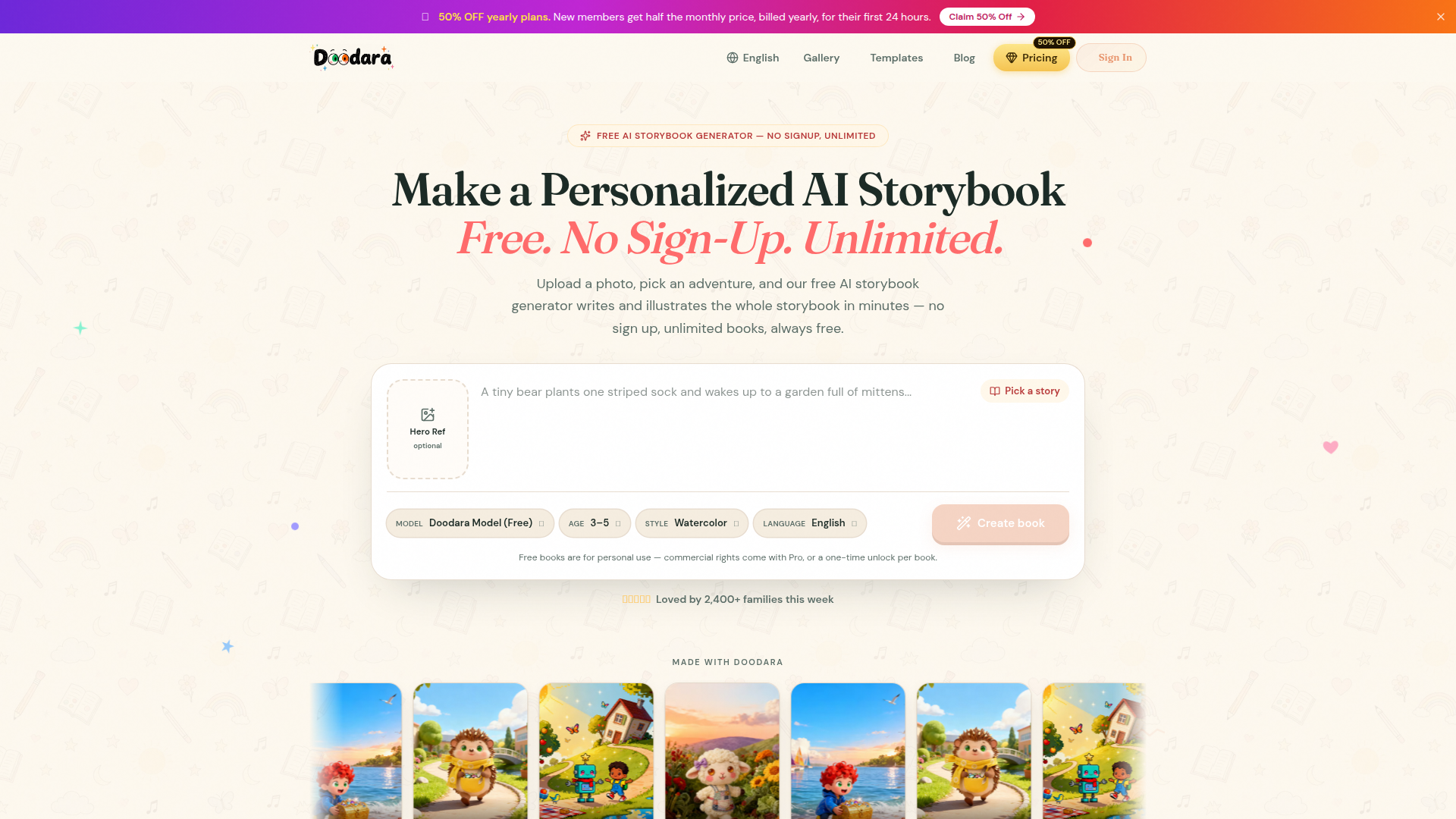
Doodara is a free AI storybook generator and personalized children's book creator that transforms a single child's photo into an illustrated storybook in minutes. Positioned as an accessible, no-sign-up creative tool for families, teachers, and caregivers, it removes technical barriers so anyone can produce a custom picture book without design or writing skills. The target audience includes parents, grandparents, educators, and gift-givers who want meaningful, screen-light, or printable stories featuring a specific child. Core features include photo-based character creation, 20+ story templates, 16 art styles such as watercolor, crayon, 3D rounded, anime, and collage, plus 10 output languages including English, Spanish, Chinese, Arabic, and Japanese. The AI writes the outline, script, and page-by-page illustrations while maintaining character consistency across pages. Users preview an interactive flipbook, share via link, or export PDF, EPUB, and images. Content features showcase a public gallery of user-generated books, topic-based children's books, free printables, and blog resources. User experience emphasizes speed, unlimited free books, no credit card, and simple four-step creation. Technical features include advanced AI model options, character locking, multiple formats, and print-ready spreads for panoramic moments. Free books are personal-use; Pro adds exports, advanced model, and commercial rights, with a $3.99 one-time unlock per book.
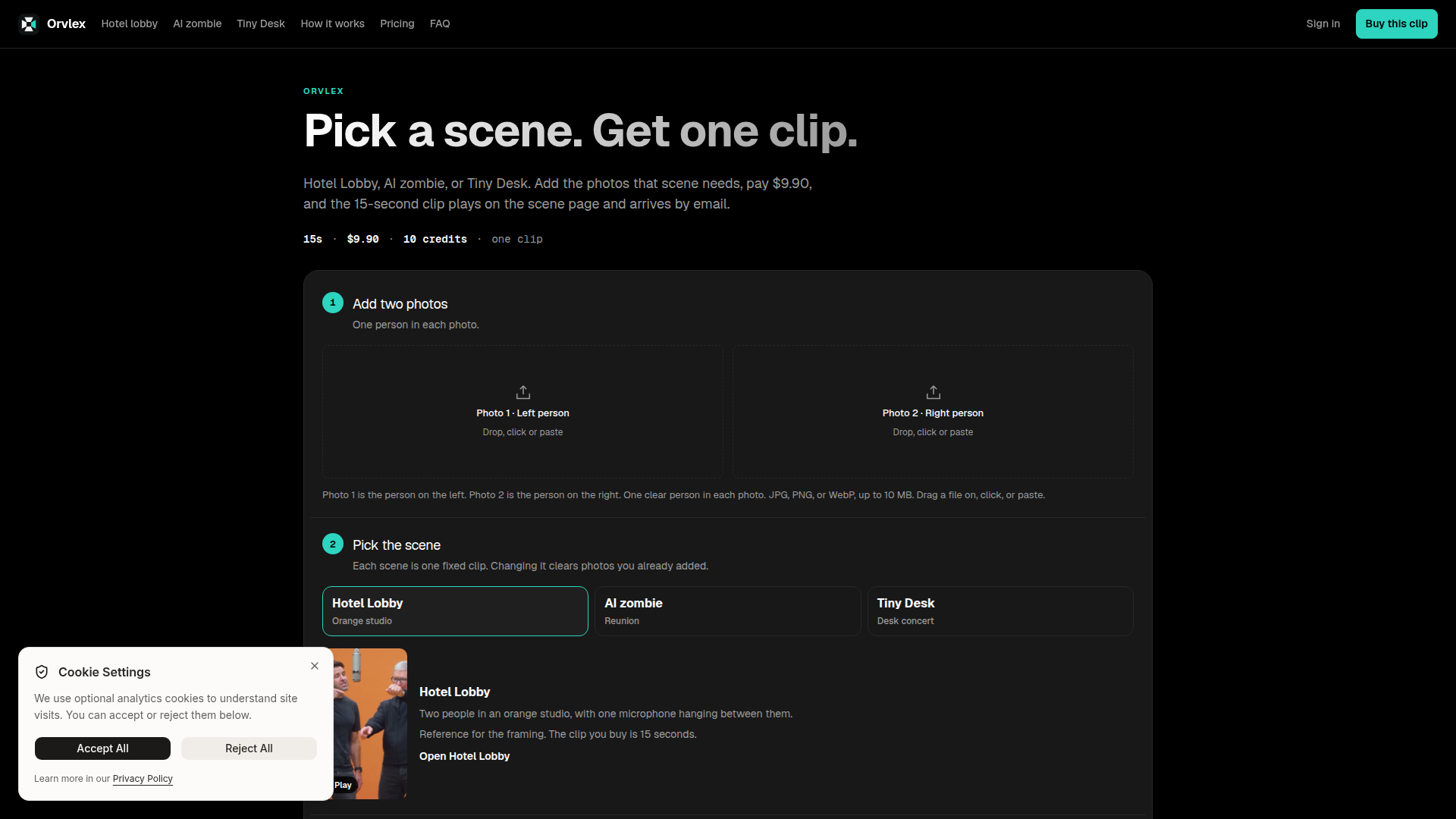
Orvlex is a lightweight, one-click AI video service that turns ordinary photos into a single 15-second finished clip. It is positioned as an alternative to complicated AI video editors, prompt-based generators, and face-swap trend replicas. Instead of offering free trials, subscriptions, or open-ended creative controls, Orvlex sells one fixed scene at a time: Hotel Lobby, AI zombie, or Tiny Desk. Users upload the required photos—usually one person per photo, up to five for Tiny Desk—pay $9.90, and receive the clip on the scene page and by private email link. Target audiences include social media users who want to join visual trends, friends or couples making personalized short videos, and creators who need a quick novelty clip without editing skills. Core features include scene selection, photo validation, credit-based checkout, safety checks, email delivery, and clear pricing. Content features include dedicated scene pages, comparison guides, and FAQ answers. The UX is deliberately minimal: three steps, no account required, drag-and-drop uploads, and an immediate purchase flow. Technically, it uses AI generation from photos, Stripe payments, 10-credit consumption per clip, supported file types JPG, PNG, and WebP up to 10 MB, and optional analytics cookies.
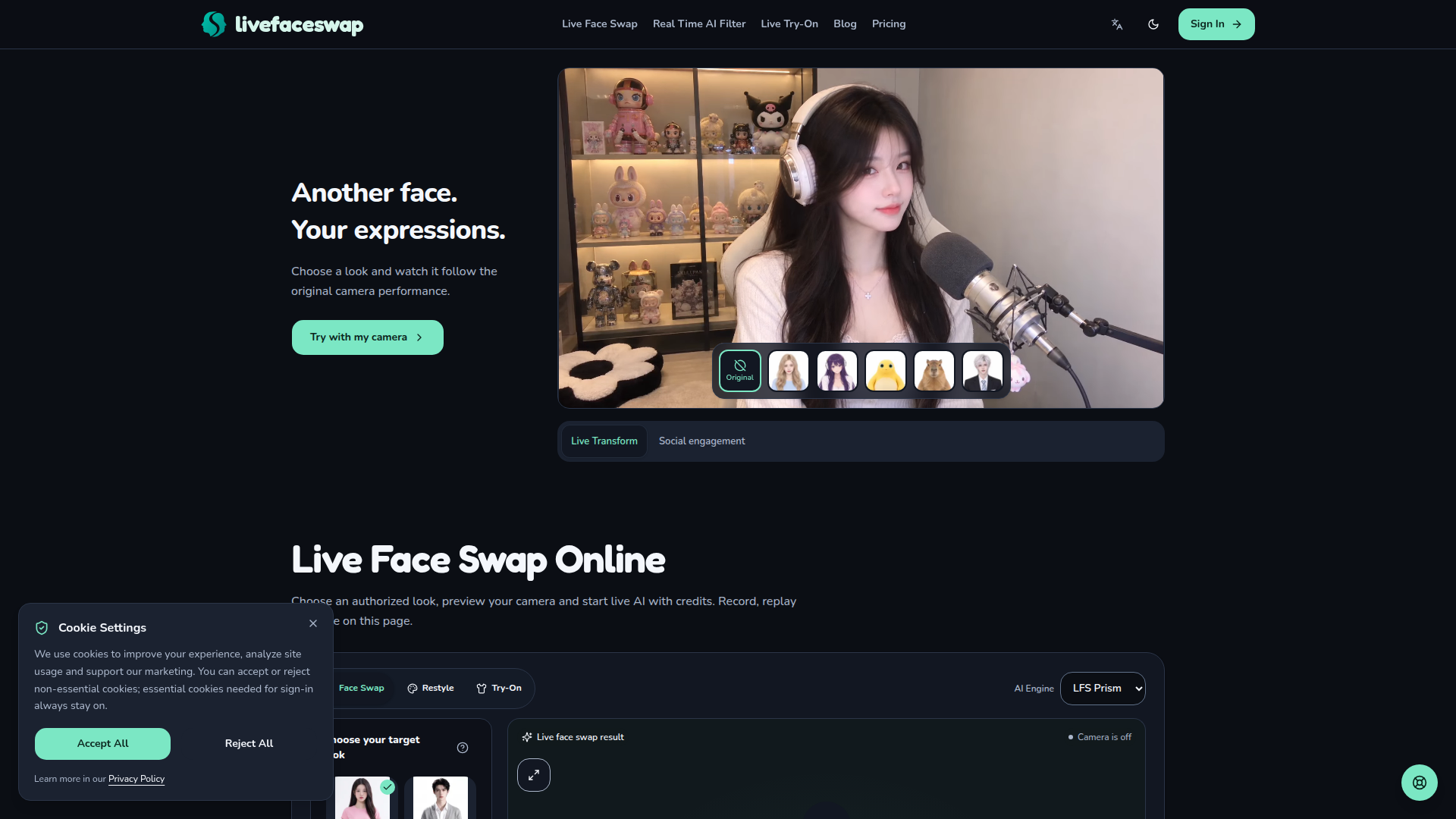
Live Face Swap is a browser-based AI webcam transformation tool positioned for real-time character performance, creative content, and experimental live video. It lets users choose a preset look or upload an authorized reference image, preview their camera locally, then start a live face swap that follows their expressions. The platform is aimed at content creators, streamers, performers, role-players, AI enthusiasts, and anyone exploring real-time visual effects; it is not a tool for deceptive impersonation or identity verification. Core features include preset looks such as modern woman/man, anime girl, capybara, mecha heroine, and panda; reference upload support for JPG, PNG, or WebP up to 4 MB and 16 megapixels; live camera preview; AI generation charged at 1 credit per second; optional local microphone recording; and in-browser record, replay, and save. The site emphasizes consent and authorized likeness use. Content includes use cases, FAQ, blog, privacy policy, acceptable use policy, and pricing page. User experience is simple: choose a look, enable webcam, start transformation, then record and save. It supports light/dark theme and multiple languages. Technically, it runs in modern browsers without app downloads; camera frames are sent to a selected model provider only during transformation, while preview and recordings remain local. OBS, virtual camera, Zoom, and Discord integrations are not confirmed.
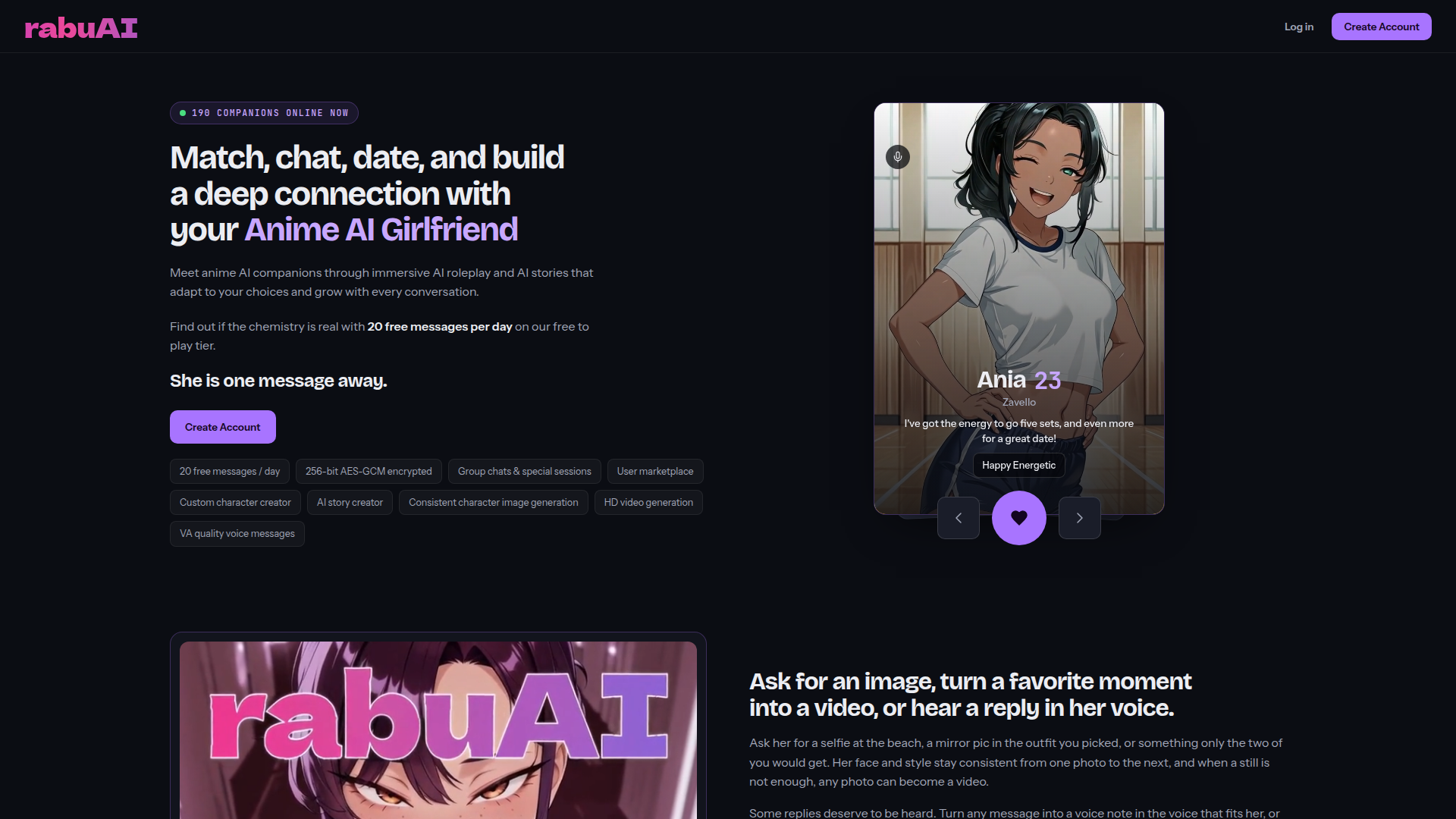
Rabu AI is an anime-focused AI companion and roleplay platform where users can match, chat, date, and build ongoing emotional connections with AI girlfriends. It positions itself as more than a chatbot skin: each companion has a distinct name, backstory, personality, appearance, and relationship path. The target audience includes anime fans, dating-sim players, AI roleplay enthusiasts, and users seeking judgment-free conversation, romantic fantasy, or creative storytelling. Core features include immersive chat, adaptive AI stories, memory recall, relationship progression, persistent conversation history, group chats, special sessions, a user marketplace, a custom character creator, and an AI story creator. Users can request consistent character images, turn photos into HD videos, and receive VA-quality voice messages from a library of 50+ voices. Content features range from slice-of-life and comedy to fantasy, romance, yandere, and intimate roleplay. The experience runs in a responsive web app with no native mobile app for now, supports free daily messages, and uses 256-bit AES-GCM encryption for conversations. Rabu AI combines anime character discovery, generative media, and emotional companion mechanics into a freemium web platform for users who want personalized, always-available AI companionship.
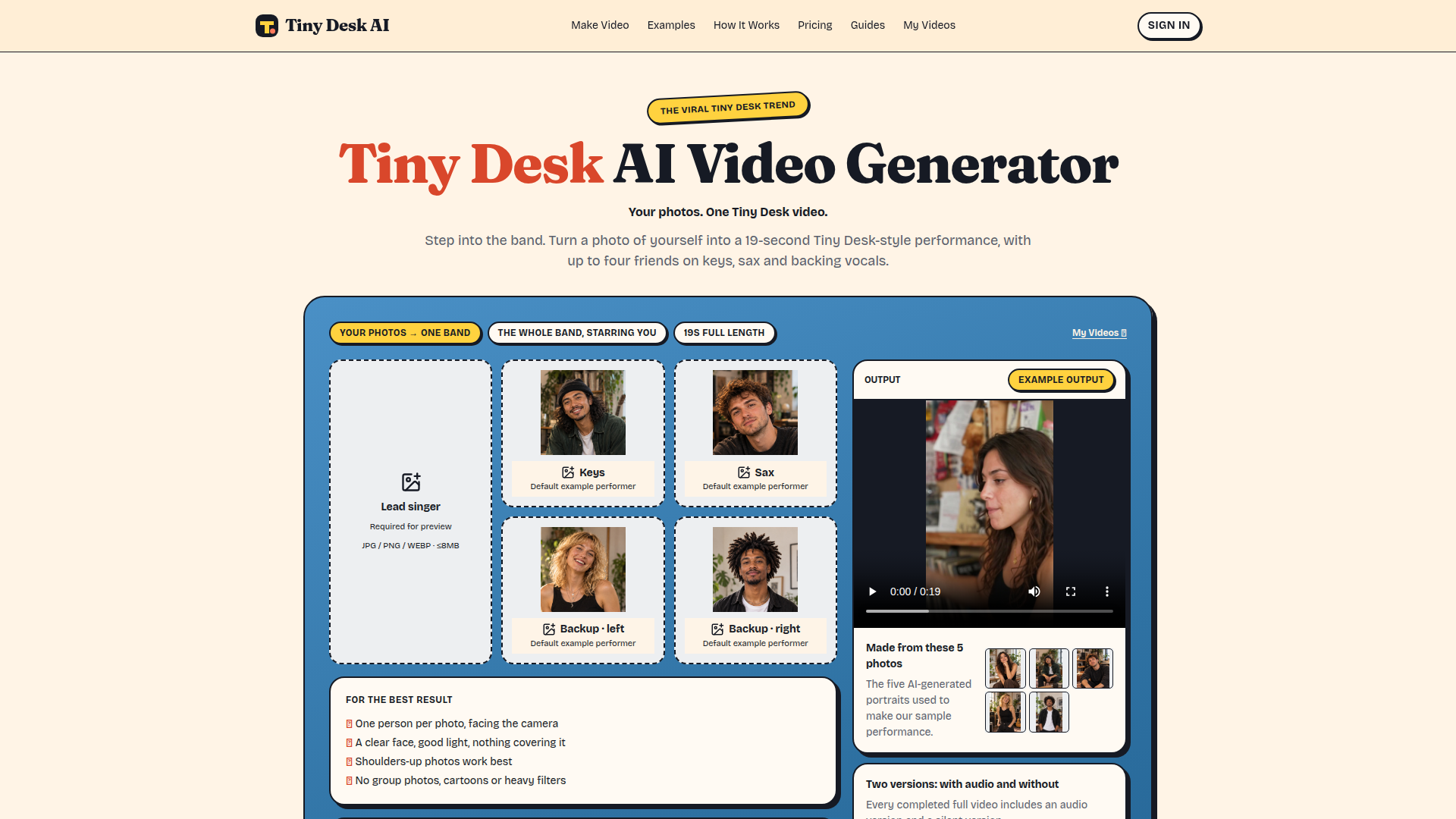
Tiny Desk AI is a browser-based AI video generator that turns ordinary photos into a viral Tiny Desk-style band performance. Positioned as an independent, lighthearted AI parody project, it lets users cast themselves as the lead singer and add up to four friends on keys, sax, and backing vocals, with empty roles automatically filled by AI musicians. The core experience is simple: upload clear, front-facing portraits, preview a free 2-second watermarked 480p clip if a daily spot is available, then generate a full 19-second performance in either Standard 480p for 50 credits or HD 720p for 100 credits. Completed videos include both audio and silent versions and are stored in My Videos. The site targets social media creators, friend groups, meme enthusiasts, and fans of the Tiny Desk and Outstanding trend who want personalized, shareable AI content without writing prompts or recording music. Content features include examples, step-by-step guides, meme explainers, FAQs, and clear safety, consent, copyright, and likeness policies. The platform emphasizes ease of use, fast role assignment, transparent credit-based pricing, and responsible sharing, while noting it is not affiliated with NPR, Tiny Desk Concerts, or Charlie Wilson.
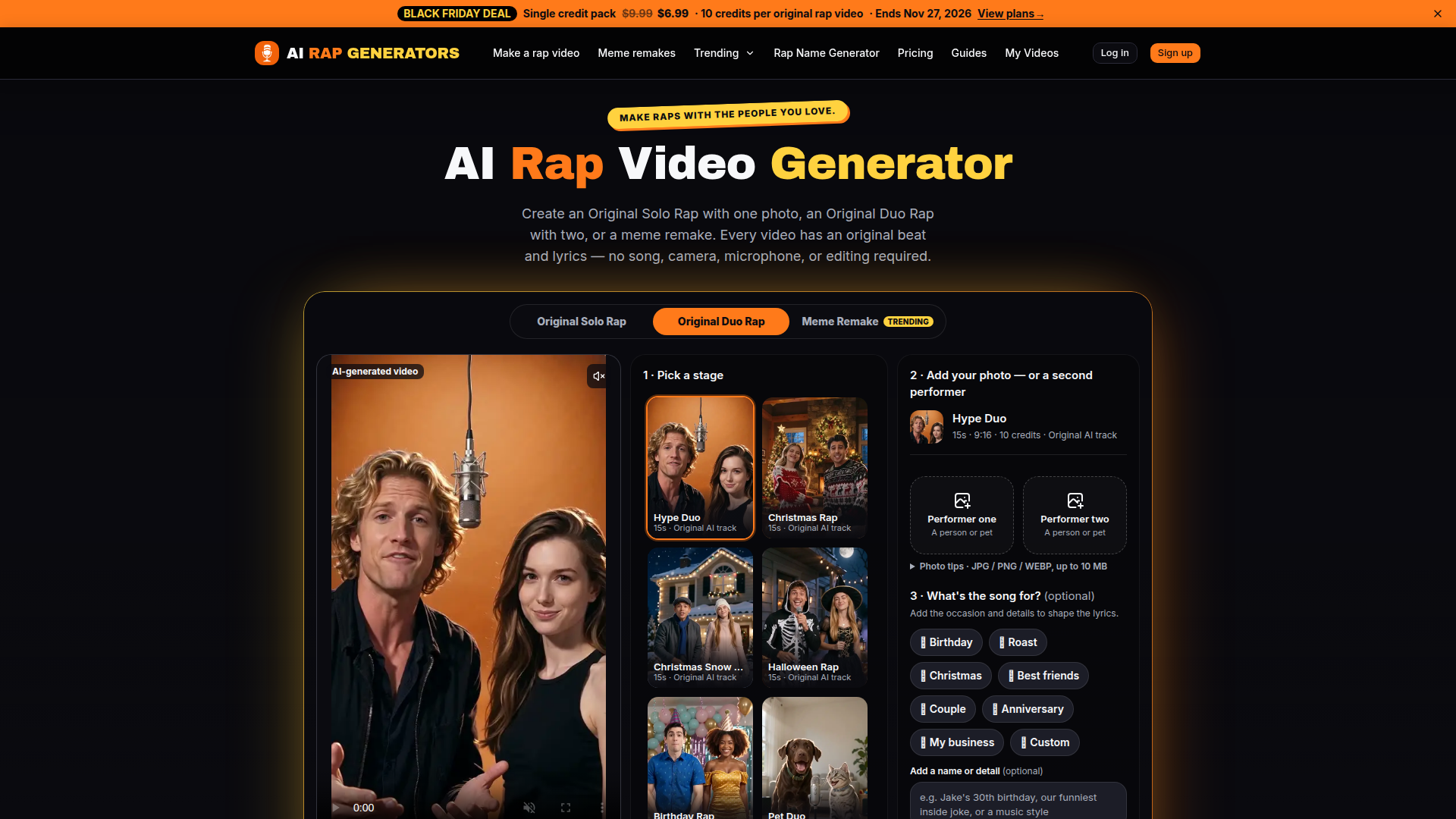
AI Rap Generators is a browser-based AI video creation platform positioned as a focused rap-performance generator rather than a general-purpose AI video tool. It is designed for social media creators, friends, couples, families, pet owners, meme fans, and small businesses that want shareable short-form rap clips for TikTok, Reels, and Shorts without cameras, microphones, editing software, or music production skills. Users choose a solo, duo, or meme-remake template; upload one or two clear photos of consenting adults or pets; optionally add an occasion, name, or inside joke; and receive a 15-second or 11–15 second meme-style MP4 with AI-written lyrics and an original AI beat. Core features include a growing template library such as Hype Duo, Christmas, Halloween, Birthday, Roast Battle, Pet Duo, Grandparents Rap, and trending meme remakes like Hotel Lobby, Bulin 47, Burning Bridges, Middle Finger Dunk, Outstanding Tiny Desk, Raindance, and Tip Toeing in My Jordan. Additional features include a Rap Name Generator, My Videos library, downloadable vertical or 16:9 MP4 output, AI-generated labeling, automatic credit refunds for failed renders, and seven-day deletion of uploaded photos. The experience is mobile-friendly, template-driven, and low-friction: no prompt writing is required, though optional details shape the lyrics. Content emphasizes responsible use with clear rules against minors, public figures, non-consenting people, and sexual or harassing material. The site is independent and not affiliated with artists, labels, or social platforms. Pricing is simple pay-per-use credit packs rather than recurring subscriptions, with 10 credits typically required per rap video.